What does the NDM directly measure?
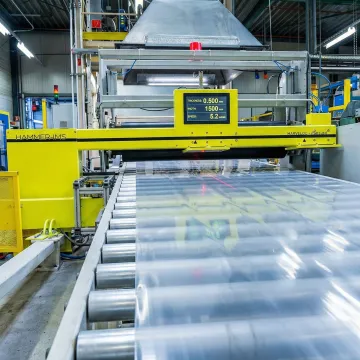
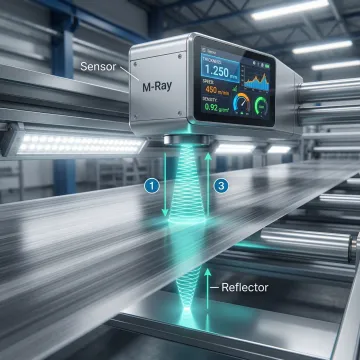
The NDM (Non-Destructive Measurement) system directly measures thickness and basis weight using millimeter wave technology. Unlike nuclear gauges that measure density and infer thickness, our M-Ray sensors emit and receive electromagnetic millimeter waves that penetrate materials contactlessly, providing direct dimensional measurements with exceptional accuracy for materials ranging from thin films to products several centimeters thick.
How does M-Ray technology compare to nuclear gauge accuracy?
M-Ray technology delivers equivalent or superior accuracy to nuclear gauges while eliminating radiation hazards. Our systems achieve adjusted thickness values nearly 5% below international standards through multi-sensor coverage and high-frequency measurement rates (up to 3 kHz), providing more comprehensive data than single-point nuclear measurements for better process control and waste reduction.
What materials can M-Ray systems measure?
M-Ray technology measures diverse materials including plastics (PE, PP, PMMA, PC), construction materials (MDF, OSB, plywood, mineral wool, gypsum board), paper and pulp products, textiles, nonwovens, coatings, and multi-layer composites. The technology maintains consistent performance across all colors and can see through opaque materials, even detecting hidden layers that optical systems cannot assess.
What regulatory advantages do non-nuclear systems provide?
Non-nuclear M-Ray systems eliminate licensing requirements, radiation safety training, source replacement costs, disposal fees, and regulatory inspections associated with nuclear gauges. This significantly reduces operational costs and administrative burden while allowing 24/7 production access for all personnel without radiation exposure concerns or restricted area designations.
How quickly can M-Ray systems be integrated into existing production lines?
Hammer-IMS offers turnkey installations with minimal production disruption. Our systems integrate via standard interfaces with existing control systems, and our team handles mechanical mounting, calibration, and operator training. Most installations are completed within days, with OEM modules available for equipment manufacturers requiring custom integration timelines.
Do M-Ray sensors require special environmental conditions?
No—M-Ray sensors feature robust designs specifically engineered for harsh industrial environments. They operate reliably in high temperatures (including near extrusion nozzles), unclean conditions, and environments with dust, moisture, or vibration. The contactless measurement principle prevents sensor contamination, and the millimeter wave technology is unaffected by ambient light or material color variations.
Can M-Ray systems detect product defects beyond thickness measurement?
Yes—our advanced systems include built-in anomaly detection capabilities. For paper processing, we detect weld points, wrinkles, and creases. For plastic extrusion, multi-sensor heads identify local deviations corresponding to individual screw bolts. The see-through capability of millimeter waves also enables detection of hidden defects, voids, or contamination within multi-layer products that surface inspections miss.
What ongoing support and training does Hammer-IMS provide?
Hammer-IMS delivers comprehensive support including initial operator training, remote monitoring via our Industry 4.0 app, technical documentation, API interfaces for system integrators, and access to international support teams. Our Connectivity 3.0 software enables remote diagnostics and data analytics, while our global presence ensures responsive local support across Europe, Asia-Pacific, and North America.