What is the defect detection process?
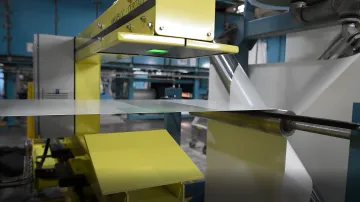
The defect detection process uses contactless M-Ray millimeter wave sensors positioned above and/or below the moving material. These sensors continuously scan the production width at high speeds (up to 3 kHz), measuring thickness, basis weight, and surface characteristics. When measurements deviate from specified tolerances, the system immediately alerts operators and can automatically adjust production parameters through closed-loop control. Advanced algorithms distinguish between acceptable variations and true defects, minimizing false positives while ensuring no critical defects pass undetected.
DRE (Defect Rate Estimation) is calculated by analyzing the ratio of detected defects to total production volume over a specified time period. Our systems continuously log all measurement data and flag instances where material characteristics fall outside defined tolerance ranges. The software aggregates this data to calculate defect rates per production run, shift, or custom time period. Advanced analytics can break down defect rates by defect type, location across the web, or production conditions to identify root causes and optimization opportunities.
What is aoi in manufacturing?
AOI (Automated Optical Inspection) in manufacturing refers to camera-based systems that visually inspect products for defects. While traditional AOI relies on cameras and visible light, Hammer-IMS's M-Ray technology offers advantages for web and sheet materials: it can measure internal thickness variations that cameras cannot see, works independently of material color or transparency, functions in dusty or harsh environments where optical systems struggle, and provides quantitative measurement data rather than just visual assessment. Our systems complement or replace AOI depending on your specific quality control requirements.
What materials can your defect detection systems inspect?
Our systems inspect a wide range of industrial materials including plastic sheets and films (PE, PP, PMMA, PC), textiles and nonwovens, paper and pulp products, construction materials (particle board, plywood, MDF, OSB), mineral wool and insulation materials, gypsum boards, and multi-layer composite materials. The M-Ray technology adapts to materials ranging from thin films to construction sheets up to 30 centimeters thick.
How accurate are your thickness measurements?
Our M-Ray measurement systems deliver sub-millimeter accuracy appropriate to your material type and thickness range. For thin films and sheets, precision is typically within micrometers. For thicker construction materials, accuracy scales proportionally while remaining well within industry standards. The multi-sensor approach further enhances accuracy by providing multiple measurement points across the production width, ensuring consistent precision regardless of material position.
Can your systems integrate with existing production lines?
Yes, our turnkey Marveloc-CURTAIN installations are designed for seamless integration into both new and existing production lines with minimal disruption. We offer flexible mounting configurations, compatibility with standard industrial protocols for data exchange, and customization to accommodate your line speed, material width, and environmental conditions. Our engineering team works closely with your staff to ensure smooth integration and comprehensive training.
What are the advantages of non-nuclear measurement technology?
Non-nuclear M-Ray technology eliminates all radioactive materials, providing significant advantages: no radiation safety concerns or exposure risks for operators, no regulatory licensing requirements or compliance costs, 24/7 production capability without radiation safety protocols, simplified maintenance without handling radioactive sources, and environmentally responsible operation. Our clean technology delivers equal or superior measurement performance compared to nuclear systems without any safety drawbacks.
How quickly can defects be detected during production?
Our high-speed measurement systems operate at rates up to 3 kHz, enabling detection of defects within milliseconds as material passes through the inspection zone. This allows production lines to run at speeds up to 500 meters per minute while maintaining complete quality monitoring. Real-time feedback to production control systems enables immediate corrective actions, minimizing the production of defective material and reducing waste.