Introduction
A glass fiber panel that's 0.1 mm too thin can fail structural load requirements. One that's too thick adds weight, wastes material, and triggers rejection at inspection. The global fiberglass market is projected to reach $34.52 billion by 2033 — and at that scale, thickness deviations translate directly into mechanical failures, non-conformance, and scrapped batches.
Accurate measurement isn't optional in aerospace, construction, automotive, or composites manufacturing. It's what keeps production within tolerance and product out of the waste bin.
Higher production speeds raise the stakes further. This article covers the main glass fiber thickness measurement techniques, how to choose between them, and what modern non-contact solutions offer that traditional methods can't.
Key Takeaways
- Glass fiber thickness measurement ensures product quality, structural performance, and material efficiency in composite and nonwoven production
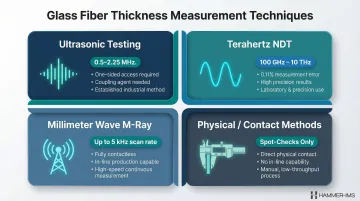
- Main techniques include ultrasonic testing, terahertz NDT, millimeter wave, and physical contact methods, each suited to different production environments
- Modern contactless, non-nuclear systems enable real-time in-line thickness control without halting production or introducing radiation risks
- Accurate thickness control directly reduces material waste and tightens production tolerances across high-speed manufacturing lines
What Is Glass Fiber Thickness Measurement and Why It Matters
Glass fiber thickness measurement quantifies the wall, laminate, or layer thickness of glass fiber-reinforced materials—whether as raw fabric, nonwoven mat, cured composite laminate, or pipe/tank wall—using non-destructive or physical techniques.
Where it's applied:
- Quality control on production lines
- Incoming material inspection
- Structural integrity audits of installed pipelines and tanks
- Composite layup verification in aerospace and automotive
- Nonwoven fabric grammage control
Why it's critical:
Glass fiber product performance across strength, insulation, and corrosion resistance is directly tied to thickness consistency. Under-thickness causes structural weakness and safety failures. Over-thickness wastes material, raises cost, and adds unnecessary weight.
Research confirms the stakes: flexural and impact properties of GFRP laminates decrease with decreasing laminate thickness, meaning even small deviations from spec translate directly into compromised part performance.
Glass Fiber Thickness Measurement Techniques: An Overview
No single technique fits all glass fiber measurement scenarios—the right choice depends on material form, thickness range, surface access, production speed, and accuracy requirements. Techniques range from contact-based to fully non-contact and from lab-only to in-line production methods.
Ultrasonic Thickness Measurement
Ultrasonic gauges transmit high-frequency sound waves through the material, measuring the time-of-flight between reflected echoes at interfaces to calculate thickness. It's the most widely used method for cured GFRP laminates, pipes, and tanks—capable of one-sided access.
Key considerations:
- Lower MHz frequencies (0.5–2.25 MHz) work best for thicker or higher-attenuation materials
- A-scan waveform display helps operators identify false echoes from internal delaminations or laminate layer interfaces
- Water immersion probes suit complex geometries or inner-wall measurements
- Coupling media (water or gel) are required, which creates operational inconvenience in some production settings
Because GFRP exhibits mean attenuation coefficients of 0.35 to 0.52 dB/mm depending on glass content, low-frequency broadband delay line transducers are recommended to increase measurement accuracy.
Terahertz (THz) Non-Destructive Testing
THz NDT uses electromagnetic waves in the 100 GHz–10 THz range to non-invasively characterize glass fiber composite thickness.
Advantages:
- No ionizing radiation
- Excellent penetration in non-metallic dielectrics
- High spatial resolution
- Achieves 0.11% thickness error on GFRP laminates using advanced dispersion compensation methods
Limitations:
- Dispersion effects in thick multi-layer specimens reduce accuracy and require compensation algorithms
- High attenuation/dispersion beyond 1 mm thickness range
- Best suited to precision lab and research environments rather than high-speed in-line production
Millimeter Wave (M-Ray) Contactless Measurement
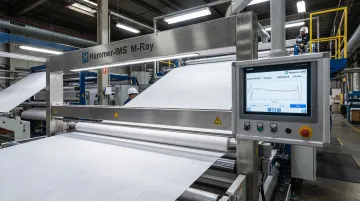
Millimeter wave-based technology transmits low-energy electromagnetic waves (typically 80–300 GHz) through glass fiber material, enabling thickness measurement without physical contact or coupling media. Industrial FMCW systems achieve measurement rates up to 5 kHz, making them ideal for continuous in-line production.
Suitability:
- Glass fiber fabric, nonwoven mats, and sheet production
- Moving production webs where contact methods fail
- Real-time feedback to production processes
- Closed-loop control—reducing thickness variability across production runs without halting the line
Systems like Hammer-IMS's M-Ray platform operate contactlessly and provide continuous, full-width coverage in real-time production environments.
Physical and Contact Methods
Calipers, micrometers, and mechanical gauges serve as baseline methods for spot-checks and calibration reference purposes.
Limitations:
- Can compress soft materials like nonwovens, producing false readings
- Cannot measure inside structures or moving webs
- Offer no in-line capability
- Require material access and can scratch or deform surfaces
Common Challenges in Glass Fiber Thickness Measurement
Interface Reflections and False Readings
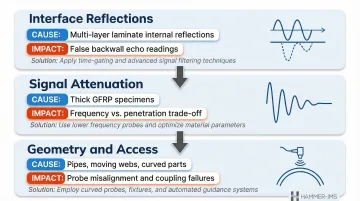
The multi-layer laminate structure of glass fiber composites causes internal interface reflections that produce false or ambiguous readings in ultrasonic measurements. Delamination defects can cause the backwall echo to disappear entirely, making total thickness undetectable without skilled waveform interpretation or advanced signal processing. In practice, this means a single void or delamination can invalidate an entire measurement pass — a costly problem in high-throughput production environments.
Signal Attenuation and Dispersion
As THz or ultrasonic waves travel through thicker GFRP specimens, echo amplitude decreases and signal distortion increases, which makes accurate time-of-flight estimation progressively harder. Probe and frequency selection involves a direct trade-off: higher frequencies yield finer resolution but lose penetration in thick laminates, while lower frequencies penetrate deeper but miss fine structural detail.
Physical Access and Geometry Challenges
Signal challenges aside, the physical geometry of parts introduces a separate layer of complexity. Measuring the inner wall of pipes and tanks, curved surfaces, or fast-moving production webs creates:
- Probe alignment errors
- Coupling consistency issues
- Speed limitations that contact methods cannot solve
These scenarios push manufacturers toward non-contact or immersion-based approaches.
Choosing the Right Glass Fiber Thickness Measurement Technique
Define Your Measurement Context
Laboratory/QC inspection:
- Accuracy and flexibility are paramount
- Suitable for high-frequency ultrasonic or THz methods
In-line production measurement:
- Speed, non-contact operation, and continuous coverage matter
- Millimeter wave systems provide full-width, real-time monitoring
Field/maintenance inspection:
- Single-sided access and portability are critical
- Ultrasonic gauges with appropriate probe selection work well
Material Form and Thickness Range
Thin glass fiber fabrics and nonwovens:
- Ultrasonic contact methods can compress the material
- Benefit from non-contact electromagnetic techniques (M-Ray)
Cured thick-wall composites, pipes, and tanks:
- Well-served by ultrasonic gauges with 0.5–2.25 MHz probes
Very thin precision laminates:
- Require THz or high-frequency ultrasonic approaches
Accuracy vs. Throughput Trade-Offs
The right balance depends on whether the priority is characterizing individual samples or controlling a live process.
| Technique | Accuracy | Coverage | Best For |
|---|---|---|---|
| Ultrasonic spot-checking | High | Single point | Lab QC, sample characterization |
| Millimeter wave in-line | Process-grade | Full web width | Real-time process control, waste reduction |
Safety, Environmental, and Regulatory Considerations
Beyond technical performance, the measurement technology you choose carries real compliance obligations — particularly if nuclear gauges are under consideration.
Nuclear thickness gauges are strictly regulated in both major markets:
- US: The NRC mandates specific licenses, radiation protection programs, and disposal procedures
- Europe: The Euratom Directive 2013/59 requires authorization, record-keeping, and secure disposal for sealed sources
Decommissioning liabilities in the US alone can exceed $300,000 per sensor. These costs are pushing manufacturers toward non-nuclear technologies like M-Ray, which carry no licensing requirements, no disposal obligations, and no radiation-related compliance overhead.
How Hammer-IMS Can Help
Hammer-IMS provides non-nuclear, contactless thickness measurement solutions designed for in-line industrial production—including glass fiber nonwovens, technical textiles, and composite sheet applications. Customers such as Owens Corning rely on Hammer-IMS measurement systems as part of their production quality control infrastructure.
At the core of the system is M-Ray technology — millimeter-wave-based measurement that works without contact, without nuclear sources, and without operator risk. It delivers real-time thickness data across the full production width and connects directly to your process via Connectivity 3.0 software. When thickness drifts out of spec, closed-loop adjustment corrects it automatically — before defective material reaches the next stage.
For production teams, that translates to concrete gains:
- Uniform thickness coverage across the full web width
- Tighter production margins and less material give-away
- Lower raw material waste
- No nuclear licensing, no radiation safety compliance burden
- Remote monitoring capability for distributed or multi-site operations
Contact Hammer-IMS at +32 11 36 55 01 or sales@hammer-ims.com to discuss your specific glass fiber measurement application.
Frequently Asked Questions
How is fiberglass thickness measured?
Fiberglass thickness is most commonly measured using ultrasonic thickness gauges that use sound wave time-of-flight from one side. Contactless electromagnetic methods such as millimeter wave technology are now widely used for in-line production measurement.
What is the most accurate method for measuring glass fiber composite thickness?
For precision lab measurement of cured GFRP laminates, high-frequency ultrasonic testing or terahertz NDT offers the highest accuracy. For in-line production, calibrated millimeter wave systems provide consistent real-time coverage across the full material width.
Can glass fiber thickness be measured without contact?
Yes—both terahertz NDT and millimeter wave (M-Ray) systems measure glass fiber thickness without physical contact or coupling media, making them suitable for moving production webs and fragile materials.
Why does ultrasonic thickness measurement sometimes give false readings on fiberglass?
The multi-layer structure of glass fiber laminates creates internal interface reflections that can be mistaken for the backwall echo, producing false thickness values. A-scan waveform review and correct gain/blanking settings help operators identify and filter these false echoes.
How do you measure the thickness of glass fiber fabric or nonwoven mat during production?
Contactless electromagnetic measurement systems (such as millimeter wave gauges) are the preferred solution for measuring glass fiber fabrics and nonwovens on moving production lines. They do not compress the material and provide continuous, full-width coverage in real time.
What factors affect accuracy in glass fiber thickness measurement?
Key factors include:
- Number of layers and laminate structure
- Material density and refractive/acoustic properties
- Probe or sensor frequency selection
- Surface geometry
- Whether measurement is performed on moving or stationary material