Introduction
Precise basis weight control isn't just another quality checkpoint in glass fiber manufacturing—it fundamentally determines whether the final product will perform as specified. In composites, it dictates structural integrity and resin uptake consistency. In insulation, it directly controls thermal resistance (R-value). In filtration nonwovens, it governs permeability and service life.
Yet many manufacturers face a troubling gap: their measurement techniques can't keep pace with modern production realities. Traditional cut-and-weigh methods introduce time delays that allow hundreds of meters of out-of-spec product to accumulate before detection. Even nuclear beta gauges (once considered the industry standard) struggle with the unique challenges of inorganic glass fiber and face growing licensing and handling restrictions.
As production speeds push toward 500 m/min and quality tolerances tighten, glass fiber manufacturers are re-evaluating their entire measurement strategy. This article examines the main basis weight measurement techniques in use today—their operating principles, limitations, and where newer non-nuclear approaches are changing what's possible.
Key Takeaways
- Basis weight (g/m²) governs insulation thermal performance, composite mechanical strength, and nonwoven filtration efficiency
- Techniques range from offline gravimetric testing to inline sensors including beta, X-ray, infrared, and millimeter-wave technologies
- Nuclear methods face regulatory complexity and calibration challenges specific to inorganic silica-based glass fiber
- Non-nuclear options — millimeter-wave and terahertz — skip radiation licensing entirely and support real-time closed-loop control
- Selection depends on line speed, material format, required accuracy, and regulatory constraints
What Is Basis Weight in Glass Fiber Manufacturing?
Basis weight—formally defined as mass per unit area—measures the mass of glass fiber per square meter (g/m²) or square yard (oz/yd²). It's the single most important specification for glass fiber mats, woven fabrics, nonwoven veils, and insulation blankets.
Measurement occurs at three critical stages:
- Incoming raw material verification – Validating supplier consistency
- In-process quality control – Continuous monitoring during production
- Final product certification – Compliance testing before shipment
Each stage has different requirements. Incoming verification can tolerate slower, more precise offline methods. In-process control demands real-time data to prevent accumulation of out-of-spec product. Final certification requires traceable, standards-compliant measurements.
Basis weight directly controls downstream performance:
- Thermal insulation – R-value in glass fiber blankets correlates directly to density (which depends on basis weight and thickness)
- Composite laminates – Uniform basis weight ensures consistent resin uptake and fiber volume fraction, preventing resin-rich zones or dry spots that compromise laminate strength
- Filtration media – Permeability and particle retention depend on basis weight uniformity across the veil surface
Product Range Examples:
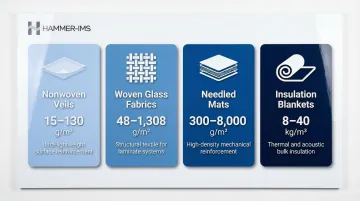
| Product Type | Typical Basis Weight |
|---|---|
| Nonwoven veils (surfacing) | 15–130 g/m² |
| Woven glass fabrics | 48–1,308 g/m² |
| Needled mats | 300–8,000 g/m² |
| Insulation blankets | 8–40 kg/m³ (volumetric density — blankets are characterized by volume, not areal mass) |
Why Accurate Basis Weight Measurement Matters in Glass Fiber Production
Material Waste and Quality Costs
Basis weight deviation drives waste in both directions. Overweight production burns expensive glass fiber raw material unnecessarily—manufacturers literally give product away. Underweight product fails performance specs and generates customer claims or outright rejection.
A composite manufacturing case study found that improving transfer efficiency from 80.5% to 92% (reducing basis weight variation and overspray) saved $15,606 annually on a single part line and eliminated over 12,000 pounds of waste. That's one part line. A facility running ten or twenty lines sees proportionally larger losses — and proportionally larger gains from tighter control.
Cross-Direction Uniformity Creates Critical Defects
Average basis weight tells only half the story. Non-uniformity across the web width creates localized defects that compromise the entire product:
- Composites reinforcement – Variations in fiber volume fraction due to uneven basis weight cause resin-rich zones (brittle) or dry spots (weak), significantly affecting delamination resistance in processes like Resin Transfer Molding
- Insulation products – Lightweight zones create cold spots with reduced R-value, causing thermal performance failures
- Roofing membranes – Thin areas become structural weak points prone to premature failure
In practice, a product with an acceptable average weight but a poor cross-direction profile can still fail at the defect zone — making profile measurement a separate, non-negotiable requirement.
Closed-Loop Control Prevents Costly Overruns
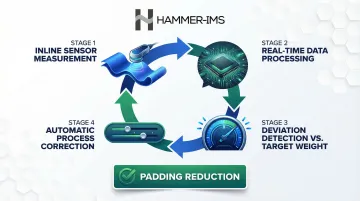
Real-time, inline measurement enables closed-loop control systems that adjust fiber deposition or line speed based on live basis weight data. Two outcomes follow directly:
- Out-of-spec product is detected and corrected immediately, not after hundreds of meters accumulate on the roll
- Manufacturers can run closer to target weight instead of padding production intentionally heavy to avoid underweight failures
The NAIMA 202 standard for insulation illustrates this padding problem: R-value cannot fall below 103% of nominal in testing. To avoid failures, manufacturers routinely pad their basis weight targets above nominal, directly increasing raw material costs.
Glass Fiber Basis Weight Measurement Techniques Explained
No single technique optimally serves all glass fiber applications. Glass fiber's inorganic silica composition, porous fibrous structure, and extreme product range—from 10 g/m² veils to 1,000+ g/m² insulation mats—create application-specific measurement challenges. Understanding each technique's strengths and limitations is essential.
Gravimetric (Cut-and-Weigh) Method
The gravimetric method is straightforward: cut a sample of known area from the web, weigh it on a precision balance, and calculate basis weight as mass divided by area. Standards like ISO 3374:2000 specify procedures for glass fiber mats and fabrics.
Critical limitations:
- Removes material from production, introducing time delays and halting inline feedback
- Captures a single point only — cross-web variation and spatial uniformity remain invisible
- Process drift continues unchecked between sample cuts
Suitable for QC spot-checks, calibration reference, and final product certification, but incompatible with real-time process control.
Precision caveat: Both ISO 3374 and ISO 9073-1 standards explicitly state that repeatability and reproducibility data are "not known because inter-laboratory data are not available." This acknowledges inherent variability in manual sampling and measurement.
Beta Transmission (Nuclear) Sensors
Beta sensors emit beta particles from radioactive sources (typically Kr-85 or Sr-90) through the web. Material attenuates the transmitted signal proportionally to basis weight. Beta transmission gauges became the default inline measurement method for nonwovens, paper, and plastics through the latter half of the 20th century — a status that regulatory pressures are now beginning to erode.
Source ranges:
- Krypton-85 (gas) – 10-1,400 g/m² range, ~400 mCi activity
- Strontium-90 (sealed) – 100-6,000 g/m² range, 10-50 mCi activity
Challenges specific to glass fiber:
Glass fiber's inorganic silica composition (high silicon and oxygen content, low carbon) absorbs beta particles differently than the organic polymer materials these sensors were originally calibrated for. This requires careful application-specific calibration to avoid systematic measurement errors.
Regulatory burden:
In the US, systems fall under NRC 10 CFR 31.5 general licensing. Sr-90 sealed sources require leak testing every 6 months. In the EU, Directive 2013/59/Euratom mandates strict tracking and disposal arrangements. This adds operational complexity, training requirements, and ongoing compliance costs.
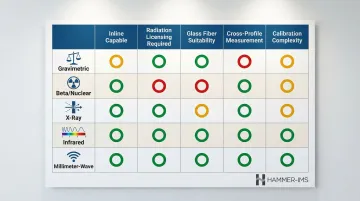
X-Ray Sensors
Where beta sensors rely on radioactive isotopes, X-ray measurement uses digitally controlled X-ray tubes that can be powered down entirely — eliminating the continuous emission hazard of isotope-based systems.
X-ray systems offer high resolution and wide measurement ranges — up to 8,000 g/m² for general materials or 20,000 g/m² for glass specifically. See Mahlo's Qualiscan QMS-12 as a representative example. X-ray is non-nuclear (no radioactive decay), but still involves ionizing radiation requiring regulatory compliance.
Calibration considerations:
Like beta, X-ray absorption depends on elemental composition. Glass fiber's high silicon and aluminum content requires calibration distinct from carbon-dominated organic materials. Different glass compositions require separate calibration curves due to varying atomic numbers:
- E-glass – 2.54–2.60 g/cc density
- C-glass – 2.52–2.56 g/cc density
- AR-glass – contains zirconia, higher effective atomic number
Infrared (IR) Sensors
X-ray and beta sensors both depend on radiation attenuation through bulk mass. Infrared takes a different approach — measuring characteristic molecular absorption of IR light — which works well for organic materials but creates a specific problem for glass fiber.
Fundamental limitation for glass fiber:
Silica-based glass fiber has minimal IR-active molecular bonds. While fused silica strongly absorbs in mid-IR ranges (9-13 µm) due to Si-O-Si resonance, it's highly transparent in the near-infrared (700-2500 nm) range commonly used for basis weight sensors.
Applicable scenarios:
IR becomes viable when glass fiber products are resin-impregnated, binder-treated, or combined with organic sizing agents — the IR sensor measures the organic component rather than the glass fiber itself.
Terahertz and Millimeter-Wave Sensors
The limitations above — radioactive sources, composition-sensitive calibration, and IR transparency — point toward a different interaction mechanism entirely. Terahertz (THz) and millimeter-wave technologies (including M-Ray systems) operate in frequency ranges that penetrate fibrous, porous materials non-destructively without ionizing radiation. They interact with bulk material properties in ways that IR cannot, making them viable for direct glass fiber basis weight measurement.
Key advantages:
- Classified as non-ionizing by ICNIRP and WHO — no nuclear sealed-source or X-ray licensing required
- Mounts directly on production lines without contacting or disrupting the web
- Measures thickness and basis weight simultaneously in a single pass
- Unaffected by material color, texture, or surface finish
Technical validation:
THz time-domain spectroscopy has successfully measured fiber mass fraction and thickness in glass fiber composites with measurement errors as low as 0.11%, demonstrating the technology's suitability for precise glass fiber applications.
For glass fiber producers facing tightening nuclear source regulations, the combination of measurement accuracy and zero licensing overhead makes millimeter-wave systems a practical replacement for legacy beta and X-ray gauges.
Key Challenges in Glass Fiber Basis Weight Measurement
Material Structure Interference
Glass fiber's fibrous, porous architecture inherently scatters measurement signals. Unlike smooth polymer films with uniform density, glass fiber mats have high air-to-fiber ratios and irregular surface topography. This creates measurement noise in many sensor types.
Mitigation strategies include:
- Optimized sensor-to-web distance to minimize geometric scatter effects
- Appropriate measurement spot size (too small amplifies local variations; too large masks true variability)
- Signal averaging algorithms that filter noise without masking genuine process variations
THz and millimeter-wave technologies benefit from relatively large wavelengths (1-10 mm) that experience limited geometric scattering on rough surfaces compared to optical methods.
Cross-Direction Profile Measurement Complexity
Cross-direction (CD) variation often matters more commercially than machine-direction average. Scanning systems on glass fiber lines must contend with:
- Edge effects – Web edges may have different density or fiber orientation than the center
- Binder gradients – Chemical treatments may concentrate in specific zones
- Fiber orientation variations – Affecting how different sensor types interact across the width
A single-point sensor mounted at one location provides no visibility into these critical variations. Traversing scanners or multi-head arrays are necessary for meaningful profile control.
Calibration Drift and Material Grade Changes
Glass fiber products span diverse compositions and forms:
Composition variants:
- E-glass (2.54-2.60 g/cc density)
- C-glass (2.52-2.56 g/cc)
- AR-glass (contains zirconia for alkali resistance)
Product forms:
- Woven fabrics
- Needled mats
- Wet-laid nonwovens
Each may require separate calibration. Attenuation-based sensors (beta, X-ray) are particularly sensitive because their mass absorption coefficients vary with atomic number. Production line changeovers create risk of measurement error if calibration isn't updated—potentially allowing systematic deviations to persist undetected.
Nuclear-based sensors face an additional burden here: temperature and pressure variations can shift baseline readings, requiring periodic recalibration — a maintenance overhead that non-nuclear alternatives avoid.
Balancing Measurement Accuracy with Production Speed
Modern glass fiber lines operate at extreme speeds. Owens Corning's Voith glass nonwoven line runs at 300 m/min with design capacity of 510 m/min.
At 510 m/min, the web moves 8.5 meters per second.
This demands sensors with millisecond response times (10-20 ms) to accurately capture variations without signal smearing. Offline gravimetric methods cannot keep pace—by the time a sample is cut, weighed, and calculated, hundreds of meters of potentially out-of-spec material have already been produced.
Even some online sensors have response lags that create dead time between detection and corrective action, leaving significant quantities of non-conforming product on the line.
How Hammer-IMS Supports Glass Fiber Basis Weight Measurement
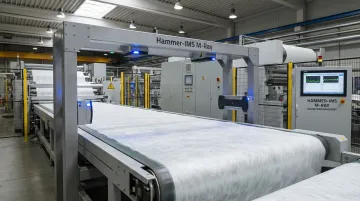
Hammer-IMS's M-Ray technology provides a non-nuclear, contactless basis weight measurement solution based on electromagnetic millimeter-wave technology. Engineered specifically for fibrous and porous materials—glass fiber mats, nonwoven veils, and insulation products—it directly addresses the limitations of nuclear and IR-based approaches. Owens Corning is among the major glass fiber manufacturers running Hammer-IMS systems across both composite reinforcement and insulation product lines.
On the production floor, M-Ray delivers:
- Delivers full web-width basis weight profiles without radiation licensing, with closed-loop control that continuously adjusts fiber deposition to maintain target weight
- Measures thickness and basis weight simultaneously from a single sensor pass at line speeds up to 500 m/min
- Minimizes the "padding" manufacturers build into targets to avoid underweight failures, reducing material overruns
- Detects and flags out-of-spec product immediately, preventing reject accumulation before it compounds
The Connectivity 3.0 software platform extends these real-time measurements into longer-term process intelligence. Rather than treating each measurement as an isolated data point, Connectivity 3.0 connects results across shifts, lines, and facilities:
- Remote connectivity for distributed facility monitoring
- Time-stamped data logging for regulatory compliance and traceability
- Analytics integration supporting continuous process improvement
- Quality trend visualization for benchmarking production performance over time
For glass fiber producers managing tight grammage tolerances across wide webs, this combination of inline measurement and integrated analytics gives quality teams a clear, actionable view of process performance—not just a pass/fail signal.
Frequently Asked Questions
What is basis weight measurement in the glass fiber industry?
Basis weight (measured in g/m² or oz/yd²) quantifies the mass of glass fiber material per unit area, serving as the primary quality metric for fabrics, mats, and insulation products. It's measured using methods ranging from laboratory cut-and-weigh procedures to inline sensor systems using beta, X-ray, or millimeter-wave technologies.
How is basis weight calculated in the glass fiber industry?
The fundamental calculation divides mass by area—a sample cut to known dimensions is weighed and the result expressed in g/m². Inline sensors derive basis weight indirectly by measuring signal attenuation, absorption, or wave propagation through the material, then converting this to basis weight using material-specific calibration curves.
What are the most common challenges in measuring basis weight in glass fiber production?
Glass fiber's fibrous, porous structure causes signal scatter and measurement noise in many sensor types, while its inorganic silica composition makes near-infrared technology poorly sensitive. Cross-direction profile measurement adds further complexity, requiring scanning systems rather than single-point sensors to capture variation across the full web width.
Is nuclear-based basis weight measurement still common in glass fiber manufacturing?
Beta (nuclear) sensors have historically been used but face growing pressure from regulatory complexity, source disposal requirements, and calibration challenges tied to inorganic glass fiber composition. Manufacturers are increasingly adopting X-ray and millimeter-wave alternatives to eliminate radiation licensing burdens while maintaining accuracy.
What is the difference between online and offline basis weight measurement?
Offline (gravimetric) measurement cuts and weighs samples after production, providing accurate but delayed, single-point results. Online/inline sensors mounted on the production line deliver continuous data across the full web width, enabling immediate process correction before out-of-spec product accumulates.
How does basis weight variation affect the performance of glass fiber products?
Uneven basis weight creates application-specific failures: inconsistent resin uptake and weak points in composites, thermal cold spots that reduce R-value in insulation, and unpredictable permeability in filtration media. In each case, poor uniformity translates directly to out-of-spec product and rejected shipments.