

Introduction
Basis weight is a foundational quality parameter in paper and paperboard manufacturing, governing material cost, structural performance, printability, and end-use suitability. Yet it remains one of the most misunderstood specifications in the industry.
The same numerical basis weight across different paper grades does not mean the same physical weight or thickness—a distinction that causes costly specification errors in procurement and production alike.
A 2024 Government Publishing Office standard establishes ±5% as the baseline acceptable tolerance for commercial paper grades. Within those narrow margins, manufacturers must balance cost, performance, and compliance — making accurate basis weight control essential for profitability.
This article explains what basis weight actually means technically, how production conditions influence it in real-world environments, how it's measured and validated using both traditional and inline methods, and what happens when output deviates from target values.
Key Takeaways
- Basis weight is the weight of 500 sheets at a grade-specific standard size; the figure only makes sense when you know the paper type
- GSM (grams per square meter) allows universal comparison across grades; U.S. pound-based basis weight varies by paper type
- Production basis weight fluctuates with raw materials, machine conditions, moisture, and coatings—requiring active monitoring
- Deviations directly impact waste, quality, compliance, and per-unit cost
- Inline measurement systems replace offline sampling to catch deviations in real time
What Basis Weight Represents in Paper
Basis weight is defined as the weight in pounds of a ream (500 sheets) of a given paper type cut to its designated basic sheet size. This makes it a derived mass-per-area property, not a direct thickness measurement.
TAPPI T 410 om-23, the official U.S. standard, defines it as "grammage of paper and paperboard (weight per unit area)" — calculated using grade-specific ream dimensions that differ by paper type.
Basis weight functions as both a design specification set during papermaking to meet product requirements and an operating variable that must be actively controlled as process output fluctuates.
The Critical Distinction: Basis Weight vs. Grammage
Grammage (GSM) measures the weight of one square meter of paper in grams, regardless of paper type. ISO 536:2019 defines grammage as "mass per unit area" expressed universally in g/m² — unlike basis weight, which varies by paper grade depending on the basic sheet size used for calculation.
A 20 lb Bond sheet and a 50 lb Text sheet both measure approximately 74–75 GSM despite their different pound ratings — because each grade uses a different basic sheet size as its reference. International specifications default to GSM precisely because it eliminates that grade-dependent ambiguity.
| Measure | Unit | Reference Area | Grade-Dependent? |
|---|---|---|---|
| Basis Weight | lb | Grade-specific ream size | Yes |
| Grammage (GSM) | g/m² | 1 square meter (universal) | No |
Factors That Influence Basis Weight in Real-World Production
Target basis weight is set during papermaking, but actual production output fluctuates due to multiple interdependent variables. The gap between specification and real output is where quality and cost problems emerge.
Raw Material Inputs
Fiber type, pulp consistency, filler loading, and coating weight directly determine mass deposited per unit area:
- Pulp consistency variations propagate into basis weight deviations across the sheet
- Filler loading (CaCO3, clay, TiO2) replaces fiber mass and alters sheet density independently of basis weight
- Coating processes add mass per unit area—coated grades must track base sheet weight and coating weight separately to maintain total basis weight within tolerance
Research on headbox dilution control shows that modern cross-direction (CD) basis weight adjustment relies on hydraulic headbox dilution valves operating at 3-20% dilution ratios, enabling precise profile control without altering total flow rate.
Machine-Side Parameters
Forming speed, wire tension, headbox pressure, and press loading affect fiber distribution uniformity across sheet width (cross-direction) and roll length (machine-direction):
- Jet-to-wire ratio defines fiber alignment and MD/CD tensile properties—operating at a ratio of approximately 1.0 minimizes MD and CD strength differences
- Ratios outside this range create anisotropic fiber orientation, producing within-reel basis weight variation
Moisture Content as a Confounding Variable
Paper weight changes with ambient humidity and drying conditions. Industry guidance notes that a 20-60% change in relative humidity results in approximately 1% moisture content change, and this change is nearly proportional to the change in basic ream weight.
A sheet can appear to meet or miss basis weight specification depending on when and where it's measured. That's why ISO 187:2022 mandates conditioning at 23±1°C and 50±2% RH before weighing.
Fiber type, pulp consistency, filler loading, and coating weight directly determine mass deposited per unit area:
Standard Basis Weight Ranges and the U.S. vs. GSM Comparison
Each major U.S. paper grade uses a different basic sheet size as the reference for its 500-sheet ream. This makes basis weight numbers across grades fundamentally incomparable without conversion—the single most common source of specification errors.
Standard Basic Sheet Sizes and Typical Ranges
| Paper Grade | Basic Sheet Size | Sheet Area (sq. in.) | Typical Basis Weight Range |
|---|---|---|---|
| Bond/Writing | 17" × 22" | 374.0 | 16–36 lb |
| Text/Book | 25" × 38" | 950.0 | 40–100 lb |
| Cover | 20" × 26" | 520.0 | 50–130 lb |
| Index | 25.5" × 30.5" | 777.8 | 90–170 lb |
GSM Conversion and Equivalents
GSM normalises weight to a fixed unit area, cutting through grade-based confusion. The conversion formula is:
GSM = (Basis Weight in lbs × 1406.1) / Basic Sheet Area in sq. inches
Applying this formula to common grades reveals just how different the U.S. numbers look compared to what is physically the same sheet weight:
| Grade Example | U.S. Basis Weight | GSM Equivalent |
|---|---|---|
| 20 lb Bond | 20 lb | 75 g/m² |
| 50 lb Text | 50 lb | 74 g/m² |
| 65 lb Cover | 65 lb | 177 g/m² |
| 110 lb Index | 110 lb | 199 g/m² |
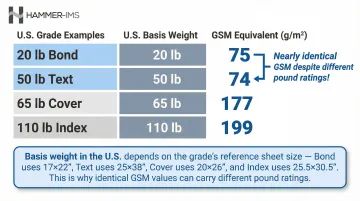
Example: 20 lb bond, 50 lb text, and 75 GSM all describe the same sheet density. When sourcing paper internationally or across grade categories, GSM is the only number that means the same thing on every specification sheet.
How Basis Weight Is Specified, Measured, and Validated
Basis weight serves two distinct roles in paper production. It is a contractual specification defined in purchase orders and industry standards, and a process control parameter verified continuously during production to catch out-of-spec output before it reaches customers.
Specification and Standards
Basis weight specifications appear in supplier datasheets as nominal values with stated tolerances. The rated value is a target. Real production output varies around it, which is why tolerance bands exist.
Acceptable tolerance bands typically range ±2–5% depending on grade and application. The U.S. Government Publishing Office establishes ±5% as the baseline across major commercial grades including offset book, bond, cover, and kraft.
ISO 536 defines the standard gravimetric measurement method: conditioning the sample, cutting to a known area, and weighing. This lab method provides accurate spot-check data but isn't suited for real-time process control on running production lines.
Measurement in Production Environments
Offline Measurement:
Cut-and-weigh gravimetric sampling provides high accuracy but is inherently slow, covers only a fraction of production, and cannot detect transient deviations or cross-direction profiles in real time.
Inline/Online Measurement Technologies:
Modern production lines use continuous inline systems:
| Technology | Operating Principle | Measurement Accuracy | Key Limitations |
|---|---|---|---|
| Beta-transmission (nuclear) | Absorption of beta particles (Kr-85, Sr-90) through the web | 0.1 g/m² 2-sigma repeatability | Requires radiation safety compliance, sensitive to air gap and pressure |
| Near-infrared (NIR) | Absorption at specific IR wavelengths (1.94 µm water, 2.10 µm fiber) | Moderate | Impacted by ambient temperature and humidity nonlinearities |
| Microwave/millimeter wave | Ratiometric resonance or wave propagation analysis | High | Primarily measures moisture; requires calibration |

Inline systems provide continuous basis weight profiles across full web width in real time, enabling closed-loop feedback to forming processes.
Hammer-IMS's M-Ray technology falls in the millimeter wave category, applying non-nuclear contactless sensing to paper and board lines. The system integrates with production controls via Profinet and TCP/IP through Connectivity 3.0 software, supporting closed-loop adjustments without the radiation compliance overhead of nuclear gauges.
Practical Challenges:
Inline sensors require regular calibration against reference samples. They must also compensate for moisture variation and avoid conflating basis weight with caliper: a sheet can be thick but light (low-density fiber) or thin but heavy (dense coating), so treating them as equivalent will produce bad process decisions.
Implications of Deviating from Target Basis Weight in Manufacturing
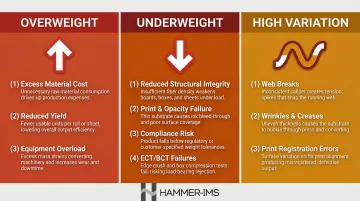
Overweight (Running Above Target)
Direct cost consequences:
- Excess material consumed per unit area
- Increased raw material cost per roll or sheet (fiber accounts for approximately 50% of production costs)
- Reduced yield—fewer sellable square meters per tonne
- Potential downstream issues: overloading converting equipment, exceeding postal/logistics weight thresholds
Underweight (Running Below Target)
Quality and compliance consequences:
- Reduced structural integrity
- Insufficient opacity or print density
- Failure to meet product specifications for end-use applications (packaging strength, writing surface durability)
- Potential regulatory non-compliance in applications with defined weight requirements
- Edge Crush Test (ECT) and Box Compression Test (BCT) failures in corrugated packaging
High Cross-Direction or Machine-Direction Variation
Hitting the average target isn't enough. Even when average basis weight is on-target, high variability creates localized defects—areas too thin or too heavy—that cause problems in converting, printing, or end-use performance.
Web tension studies show that uneven basis weight and moisture profiles cause drastic web tension variations. Common consequences include:
- Web breaks and flutter during high-speed runs
- Wrinkles and calendar cuts in paper machines and winders
- Print defects and registration errors on press
Real-time inline measurement with closed-loop control keeps these variations within acceptable bounds—directly reducing the safety margins mills need to build into their production targets.
Common Misinterpretations of Basis Weight in Practice
Basis weight errors tend to cluster around three recurring problems: cross-grade comparisons, confusion with physical thickness, and applying lab data directly to production. Each one causes real problems in practice.
Comparing Basis Weight Across Different Grades
The most prevalent mistake: assuming 80 lb cover and 80 lb text are the same weight.
- 80 lb Text (25" × 38" basic size) = 118 GSM
- 80 lb Cover (20" × 26" basic size) = 216 GSM
80 lb cover is nearly double the mass per unit area of 80 lb text because its basic sheet size is smaller, meaning 500 sheets of that smaller size weigh 80 lbs.
Basis Weight vs. Caliper (Thickness)
Heavier basis weight generally means thicker paper, but coatings, calendering, and fiber type can make a lower-basis-weight sheet thicker or thinner than expected.
- Basis weight (TAPPI T 410) measures mass per unit area
- Caliper (TAPPI T 411) measures physical thickness in mils or micrometers
Specifying one without the other leads to ordering errors — a sheet that meets basis weight requirements can still be dimensionally out of spec for a given application.
Applying Lab Values Directly to Production
Basis weight measured in a conditioned lab at standard temperature and humidity (23°C, 50% RH) will differ from production-line measurements. Applying those published spec values directly to process control setpoints without accounting for real-world variation introduces systematic error. Key factors to reconcile between lab and production include:
- Moisture content: Paper absorbs ambient humidity, shifting mass per unit area between conditioning and production environments
- Temperature drift: Equipment and material temperatures on the line rarely match the 23°C lab standard
- In-process tension and speed: Web tension and machine speed affect how material behaves during measurement
Real-time, in-line measurement systems address this gap by capturing basis weight under actual production conditions — eliminating the assumption that lab values hold on the floor.
Frequently Asked Questions
What does basis weight mean?
Basis weight is the weight in pounds of 500 sheets (one ream) of paper cut to its grade-specific standard sheet size. The number only has meaning when paired with the paper type—20 lb bond and 50 lb text have nearly identical mass per area despite different pound ratings.
How do you calculate basis weight?
Weigh 500 sheets cut to the grade's basic sheet size in pounds—that total weight is the basis weight. Alternatively, convert from GSM using: basis weight (lbs) = GSM × (basic sheet area in m²) × 500 / 453.6.
Is basis weight the same as grammage?
Both measure mass per unit area, but grammage (GSM) uses a fixed reference area (one square meter), making it grade-independent and internationally consistent. Basis weight varies by paper type because it uses different standard sheet sizes for each grade.
Which is heavier, 65 lb or 110 lb cardstock?
110 lb is heavier when both refer to the same grade (for example, both cover stock). Across different grades, GSM conversion is required: 65 lb cover ≈ 176 GSM while 110 lb index ≈ 199 GSM, so 110 lb index is heavier despite the lower pound rating.
What is the difference between basis weight and paper caliper?
Basis weight measures mass per unit area (weight), while caliper measures physical thickness. They're related but not directly interchangeable—coatings and fiber density affect thickness independently of weight.
How is basis weight measured in paper manufacturing?
Offline lab methods (ISO 536 gravimetric weighing) provide reference measurements. Modern production lines use inline sensor technologies, including non-nuclear microwave and millimeter wave systems, to measure basis weight continuously across the web. This real-time data enables closed-loop process control.