Introduction
For many industrial facilities, radiation licensing feels like an unavoidable cost of doing business — but it doesn't have to be. As of February 2024, over 17,000 active radioactive materials licenses exist across the United States: 2,014 issued directly by the Nuclear Regulatory Commission (NRC) and 15,265 managed by Agreement States. Facilities operating nuclear gauges for thickness, density, or basis-weight measurement represent a substantial portion of this landscape, each carrying compliance obligations that extend far beyond the initial purchase price.
The operational burden of maintaining a radiation license compounds over time. Facilities must employ or contract a qualified Radiation Safety Officer (RSO), conduct mandatory surveillance activities every six months, and prepare for periodic agency inspections. They must also fund eventual decommissioning — a liability that can exceed $300,000 per sensor over its lifetime.
These costs accumulate whether the nuclear gauge runs continuously or sits idle, creating a fixed overhead that many organizations underestimate during initial technology selection.
What many facilities fail to recognize is that radiation licensing costs are not inherent to the measurement task itself — they are purely a consequence of technology choice. This article examines where these costs originate, how they accumulate across a gauge's operational life, and how switching technologies can eliminate this regulatory burden entirely.
Key Takeaways
- Licensing costs compound across fees, RSO staffing, audits, and decommissioning, often exceeding €300,000 over a single sensor's lifetime
- The largest cost drivers are ongoing management overhead and long-tail liabilities, not just annual fees
- The most impactful cost-reduction decision is asking whether your measurement tasks actually require radioactive sources at all
- Non-nuclear technologies now deliver equivalent accuracy for inline thickness and basis-weight applications, with no licensing requirements
- Effective cost reduction requires a technology strategy, not just compliance optimization
How Radiation Licensing Costs Build Up Over Time
Radiation licensing costs rarely appear as a single budget line. Instead, they accumulate across multiple categories that become visible only when tracked comprehensively. Initial license applications, annual fees, RSO training programs, inspection readiness activities, and periodic renewals all represent non-discretionary expenses once a nuclear gauge enters operation.
These costs compound rather than remain static. The NRC's proposed FY 2025 annual fee for industrial gauges (Category 1.C.) increased 5.9% to $3,600 — part of a consistent upward trend across multiple budget cycles.
An aging nuclear gauge that appeared cost-justified at purchase carries escalating obligations as regulatory requirements tighten, isotopes decay and require replacement, and eventual decommissioning becomes unavoidable.
The hidden burden of compliance labor adds up fast. For 10 CFR Part 30 licensees alone, the NRC estimates a total annual burden of 273,991 hours — translating to over $59 million in compliance costs. That time lands squarely on RSOs and EHS staff, consumed by:
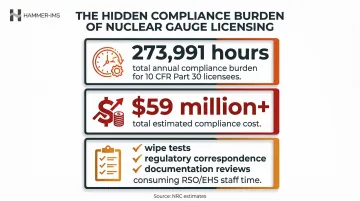
- Routine wipe tests and source inventory records
- Regulatory correspondence and inspection preparation
- Documentation reviews that meet compliance requirements but add no production value
None of this contributes to output quality or process efficiency.
Key Cost Drivers for Radiation Licensing
Radiation Safety Officer Requirements
The RSO requirement is typically the single largest recurring cost. Organizations must either employ a qualified RSO internally, which requires specialized training courses costing $895–$2,195 plus ongoing recertification, or hire external radiation safety consultants billing $100–$400 per hour. These costs persist regardless of how often the facility uses its nuclear gauge.
Regulatory Inspection and Audit Readiness
Facilities must maintain surveillance records on mandatory schedules:
- Leak tests every six months
- Physical inventories every six months
- Shutter checks at regular intervals
Any gap found during an agency inspection triggers costly corrective actions. US enforcement cases illustrate the financial exposure: Alcoa Corporation received a $9,000 fine in 2025 for failing to maintain an approved RSO and conduct leak tests, while Alt and Witzig Engineering paid $8,500 in 2020 after a portable gauge was stolen due to inadequate physical barriers.
Decommissioning Liability
NUREG-1757 explicitly recommends a 25% contingency factor for all decommissioning cost estimates to account for unforeseen circumstances, such as higher contamination levels or waste disposal price spikes. When a nuclear gauge reaches end-of-life, the facility remains responsible for source removal, contamination surveys, waste disposal, and license termination — costs that must be recalculated every three years for inflation and market changes.
Context-Dependent Cost Profiles
A plant operating a single nuclear gauge under a specific license faces different cost structures than a multi-site organization managing a broad-scope license across several locations. In both cases, the overhead is structural — built into the license itself, not into how much the equipment actually runs. That fixed burden is precisely what non-nuclear measurement eliminates.
Cost-Reduction Strategies for Radiation Licensing Costs
Strategies for reducing radiation licensing costs vary depending on whether facilities are selecting technologies for new applications, managing existing licensed programs, or reassessing long-term measurement infrastructure.
Strategies That Reduce Costs by Changing Decisions
These approaches target decision points where cost trajectories can be redirected before or around license acquisition and renewal.
Evaluate whether the measurement task requires radioactive material at all. Before acquiring or renewing a nuclear gauge license, conduct a structured technology assessment. Many inline measurement applications—thickness, basis weight, coat weight, density—can now be performed with non-nuclear technologies such as millimeter wave systems, laser triangulation, or ultrasonic sensing. Eliminating the radioactive source eliminates the license requirement entirely.
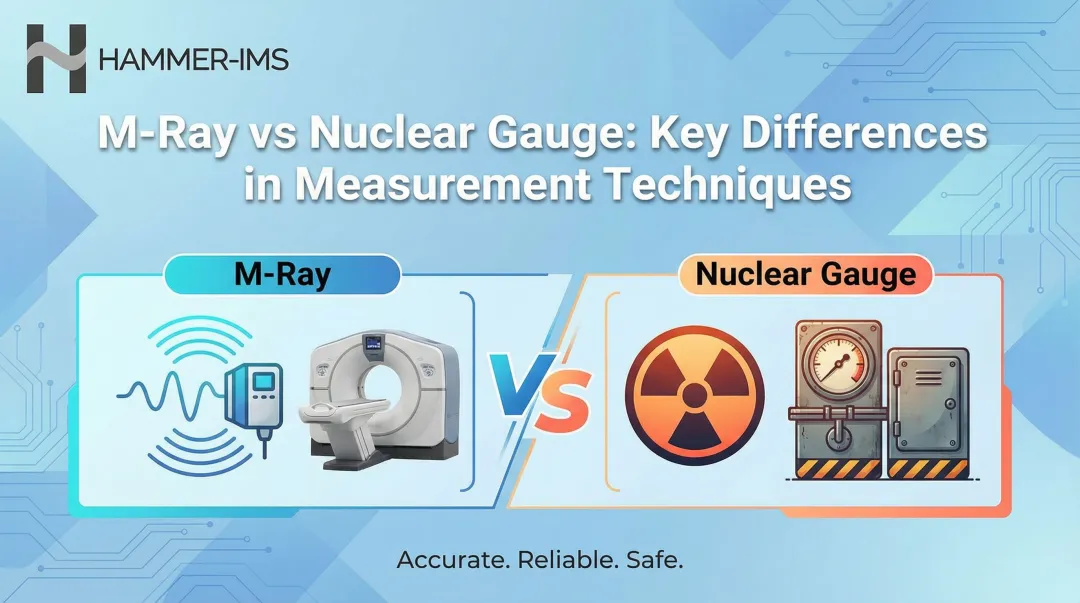
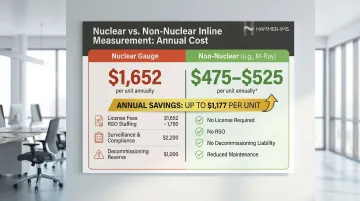
Switch to non-nuclear measurement platforms for inline applications. For facilities currently using nuclear gauges for thickness or material characterization, transitioning to non-nuclear alternatives delivers the greatest cost reduction available. Hammer-IMS's M-Ray technology uses millimeter wave-based contactless measurement to deliver real-time inline data across textiles, nonwovens, plastics, and other sheet materials. The system requires no radioactive source, no license, and no RSO. For cost reference, a lifecycle study found non-nuclear density gauges run approximately $475-$525 per unit annually versus $1,652 for nuclear equivalents — excluding storage and disposal.
Consolidate or reduce licensed inventory before renewal cycles. Organizations operating multiple nuclear gauges should audit actual utilization rates. Retiring underused or redundant gauges before license renewal reduces the scope of the license, associated fees, and ongoing surveillance obligations.
Build full lifecycle cost into technology selection decisions. Nuclear gauges are often selected on purchase price alone, without factoring in the 10-to-20-year cost of licensing, RSO support, waste disposal, and decommissioning. Establish internal policies requiring full lifecycle cost modeling—including regulatory obligations—for any measurement technology decision.
Strategies That Reduce Costs by Changing How Licensing Is Managed
These approaches improve control, documentation discipline, and administrative efficiency within existing licensed programs.
Three administrative practices deliver consistent cost control:
- Centralize license administration. Consolidating to a broad-scope license (where applicable) or centralizing RSO responsibilities across sites reduces duplicated effort, audit risk, and per-site overhead.
- Maintain proactive renewal and inspection readiness. A rolling compliance calendar with pre-scheduled leak tests, inventory checks, and documentation reviews prevents missed renewals, incomplete records, and the fines or license conditions that follow.
- Invest in RSO training and succession planning. RSO turnover without a qualified successor creates immediate compliance gaps. Cross-training and a pipeline of qualified personnel prevent operational disruptions that cost far more than the training itself.
Strategies That Reduce Costs by Changing the Context Around Radiation Use
These approaches address the broader operational environment surrounding licensed nuclear gauge use.
Align gauge retirement with decommissioning cost windows. Decommissioning costs are generally lowest when planned well in advance and coordinated with qualified vendors. Facilities that proactively schedule gauge retirement—rather than waiting until equipment failure or regulatory pressure—can secure better pricing for source removal and waste disposal while avoiding emergency decommissioning premiums.
Use end-of-life gauge replacement as the natural transition point to non-nuclear technology. Rather than like-for-like replacement of aging nuclear gauges, treat equipment end-of-life as a structured opportunity to evaluate non-nuclear alternatives. The capital cost comparison is most favourable at this point, and the facility avoids entering a new licensing cycle.
Engage regulatory agencies early for license termination guidance. Facilities planning to decommission nuclear gauges should notify the relevant agency well in advance (typically 20-60 business days, depending on jurisdiction) and request pre-inspection guidance. Early engagement reduces the risk of discovering undocumented contamination at close-out, which can dramatically increase remediation and termination costs.
Conclusion
The true cost of radiation licensing is not the annual fee—it is the accumulated weight of compliance labour, RSO requirements, decommissioning liability, and operational constraints that compound across every nuclear gauge's full lifecycle. Reducing these costs depends on identifying where they originate, not on cutting individual line items.
The most direct cost-reduction strategy is also a one-time decision: choosing measurement technology that does not require radioactive material. When the regulatory burden traces back to the radioactive source itself, removing that source eliminates the burden at its origin. Companies like Hammer-IMS build non-nuclear measurement systems precisely on this principle — no licensed material, no licence to maintain.
Frequently Asked Questions
Which regulatory agency requires minimizing radiation exposure?
In the United States, the Nuclear Regulatory Commission (NRC) and Agreement State agencies enforce radiation protection requirements, including ALARA (as low as reasonably achievable) standards for licensed radioactive material users. OSHA and EPA have overlapping authority in specific contexts, particularly for occupational safety and environmental protection.
How to get a radioactive material license?
Obtaining a radioactive materials license requires submitting NRC Form 313, demonstrating qualified RSO credentials, documenting facilities and procedures, and paying applicable fees—proposed at $1,500 for new Category 1.C. industrial gauge licenses in FY 2025. Timelines and requirements vary by license type and jurisdiction.
What are the ongoing costs of maintaining a radioactive materials license?
Ongoing costs include annual license fees ($3,600 proposed for FY 2025), RSO staffing or consultancy ($52–$400 per hour), mandatory surveillance activities (leak tests, inventory records, area surveys every six months), and inspection preparation. Decommissioning obligations alone can exceed $300,000 per sensor over its lifetime.
Can non-nuclear measurement technology match the accuracy of nuclear gauges?
Modern non-nuclear technologies—including millimeter wave, laser, and ultrasonic systems—match nuclear gauge accuracy for most inline industrial applications. The Idaho Transportation Department found non-nuclear density gauges delivered tighter standard deviations (0.5 pcf vs. 1 pcf for nuclear) in lab testing, with field trials confirming agreement with core densities.
What industries are most impacted by radiation licensing requirements?
Key sectors include textiles and nonwovens, plastics film and sheet, paper and board, steel processing, and construction materials—all traditional users of nuclear gauges for inline thickness and density measurement. These industries are increasingly transitioning to non-nuclear alternatives to eliminate regulatory burdens.
What is the difference between nuclear and non-nuclear thickness measurement?
Nuclear thickness gauges use a radioactive isotope to measure material properties by detecting radiation transmission or backscatter, requiring a license and comprehensive safety protocols. Non-nuclear systems use technologies such as millimeter waves, laser triangulation, or ultrasound to achieve the same measurement without any radioactive source, eliminating all associated licensing and compliance requirements.