Introduction
Nuclear gauges have dominated inline thickness and basis-weight measurement for decades. But radiation licensing requirements, strict safety protocols, and growing operational restrictions are pushing manufacturers in nonwovens, plastics, and textiles to look seriously at alternatives — M-Ray technology in particular.
The choice between nuclear gauges and M-Ray technology directly affects production efficiency, regulatory burden, material waste, and long-term cost. This guide breaks down how each technology works, where each excels, and what to prioritize when choosing.
Key Takeaways
- Nuclear gauges measure via radiation attenuation from radioactive isotopes, requiring licensing, trained safety officers, and regulated disposal
- M-Ray uses non-ionizing millimeter waves (60 GHz) for contactless, high-precision measurement with no radioactive materials, no licensing, and standoff distances up to 30–40 cm
- Nuclear gauges add radiation compliance overhead; M-Ray matches or exceeds their accuracy with zero radioactive risk
- Nonwovens, film, and textile producers increasingly favor M-Ray for full-width coverage and production-line flexibility
- Use nuclear gauges for thick steel, borehole logging, or slurry pipelines; use M-Ray for flat material lines where safety and agility matter
M-Ray vs Nuclear Gauge: At a Glance
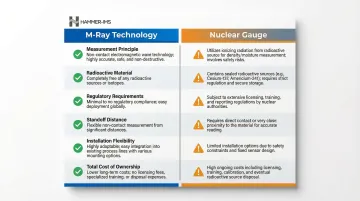
| Feature | M-Ray Technology | Nuclear Gauge |
|---|---|---|
| Measurement Principle | Non-ionizing millimeter waves (60 GHz) | Ionizing radiation (gamma/beta/neutron) from radioactive isotopes |
| Radioactive Material | None—purely electronic | Sealed radioactive sources (Cs-137, Kr-85, Sr-90, Am-241) |
| Regulatory Requirements | No NRC or equivalent licensing; standard industrial electrical safety only | NRC or national equivalent licensing; requires radiation protection officer, leak testing, and formal disposal protocols |
| Standoff Distance | Up to 30–40 cm clearance | Typically ~1 cm operating distance |
| Installation Flexibility | Fully portable across production lines and sites | Fixed or semi-fixed installation |
| Material Coverage | Multiple sensors traverse full width for complete coverage | Single-point or narrow-beam (requires costly scanning frame for full coverage) |
| Total Cost of Ownership | Higher upfront investment; no ongoing licensing, disposal, or compliance costs | Variable upfront cost; ongoing regulatory fees, RPO staffing, source replacement, and disposal expenses can exceed €300,000 over a system's lifetime, per Hammer-IMS analysis |
What is a Nuclear Gauge?
Nuclear gauges are instruments that use sealed radioactive sources to measure properties like thickness, density, fill level, and moisture content. Source types include gamma emitters such as Cesium-137 (Cs-137) and Cobalt-60 (Co-60), beta emitters like Krypton-85 (Kr-85) and Strontium-90 (Sr-90), and neutron sources — each selected based on material type and measurement parameter.
Measurement Principles
Two core measurement methods drive nuclear gauge operation:
- Transmission mode: Source and detector positioned on opposite sides of the material; attenuation of radiation through the material is measured to determine thickness or density
- Backscatter mode: Source and detector on the same side; reflected radiation is measured, useful for applications where only one side of the material is accessible
The choice of radioisotope depends on material type and measurement parameter—denser materials require higher-energy gamma sources for adequate penetration.
Regulatory and Safety Infrastructure
Operating nuclear gauges requires substantial compliance overhead:
- NRC or equivalent national licensing (specific or general licenses depending on design)
- Appointment of qualified Radiation Safety Officers (RSOs)
- Mandatory leak testing every 6–12 months per ISO 9978
- Controlled storage facilities and dose monitoring for operators
- End-of-life disposal plans—disposal of large Cs-137 sources can cost $200,000–$220,000
Use Cases of Nuclear Gauges
Nuclear gauges remain the proven choice for demanding industrial environments:
- Thickness measurement in steel and aluminum rolling mills
- Basis weight monitoring in paper and film production
- Density gauging in pipelines and slurries
- Level measurement in cement or chemical containers
- Applications involving extreme temperatures (up to 930°F) where other technologies fail
Their strongest technical case is in applications with very dense or opaque materials — thick metals, slurries, high-density composites — where radiation penetration depth gives them a measurable edge over most alternatives.
What is M-Ray Technology?
M-Ray technology is a non-nuclear measurement technique that uses millimeter waves at 60 GHz to measure the thickness and basis weight of flat materials. It operates without contact and without ionizing radiation, making it suitable for continuous production lines.
Measurement Principle
Millimeter waves are emitted toward the material and travel through it, reflecting back to be captured by a sensor. The system tracks the precise time required for the wave to pass through the material, then calculates thickness and basis weight data without physical contact and without ionizing radiation.
Key Technical Capabilities
M-Ray technology delivers several operational advantages:
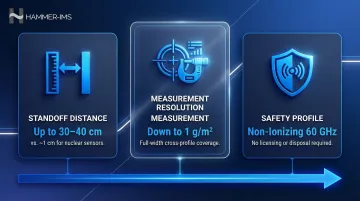
Standoff Distance: Up to 30–40 cm clearance, compared to ~1 cm for nuclear gauges. This allows measurement of thick nonwovens, freshly extruded plastics, or fluttering fabrics without risk of sensor damage or material contamination.
Measurement Resolution: Measures down to 1 g/m² basis weight, covering ultra-thin films through heavy industrial substrates. Multi-sensor scanning heads traverse the full material width for complete cross-profile coverage.
Safety Profile: Millimeter waves at 60 GHz are classified as non-ionizing by ICNIRP and IEEE, posing no harm to operators or the surrounding environment. This removes the licensing, handling, and disposal requirements that come with nuclear gauges.
Use Cases of M-Ray Technology
M-Ray delivers highest value in continuous production environments:
- Nonwovens manufacturing: Post-carding and post-forming measurement for basis weight profiling
- Plastic film and sheet extrusion: Measurement directly after chilling rolls, even on hot materials
- Technical textiles: Full-width grammage verification for coated and non-coated fabrics
- Wall coverings, rubber, and bitumen coatings: Reduces over-application waste in real time through inline measurement feedback
Hammer-IMS deploys M-Ray-based systems across these environments, with customers including Owens Corning, Balta, and Autoneum. Their Connectivity 3.0 software connects measurement data directly to production controls, enabling closed-loop adjustments and process data logging from a single interface.
Key Differences Between M-Ray and Nuclear Gauge
Radiation and Safety
Nuclear gauges emit ionizing radiation requiring shielding, controlled access, and regulatory oversight. M-Ray emits non-ionizing millimeter waves that require none of these measures. That makes M-Ray safer for operators and removes the liability and compliance costs tied to radioactive source management.
Regulatory Burden
Nuclear gauge users must:
- Obtain and maintain licenses from national regulatory bodies (NRC in the US, EURATOM in the EU)
- Appoint qualified radiation protection officers
- Conduct periodic leak tests every 6–12 months
- Keep source accountancy records
- Plan for certified disposal
None of these apply to M-Ray systems, eliminating operational overhead for production teams.
Measurement Coverage and Material Suitability
Nuclear gauges: Typically use a single-point or narrow-beam source, limiting cross-profile coverage unless a costly scanning frame is added
M-Ray scanners: Use multiple sensors traversing the full material width, generating color-coded thickness and basis weight profiles across the full sheet or web — pinpointing out-of-spec zones as they occur
Standoff Distance and Installation Flexibility
The 30–40 cm clearance of M-Ray systems allows measurement immediately post-extrusion (hot materials), post-carding (fluffy nonwovens), or in environments prone to material flutter.
A nuclear gauge operating at ~1 cm clearance in those same conditions risks sensor damage or source contamination.
Closed-Loop Process Integration
M-Ray systems are designed for integration into closed-loop production control—feeding real-time measurement data back to adjust process parameters automatically and reduce material waste. Implementing real-time basis weight control can reduce material waste by up to 15% in film extrusion.
Total Cost of Ownership and Operational Sustainability
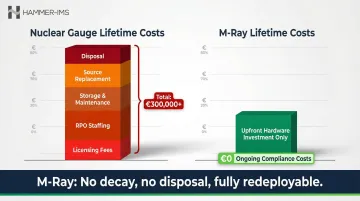
Nuclear gauges carry ongoing costs that are easy to underestimate:
- NRC or regulatory licensing fees
- RPO training and salaries
- Storage facility maintenance
- Source replacement (due to isotope decay)
- Disposal fees, with total lifetime costs that can exceed €300,000
M-Ray systems have no radioactive source decay (no measurement drift over time), no disposal liability, and can be redeployed across multiple production lines or sites, spreading investment across a larger production footprint.
Which Measurement Technology Fits Your Production Line?
Choose nuclear gauges when:
- Applications involve highly dense materials (thick steel, slurry pipelines, borehole density logging)
- Radiation penetration depth is technically necessary
- Extreme temperatures or pressures are present
- No alternative achieves equivalent accuracy
Choose M-Ray when:
- Priority is flat material quality control on production lines
- Safety compliance, full-width coverage, and high standoff distance are key requirements
- Closed-loop integration with automated process control is desired
- Regulatory burden and disposal liability must be minimized
For manufacturers in nonwovens, plastics, technical textiles, wall coverings, rubber, and coatings, M-Ray technology removes both the technical constraints and regulatory overhead of nuclear gauges. Full-width profiling and real-time production feedback are available without radiation licensing, source disposal, or safety exclusion zones.
Contact Hammer-IMS to discuss whether M-Ray technology fits your production line — and how closed-loop control and full-width profiling can reduce material waste and tighten quality margins.
Frequently Asked Questions
What are the limitations of nuclear gauges and what alternatives are available?
Nuclear gauges require radiation licensing, have limited standoff distance (~1 cm), carry disposal obligations, and typically provide only single-point coverage. Isotope supply shortages—particularly Pm-147 and Kr-85—are accelerating adoption of non-nuclear alternatives like millimeter wave-based M-Ray technology for flat material measurement.
What is M-Ray technology and how does it measure thickness and basis weight?
M-Ray uses non-ionizing millimeter waves (60 GHz) that travel through the material and reflect back to sensors. The system measures the precise time delay as waves pass through the material to calculate thickness and basis weight, delivering contactless real-time measurements without radioactive sources.
Do M-Ray systems require the same regulatory licensing as nuclear gauges?
No. M-Ray systems contain no radioactive materials and therefore require no NRC or equivalent national licensing, no radiation protection officers, and no special disposal arrangements—cutting compliance overhead compared to nuclear gauges.
Which industries benefit most from switching from nuclear gauges to M-Ray?
Nonwovens, plastic film, technical textiles, coatings, and rubber manufacturing benefit most—these sectors require full-width coverage, high standoff distance, and closed-loop production feedback that single-point nuclear gauges cannot provide.
Can M-Ray achieve the same measurement accuracy as nuclear gauges?
Yes. M-Ray systems measure down to 1 gram per square meter resolution for basis weight, matching or exceeding nuclear gauge accuracy for flat material applications while adding full-width profiling capability that single-point nuclear gauges lack.
What is the total cost of ownership difference between M-Ray and nuclear gauge systems?
Nuclear gauges carry ongoing costs—licensing, RPO staffing, mandatory leak testing, source replacement, and disposal—that can exceed €300,000 over the system lifetime. M-Ray systems carry none of these expenses, and redeployability across multiple production lines improves long-term ROI further.