Introduction
Manufacturing quality failures drain industrial producers of substantial capital. In U.S. discrete manufacturing alone, defects cost between $32.0 billion and $58.6 billion annually, representing massive losses from scrap, rework, and warranty claims. Traditional measurement methods—whether nuclear gauges with their regulatory burdens, contact gauges that disturb delicate materials, or optical systems that struggle with transparency—often fall short in continuous production environments.
Electromagnetic millimeter-wave (mmWave) technology fills that gap directly. Sensors operating in the 30–300 GHz frequency range deliver contactless, non-nuclear measurement with micrometer-level precision—without the licensing overhead of radioisotope gauges or the surface contact that distorts soft materials.
TLDR:
- mmWave operates at 30–300 GHz, enabling contactless thickness and basis-weight measurement with micrometer accuracy
- Non-nuclear design eliminates regulatory licensing, safety protocols, and disposal costs associated with radioisotope gauges
- Suitable for plastics, nonwovens, insulation, textiles, and rubber across production widths up to 5+ metres
- Reduces material waste by tightening thickness control—saving up to 15% on material costs in film extrusion
- Real-time feedback enables closed-loop production adjustment via Modbus, OPC-UA, and PROFINET integration
What Is Electromagnetic Millimeter-Wave Technology?
Millimeter-wave technology occupies the Extremely High Frequency (EHF) band of the electromagnetic spectrum, spanning 30–300 GHz with wavelengths of 1–10 mm. Some industrial applications extend down to 24 GHz, built on mature hardware ecosystems originally developed for ISM (industrial, scientific, and medical) applications.
mmWave signals travel at the speed of light and exhibit optical-like propagation behaviour. They can be focused, directed, and reflected with high precision using compact antennas—a fundamental advantage for sensing applications. The short wavelengths enable narrow beamwidths and superior spatial resolution compared to lower-frequency microwaves.
Consumer vs. Industrial Applications
While many associate mmWave with 5G telecommunications, industrial applications differ substantially:
- 5G / consumer: High-bandwidth wireless data transmission
- Industrial measurement: Non-contact thickness gauging, basis-weight measurement, radar sensing, and inline quality control
For manufacturers, this means mmWave technology can deliver micron-level measurement accuracy directly on the production line, without contact or radiation hazards.
Key Propagation Properties of mmWave Signals
Limited Penetration Depth
mmWave signals exhibit shallow penetration in most solid materials. At 30 GHz, penetration depth in biological tissue is approximately 0.92 mm, decreasing to 0.23 mm at 300 GHz. In industrial polymers and composites, similar shallow interaction occurs.
Signals reflect off surfaces and sub-surface interfaces, enabling precise thickness measurement of thin layers without physical contact — no sample preparation or direct contact required.
Atmospheric and Material Attenuation
mmWave signals experience absorption from water vapour, oxygen, and specific material compositions at certain frequencies. Key attenuation characteristics include:
- Oxygen absorption peak near 60 GHz limits usable range at that band
- Atmospheric windows at 24 GHz and 77 GHz offer minimal attenuation across typical industrial measurement distances
- Material composition affects absorption behaviour, requiring frequency selection matched to the target substrate
Choosing the right operating frequency is therefore a core step in system design, directly affecting signal return quality.
High Spatial Resolution
The short wavelengths of mmWave frequencies allow highly focused beams even with small antennas. Operating in the 60 GHz band can yield range resolutions of 2 cm or better. That resolution is sufficient to detect localised variations in material thickness or density across a scanned surface — including defects that capacitive or ultrasonic methods routinely overlook in continuous production-line conditions.
Why mmWave Is Well-Suited for Industrial Measurement
Contactless Operation
mmWave measurement systems require no physical contact with materials under test. This eliminates:
- Mechanical wear on sensors
- Contamination risk to products
- Compression artifacts on soft materials
- Interference with fast-moving production lines
The technology works effectively on hot, fragile, or fast-moving materials including plastic film, foam, nonwoven fabric, and insulation—even at temperatures around 100°C directly after extrusion.
High Measurement Resolution and Accuracy
Modern mmWave systems achieve exceptional precision:
- ±6 µm accuracy over 35 mm distance (122 GHz radar sensor)
- ±1 µm systematic error over 4.8 metres (126-182 GHz ultra-wideband FMCW radar)
- Random errors as low as 30 nm in controlled setups
Hammer-IMS's M-Ray technology delivers 1 micrometre accuracy for plastic films and 1 gsm (gram per square metre) accuracy for nonwovens—precision sufficient for closed-loop production control.
Non-Nuclear and Environmentally Safe
mmWave technology eliminates ionising radiation entirely. Unlike nuclear gauges, mmWave systems require:
- No radioactive source licensing
- No radiation safety protocols
- No specialised disposal procedures
- No personnel hazard management
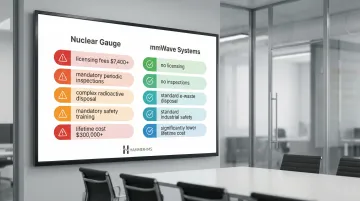
The regulatory and lifetime cost gap between the two approaches is substantial:
| Feature | Nuclear Gauges | mmWave Systems |
|---|---|---|
| Licensing fees | $7,400+ for possession licenses | None |
| Mandatory inspections | Required periodically | None |
| Disposal costs | Complex, expensive end-of-life procedures | Standard electronic waste |
| Safety training | Mandatory for operators | Standard industrial safety only |
| Total lifetime cost | $300,000+ per sensor | Significantly lower |
The NRC recovers approximately $205.5 million annually through service fees related to nuclear licenses—a figure that reflects the collective compliance burden across licensed facilities.
Real-Time Production Feedback Capability
mmWave sensors scan continuously across moving webs or sheets at line speed. Measurement data feeds directly into closed-loop production control systems to automatically adjust process parameters such as:
- Extruder die gap settings
- Calendering pressure
- Coating knife positioning
- Material feed rates
Hammer-IMS's M-Ray systems connect to production infrastructure via Connectivity 3.0 software, supporting Modbus TCP/IP, OPC-UA, and PROFINET protocols for data logging, analytics, and automated process adjustment.
Industrial Applications of mmWave Measurement Technology
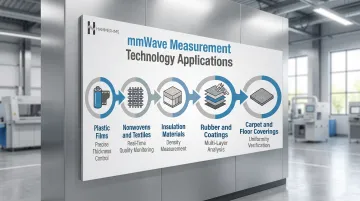
Plastic Films and Sheet Extrusion
Material costs dominate plastics extrusion economics. Manufacturers often run products thicker than necessary to ensure minimum specifications are met despite measurement uncertainties—a practice known as "thickness give-away."
Reducing average film thickness from 0.8 mil to 0.7 mil yields 15% material savings. For a single 2-metre wide polycarbonate extrusion line running 24/7, tighter thickness control can save over 1,000 metric tonnes of raw material annually.
mmWave gauges measure thickness variation across the full web width in real time, enabling:
- Immediate die bolt adjustment to correct local deviations
- Scrap reduction (cast film lines can experience 12-15% scrap rates)
- Down-gauging closer to minimum specifications
- Faster ROI—one medical film processor paid off a €125,000 investment in three months through 10% resin cost reduction
Nonwovens and Technical Textiles
The nonwovens industry, which produced nearly 2.8 million tonnes in Greater Europe in 2019, faces unique measurement challenges.
Nonwovens are characterised by low density and high porosity. Traditional contact gauges compress the material, leading to inaccurate thickness readings. Structural parameters like bulk density and porosity significantly influence mechanical properties—compression during measurement introduces bias.
For these materials, mmWave sensors offer a more reliable path:
- Measures both thickness and basis weight without contact
- Maintains 1 gsm accuracy even with high standoff distances (up to 30 cm)
- Works on low-density or porous materials where optical methods struggle
- Suitable for automotive acoustics, filtration media, and geotextiles
Insulation and Construction Materials
Insulation materials like mineral wool and glass wool must meet strict standards for thermal performance, directly linked to thickness and density.
EN 13162 specifies rigorous thickness tolerances, with tolerance classes ranging from -5% or -5mm to +15% or +15mm depending on product class. Contact measurement introduces a compounding problem here: mineral wool is highly compressible, so probe-based methods introduce bias and fail to reflect true "installed" thickness. mmWave sensors verify compliance with EN 13162 without physical contact, preserving material integrity.
Rubber and Coated Substrates
mmWave's ability to penetrate certain material layers enables measurement of:
- Rubber sheet thickness
- Coated textile layer thickness
- Individual layer thickness in multi-layer composite stacks
The combination of non-contact operation and controlled penetration depth allows measurement of sub-surface layers without disturbing the material.
Carpet and Floor Coverings
In carpet and tufted textile manufacturing, mmWave systems measure:
- Pile height uniformity
- Backing thickness
- Total product thickness
Measurements occur across the full production web width, ensuring consistent product quality for flooring manufacturers. Traversing sensor configurations provide nearly 100% material coverage, detecting local variations that affect product appearance and performance.
mmWave Measurement vs. Traditional Industrial Measurement Methods
mmWave vs. Nuclear Gauges
Nuclear (radioisotope) gauges have traditionally dominated non-contact thickness measurement but carry significant disadvantages:
Regulatory Compliance:
- €7,400+ licensing fees for certain possession licenses
- Mandatory periodic inspections
- Licensed operator requirements
- Complex radioactive source disposal procedures
Operational Costs:
- Expensive source replacements
- Nuclear waste processing fees
- Operator safety training
- Legal compliance tracking
- Total lifetime costs exceeding €300,000 per sensor
mmWave Advantage:
mmWave delivers equivalent or superior measurement performance with none of these burdens. European regulations increasingly require facilities to justify nuclear technology use when non-nuclear alternatives perform comparably, making mmWave the lower-risk compliance path for new installations.
Where nuclear gauges demand ongoing regulatory overhead, contact methods introduce a different set of problems: physical damage to the material itself.
mmWave vs. Contact Gauges
Contact methods (caliper/roller gauges) physically touch the material, causing:
- Marking or scratching of delicate surfaces
- Compression of soft materials (foam, nonwovens)
- Contamination risk
- Mechanical wear requiring maintenance
- Inability to scan full web width in real time
A single mmWave sensor array addresses all of these limitations at once. For high-speed lines, this matters: the technology operates at line speeds up to 1,000 m/min without any surface contact.
mmWave vs. Optical/Laser Thickness Measurement
Optical methods measure surface-to-surface dimensions but struggle with:
- Transparent materials (light passes through)
- Highly reflective surfaces (scattering)
- Varying colours and gloss levels
- Materials where the measurement target is beneath a coating
Infrared sensors can be inconsistent with thin or reflective surfaces and are sensitive to dust and ambient light. mmWave penetrates certain material layers and is less sensitive to surface appearance or colour.
mmWave vs. Ultrasound
Ultrasonic measurement typically requires a coupling medium (gel or liquid) and is better suited to rigid or dense materials. It is slower for full-web scanning in continuous production and requires additional infrastructure to manage the coupling medium.
mmWave operates in air without any coupling medium. It can be deployed across the full material width using traversing or multi-sensor array configurations, supporting web widths of 5+ metres in continuous production environments.
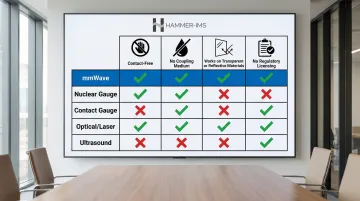
Comparison at a Glance
| Method | Contact-Free | No Coupling Medium | Works on Transparent/Reflective Materials | No Regulatory Licensing |
|---|---|---|---|---|
| mmWave | ✓ | ✓ | ✓ | ✓ |
| Nuclear Gauge | ✓ | ✓ | ✓ | ✗ |
| Contact Gauge | ✗ | ✓ | ✓ | ✓ |
| Optical/Laser | ✓ | ✓ | ✗ | ✓ |
| Ultrasound | ✓ | ✗ | ✓ | ✓ |
Frequently Asked Questions
Are electromagnetic millimeter waves (mmWave) safe for humans?
Yes. mmWave radiation is classified as non-ionizing, lacking the photon energy to break chemical bonds or damage DNA. Industrial measurement systems operate at very low power levels (typically around 1 mW), with penetration depths of less than 1 mm into biological tissue at frequencies above 30 GHz—confining any interaction to superficial skin layers.
What industries benefit most from mmWave measurement technology?
Key sectors include nonwovens, plastic film and sheet extrusion, foam and insulation manufacturing, textiles and carpets, rubber processing, and construction materials. Any production process requiring continuous, non-contact thickness or density measurement in real time is a strong candidate for mmWave technology.
How accurate is mmWave thickness measurement for industrial applications?
Modern mmWave systems achieve micrometer-level precision, with systematic errors of ±1 µm over 4.8 metres and random errors as low as 30 nm in controlled setups. This repeatability is sufficient for closed-loop production control in demanding applications like medical film extrusion and battery separator manufacturing.
Can mmWave measurement work through coatings or on multi-layer materials?
mmWave signals can interact with sub-surface layers depending on frequency and material properties. This enables measurement through certain coatings or measurement of individual layers in some multi-layer configurations. However, performance depends on the specific materials involved. For multi-layer applications, contact your measurement system provider to confirm suitability.
How does mmWave differ from nuclear gauging in an industrial setting?
Both are non-contact methods for thickness gauging, but nuclear gauges use ionising radiation from radioactive sources, requiring licensing, safety protocols, and managed disposal. mmWave is entirely non-nuclear and non-radioactive, subject to no equivalent regulatory burden, with total lifetime costs significantly lower than the €300,000+ typical for nuclear systems.