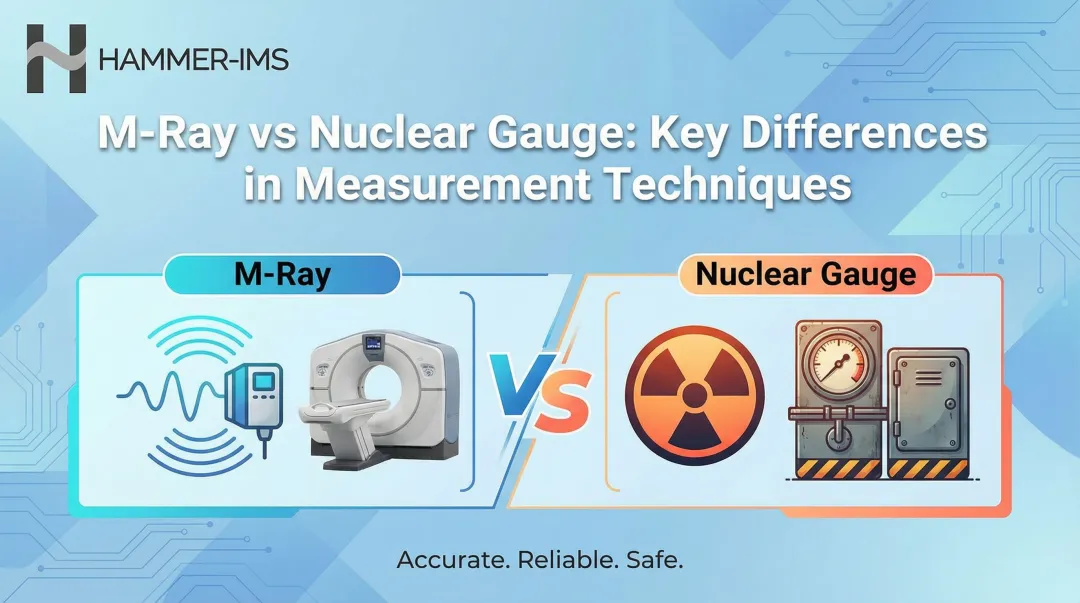
But a shift is underway. The global nonwovens market is projected to grow from $52.56 billion in 2023 to $75.74 billion by 2030, driving demand for quality control technologies that can scale with production, handle thicker materials, and reduce regulatory overhead. M-Ray technology—a non-nuclear, millimeter-wave electromagnetic measurement system—is emerging as a viable alternative, especially for manufacturers of heavy, thick, or multi-layer materials who want to avoid nuclear licensing entirely.
Choosing between beta gauges and M-Ray isn't just about upfront equipment cost. It's about long-term measurement precision, material coverage, regulatory complexity, and total lifecycle expenses—including isotope replacement, compliance audits, and decommissioning liabilities that can exceed $300,000 per sensor.
Key Takeaways
- Beta gauges reach precision down to 0.05 gsm for thin films — but come with nuclear licensing, source replacement cycles, and ongoing regulatory compliance
- M-Ray uses millimeter-wave radar technology to measure material basis weight via signal time delay—no radioactive source needed
- M-Ray operates at standoff distances up to 30 cm (versus under 5 cm for beta gauges), making it ideal for thick nonwovens and early-stage formation processes
- For ultra-thin materials, beta gauges remain the precision benchmark; M-Ray excels at multi-head scanning of heavy materials with stable long-term accuracy
- The right choice comes down to material type, basis-weight range, regulatory environment, and scanning coverage needs
Beta Gauge vs. M-Ray: Quick Comparison
| Feature | Beta Gauge | M-Ray |
|---|---|---|
| Technology Type | Radioactive isotope emission (Kr-85, Sr-90, Pm-147) | Non-radioactive millimeter-wave electromagnetic signals |
| Measurement Principle | Radiation absorption through material | Signal time delay as wave passes through material |
| Standoff Distance | Typically 1–5 cm | Up to 30 cm |
| Maximum Basis Weight | ~5 kg/m² (with Sr-90) | Validated up to 10 kg/m² (10,000 gsm) |
| Precision (Standard Deviation) | ~0.05 gsm (Kr-85); precision degrades as source decays | ~1 gsm; consistent over system lifetime |
| Multi-Head Scalability | Not economically viable | Yes; processing electronics shared across heads |
| Regulatory Requirements | Nuclear licensing, radiation safety programs, source disposal | None |
What is a Beta Gauge?
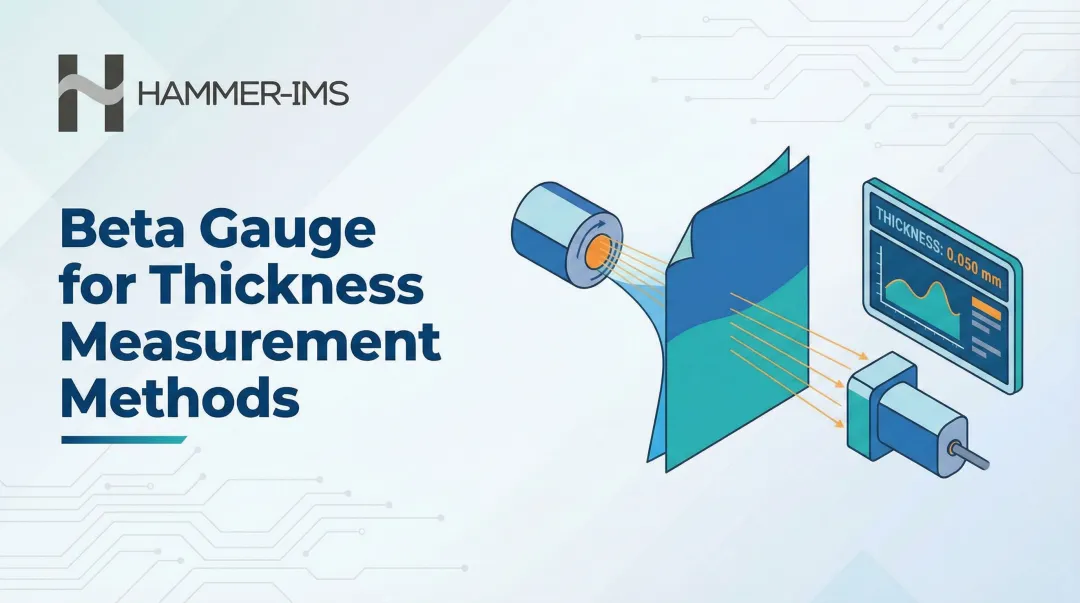
A beta gauge is a non-contact measurement device that uses beta radiation from a sealed radioactive isotope source to measure material thickness or grammage. As beta particles pass through a material web, a portion are absorbed — the heavier or thicker the material, the more radiation is blocked.
A detector on the opposite side measures the remaining radiation intensity to calculate mass per unit area.
Why Beta Gauges Became the Industry Standard
Beta gauges achieve inline measurement precision down to approximately 0.05 gsm with Krypton-85 sources, backed by decades of deployment across plastics extrusion, paper production, film manufacturing, and nonwovens. Key performance characteristics include:
- Precision down to ~0.05 gsm with Kr-85 sources
- 5-millisecond response times and streak resolution to 1.0 mm in advanced systems
- Proven across high-speed roll-to-roll processes where minor variations affect end-product quality
Isotope Selection and Measurement Range
Manufacturers select isotope sources based on target material weight:
- Promethium-147 (Pm-147): Low-energy source for lightest materials (1–250 gsm); half-life of 2.6 years
- Krypton-85 (Kr-85): Medium-energy source for standard applications (10–1,200 gsm); half-life of 10.8 years
- Strontium-90 (Sr-90): High-energy source for heavier materials (up to 5,500–7,000 gsm); half-life of 28.8 years
The trade-off: heavier material ranges require higher-energy sources, which sacrifice some measurement precision.
Limitations and Compliance Costs
Radioactive isotopes lose strength over time, and measurement precision degrades with them. Kr-85's 10.7-year half-life means that after a decade, the source emits only half its original radiation — requiring recalibration or source replacement to maintain accuracy. This creates recurring cost and administrative burden beyond the initial equipment purchase.
Operating a beta gauge also requires nuclear licensing, radiation safety programs, periodic audits, and managed end-of-life isotope disposal. In the US, for example, the Nuclear Regulatory Commission charges annual fees of $3,600 for Category 1.C licenses, with additional costs for Radiation Safety Officer training (~$1,950), bi-annual leak testing, and eventual decommissioning liabilities that can exceed $300,000 per sensor over its lifetime. European facilities face comparable requirements under national nuclear authority frameworks.
Use Cases of a Beta Gauge
Beta gauges fit best on high-speed roll-to-roll lines for thin, uniform materials where precision at low basis weights is critical:
- Plastics extrusion: Film production where basis weights are well under 5 kg/m²
- Paper manufacturing: Lightweight coatings and speciality papers
- Foil production: Precision measurement of ultra-thin metallic films
- Facilities with existing nuclear infrastructure: Plants already operating under nuclear licensing can leverage existing compliance frameworks
What is M-Ray Technology?
M-Ray technology is a measurement system using multi-gigahertz electromagnetic waves (millimeter waves) in a radar-like configuration. A transmit antenna sends waves through the material web, a receive antenna captures them, and the measured time delay relates directly to the material's grammage or basis weight. The technology is entirely non-radioactive.
The Physics Advantage: Standoff Capability
Unlike radiation-based methods where signal strength diminishes sharply with distance, M-Ray waves are not significantly absorbed by the material but are instead slowed. This enables accurate measurement at standoff distances up to 30 cm, making it viable for very thick, lofty, or uncompressed webs—materials that would damage or be unmeasurable by beta gauges with their narrow air gaps.
To achieve this, M-Ray systems employ Frequency-Modulated Continuous-Wave (FMCW) sensors, which provide high penetration depth and measurement rates of several kilohertz.
Precision and Scalability Over the System Lifetime
M-Ray achieves approximately 1 gsm standard deviation. Unlike beta gauges, there is no degrading radioactive source. Precision remains consistent over the system's lifetime, with no source replacements or recalibration events tied to isotope decay — removing a recurring maintenance cost for manufacturers focused on long-term consistency.
Scalability follows naturally from this architecture. Because system cost is driven primarily by shared processing electronics rather than individual measurement heads, multiple heads can be deployed within a single scanner at viable cost. Full-width coverage across wide production webs becomes practical — a configuration that would multiply licensing, disposal, and safety costs prohibitively with beta gauges.
Hammer-IMS's M-Ray Implementation
Hammer-IMS developed and commercialised M-Ray technology for industrial inline use. The Marveloc 602-CURTAIN integrates multiple measurement heads into a single frame, paired with Connectivity 3.0 software for real-time feedback and closed-loop production adjustment. No nuclear licensing is required, removing regulatory overhead entirely whilst sustaining measurement accuracy across the production shift.

Use Cases of M-Ray Technology
M-Ray fits production environments where material thickness, standoff clearance, or regulatory constraints make beta gauges impractical:
- Nonwoven formation lines, including pre-bonded webs that are still uncompressed and thick
- Coating and lamination lines where standoff clearance protects wet or uncured surfaces
- Technical textiles such as geotextiles, automotive acoustics materials, and heavy industrial fabrics
- Foam extrusion involving materials exceeding 1 mm thickness or requiring large measurement gaps
- Wide-web applications requiring multi-point or full-width coverage across the production frame
Beta Gauge vs. M-Ray: Which is the Better Fit?
Choosing between these technologies requires evaluating several key decision factors:
Decision Framework
Choose a beta gauge if:
- Your application involves thin, lightweight materials (well under 1 mm, low gsm)
- Sub-0.1 gsm precision is critical to your quality standards
- Your facility already operates under nuclear licensing
- Single-point scanning is sufficient for your production needs
- You have infrastructure for ongoing compliance and source replacement
Choose M-Ray if:
- You measure thick, heavy, or uncompressed materials
- You need high standoff clearance to protect lofty or wet webs
- You want to avoid nuclear regulatory overhead entirely
- You require scalable multi-head coverage across wide web widths
- Long-term measurement consistency without source decay is a priority
The Complementary Reality
In some production environments, both technologies are present at different stages. For example, a manufacturer might use M-Ray at early formation stages where webs are thick and uncompressed, then transition to beta gauges after calendering for final precision control on thin, compressed material.
Regulatory pressure is accelerating the shift to non-nuclear solutions, and M-Ray precision has closed the gap significantly in heavier material segments where beta gauges approach their physical limits. Hammer-IMS's M-Ray systems are developed specifically to serve manufacturers making this transition.
Real-World Results: M-Ray Measuring Thick Nonwovens
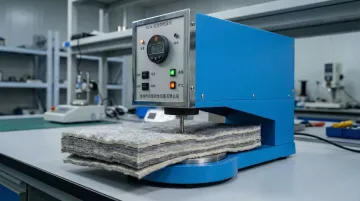
A validated experiment demonstrates M-Ray's capability at the extreme end of the measurement range. A stack of various-coloured synthetic nonwovens totalling 47 mm in thickness and 9.6 kg/m² basis weight was placed between the transmit and receive antennas of an M-Ray system.
Why this test matters: a beta gauge with Sr-90 has a validated upper limit of approximately 5 kg/m², meaning this material would be unmeasurable with standard beta equipment.
During a 40-second window, a sheet of regular copy paper was repeatedly inserted and removed from the measurement gap whilst the nonwoven stack remained in place. The M-Ray sensor accurately detected the paper's grammage each time without distortion, demonstrating sensitivity and responsiveness even at extreme standoff distances and very high basis weights.
Who Should Consider M-Ray Over Beta?
Manufacturers of thick nonwovens, geotextiles, or coated industrial fabrics operating near the limits of beta gauge capability will find M-Ray a practical alternative. It also suits facilities looking to remove nuclear compliance overhead entirely. Hammer-IMS M-Ray systems are commercially validated for these applications. To discuss your specific measurement requirements, contact Hammer-IMS for a technical consultation.
Conclusion
Beta gauges remain the high-precision standard for thin, lightweight materials in regulated environments where nuclear infrastructure already exists. M-Ray technology covers thick, heavy, and multi-head-scanned materials that beta gauges cannot handle—and does so without any radioactive source.
For manufacturers evaluating new lines or modernising existing measurement infrastructure, the choice comes down to three factors:
- Material range — what thickness and weight your process actually demands
- Regulatory cost tolerance — licensing, compliance, and source-disposal overhead for nuclear systems
- Coverage requirements — single-point scanning versus full cross-web profiling
As production scales and regulatory scrutiny grows, non-nuclear alternatives carry a clear lifecycle cost advantage for all but the most precision-critical thin-film applications.
Frequently Asked Questions
What is a beta gauge?
A beta gauge is an inline, non-contact measurement device that uses beta particles emitted from a radioactive isotope to measure material thickness or basis weight by detecting radiation absorption. The more radiation a material absorbs, the greater its grammage.
Is beta a type of radiation?
Yes, beta radiation consists of high-energy electrons emitted from unstable radioactive isotopes. In industrial gauging, this radiation is harnessed from controlled sources like Krypton-85 or Strontium-90 to measure material properties without physical contact.
What's better, beta or gamma?
Gamma is higher-energy than beta and penetrates thicker, denser materials, making it useful for heavy substrates, though it involves stricter regulatory controls. Beta suits thin, uniform materials where lower energy and higher sensitivity are advantageous. The better choice depends on material type and basis-weight range.
What are the three types of gauges?
In industrial web and sheet measurement, the three most common gauge types are beta (radioactive absorption-based), x-ray (electrically generated radiation, transmission-based), and non-nuclear options such as M-Ray (millimeter-wave radar-based). Each is suited to different material types and regulatory environments.
Can M-Ray technology replace beta gauges?
M-Ray can fully replace beta gauges in applications involving thick or heavy materials, wide standoff requirements, or where nuclear licensing is a constraint. For ultra-thin materials requiring sub-0.1 gsm precision, beta gauges retain a precision advantage — though M-Ray continues to close that gap.
What industries benefit most from M-Ray measurement systems?
Technical textiles, nonwovens, coated and laminated fabrics, foam producers, and automotive acoustics manufacturers benefit most, particularly where materials exceed 1 mm in thickness or where full-width, multi-head coverage is needed across wide production webs.