What is the 4-point system in fabric inspection?
The 4-point system is a standardized fabric inspection method that assigns penalty points based on defect size: 1 point for defects up to 3 inches, 2 points for 3-6 inches, 3 points for 6-9 inches, and 4 points for defects over 9 inches or holes. Hammer-IMS's automated systems enhance this traditional approach by providing continuous, contactless monitoring that detects anomalies in real-time, eliminating human subjectivity and ensuring consistent quality assessment across entire production runs.
What are the different types of textile testing?
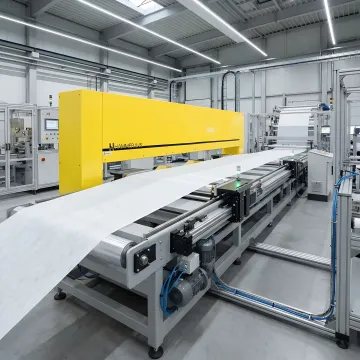
Textile testing encompasses physical tests (strength, durability, dimensional stability), chemical tests (pH, colorfastness, fiber content), and performance tests (water resistance, breathability, thermal properties). Hammer-IMS specializes in non-destructive physical testing through automated inspection systems that measure thickness, basis weight, and structural uniformity using contactless M-Ray technology, providing real-time data without damaging the material or interrupting production.
What are the three main types of nonwoven fabric?
The three main types of nonwoven fabrics are spunbond (thermally bonded continuous filaments), meltblown (ultra-fine fibers created through high-velocity air), and needlepunch (mechanically entangled fibers). Hammer-IMS's automated inspection systems accommodate all nonwoven types, providing precise thickness and basis weight measurements regardless of production method, fiber composition, or material density, with sensors that maintain accuracy for any color or filling material.
How does automated inspection reduce material waste in textile production?
Automated inspection systems provide real-time thickness and basis weight measurements that enable immediate production adjustments, preventing the manufacture of off-specification material. Hammer-IMS's M-Ray technology detects deviations with minimal latency, allowing operators to correct process parameters instantly. This closed-loop control reduces over-application of coatings, minimizes off-spec production runs, and optimizes material usage, typically enabling thickness margin reductions of up to 5%.
Are automated textile inspection systems safe for continuous operation?
Yes, Hammer-IMS's automated inspection systems use non-nuclear M-Ray technology—electromagnetic waves similar to those in cell phones—making them entirely safe for continuous 24/7 operation. Unlike traditional radioactive measurement systems, our clean technology requires no special licensing, poses no health risks to personnel, and enables unrestricted access to production areas while maintaining precise measurement accuracy.
Can automated inspection systems integrate with existing production lines?
Absolutely. Hammer-IMS offers both turnkey installations for new production lines and upgrade solutions for existing equipment. Our systems feature flexible mounting options, customizable sensor configurations, and comprehensive API interfaces that integrate with your current control systems. The Connectivity 3.0 software provides real-time data logging, analytics integration, and remote monitoring capabilities that complement your existing Industry 4.0 infrastructure.
What measurement accuracy can I expect for coated textile inspection?
Hammer-IMS's M-Ray technology delivers sub-millimeter accuracy for thickness measurements and precise basis weight detection across materials ranging from lightweight nonwovens to heavily coated technical textiles up to 30 centimeters thick. Multi-sensor platforms provide comprehensive cross-machine coverage that detects local deviations corresponding to individual process variables, ensuring uniform quality across the entire fabric width with measurement rates up to several kHz.
How quickly can an automated inspection system be installed and operational?
Installation timelines vary based on system complexity and integration requirements, but Hammer-IMS's turnkey solutions are designed for efficient deployment. Our experienced team handles everything from initial assessment and system design to installation, calibration, and operator training. Most installations are completed within weeks, with minimal production disruption. We also offer OEM modules for integrators who prefer to incorporate measurement capabilities into their own equipment designs.