Manufacturers today face unprecedented pressure to maintain top-quality standards while coping with labor shortages, rising production costs, and increasingly complex products.
A 2025 industry report shows that 95% of manufacturers plan to use AI and machine learning to enhance product quality within the next five years, signaling a major shift toward automated inspection.
Automated quality inspection systems, powered by machine vision, AI, robotics, and real-time metrology, are rapidly becoming essential tools in modern manufacturing. They detect defects faster and more reliably than human inspectors, reduce scrap and rework, and help companies comply with stringent regulatory standards.
In this guide, we’ll explore what automated quality inspection systems are, why they’re critical today, how they operate, where they’re applied, and the tangible benefits and challenges manufacturers face when implementing them.
Key Takeaways
AI, machine vision, and robotics enable faster, more accurate inspections, addressing labor shortages and rising product complexity.
Combines 2D/3D vision, AI/deep learning, optical scanning, robotics, and edge/cloud analytics for real-time defect detection.
Automotive, aerospace, electronics, medical devices, food, and general manufacturing see higher throughput, reduced scrap, and better regulatory compliance.
Cuts labor costs, scrap, and rework while lowering the cost of poor quality (COPQ); ROI is typically achievable within 1–2 years by tracking KPIs like detection accuracy and throughput.
Requires clear objectives, feasibility assessment, pilot testing, integration planning, workforce training, and continuous optimization for consistent performance.
Why Manufacturers Are Adopting Automated Inspection?
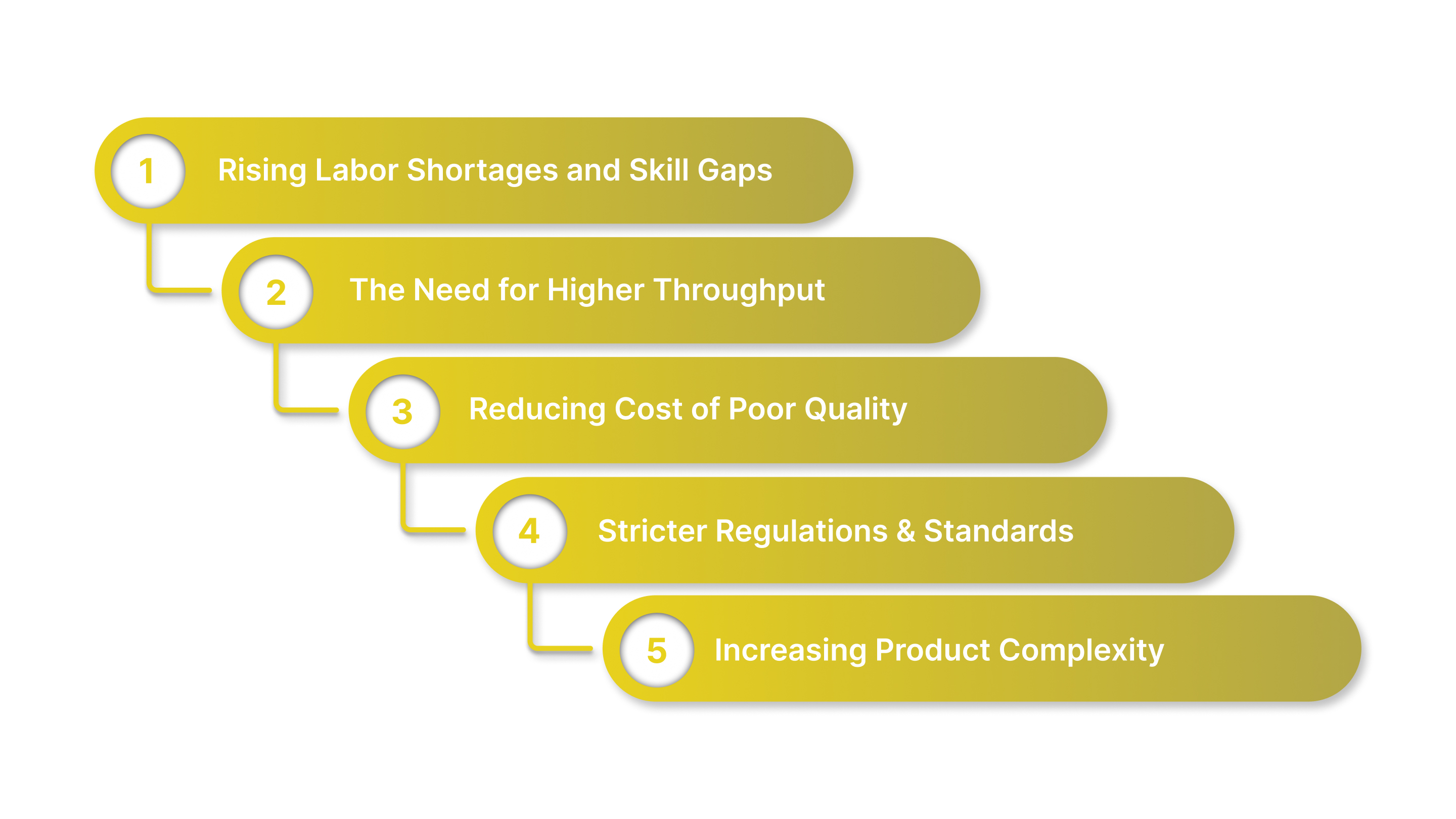
Manufacturers are accelerating their shift toward automated quality inspection as they face a combination of rising costs, growing product complexity, and increasing regulatory scrutiny. The push is about maintaining competitiveness in a reshoring-driven, digitally connected manufacturing arena.
1. Rising Labor Shortages and Skill Gaps
The U.S. manufacturing sector continues to experience a persistent labor shortage. As of mid-2025, there were over 415,000 open manufacturing jobs nationwide, a clear indicator that skilled quality inspectors and other production-line roles are becoming harder to fill.
Automated inspection fills these gaps by providing consistent, 24/7 inspection capability without depending on specialized labor.
2. The Need for Higher Throughput
Demand for faster production cycles is growing across industries like automotive, aerospace, and electronics. Automated systems can inspect parts at speeds impossible for human inspectors, helping companies meet delivery commitments while reducing bottlenecks on the production line.
3. Pressure to Reduce the Cost of Poor Quality (COPQ)
Scrap, rework, recalls, and warranty claims significantly impact the bottom line. Automated systems detect defects earlier in the process, sometimes in real time, lowering COPQ and preventing expensive downstream failures.
4. Tighter U.S. Regulatory and Industry Standards
Compliance with standards such as AS9100 (aerospace), FDA 21 CFR (medical devices), and IATF 16949 (automotive) is pushing manufacturers to adopt more reliable and traceable inspection methods. Automated systems offer consistent measurement, digital recordkeeping, and full traceability, all critical for compliance audits.
5. Increasing Product Complexity
Newer components, especially in sectors like EV batteries, microelectronics, and advanced composites, are too complex for traditional manual inspection. Automated and AI-driven systems can detect microscopic defects, surface inconsistencies, and dimensional variations that human inspectors simply cannot.
Core Technologies Behind Automated Inspection
Automated inspection systems rely on a combination of advanced imaging, sensing, and computational technologies to detect defects with speed and accuracy that far exceed manual inspection. These core technologies form the foundation of modern quality assurance in U.S. manufacturing.
1. Machine Vision Systems
Machine vision is the backbone of most automated inspection setups. It captures images of parts or surfaces and analyzes them for defects, alignment issues, or dimensional deviations.
Key Components:
2D Vision: Used for presence/absence checks, label verification, and basic surface inspections.
3D Vision: Uses laser triangulation, stereoscopic cameras, or structured light to capture depth and geometry. Essential for measuring contours, heights, warpage, or complex shapes.
High-Speed Cameras: Capture thousands of frames per second for fast-moving production lines.
Multispectral & Hyperspectral Imaging: Detects chemical residues, coatings, or material inconsistencies invisible to human eyes.
Industries: Electronics inspection, packaging, automotive components, and metal parts.
2. Artificial Intelligence & Deep Learning
AI has revolutionized automated inspection by enabling systems to recognize subtle or unpredictable defects that traditional rule-based algorithms miss.
AI Capabilities:
Deep Learning Models: Classify images and improve detection accuracy over time.
Defect Detection: Identifies unusual patterns when no clear defect rules exist, ideal for variable natural materials or unpredictable surfaces.
Adaptive Learning: Systems retrain automatically as new defect types appear, reducing downtime and false rejects.
Industries: Weld inspection, surface finish evaluation, semiconductor defects, and complex assemblies.
3. Optical Scanning & Advanced Sensor Technologies
Beyond standard cameras, advanced optical sensors add precision and dimensional accuracy critical for high-performance manufacturing.
Common Technologies:
Laser Triangulation Sensors: Precisely measure surface height, flatness, and profile.
Structured Light Scanners: Project patterns onto a surface and analyze distortions to build 3D models.
Confocal Microscopy: Enables micron-level inspection for microelectronics and medical devices.
Infrared (IR) and Ultraviolet (UV) Imaging: Material defects, coatings, and contamination.
Industries: Aerospace composites, medical implants, turbine blades, battery cells.
4. Robotics & Automation Systems
Robots expand the reach and consistency of automated inspection by positioning sensors in ways that humans cannot.
Robotic Inspection Types:
Robot-Guided Vision Systems: Cameras or sensors are mounted on robotic arms for dynamic inspection of complex geometries.
Collaborative Robots (Cobots): Safe for human interaction, ideal for hybrid lines requiring assisted inspection.
Automated Handling & Sorting: Robots remove defective parts and optimize flow through inspection stations.
Industries: Automotive interiors, painted surfaces, and large structural components.
5. Data Processing, Analytics & Edge Computing
Automated inspection technologies generate large volumes of data, requiring fast and intelligent processing.
Capabilities:
Edge AI Processors: Analyze images in real time directly on the machine, reducing latency.
Cloud-Based Analytics: Aggregate inspection data across facilities to identify trends or recurring defects.
Digital Twins: Simulate inspection scenarios and optimize detection algorithms before deployment.
Industries: Enterprise-scale quality monitoring, multi-plant operations, predictive quality systems.
Key Applications Across Industries
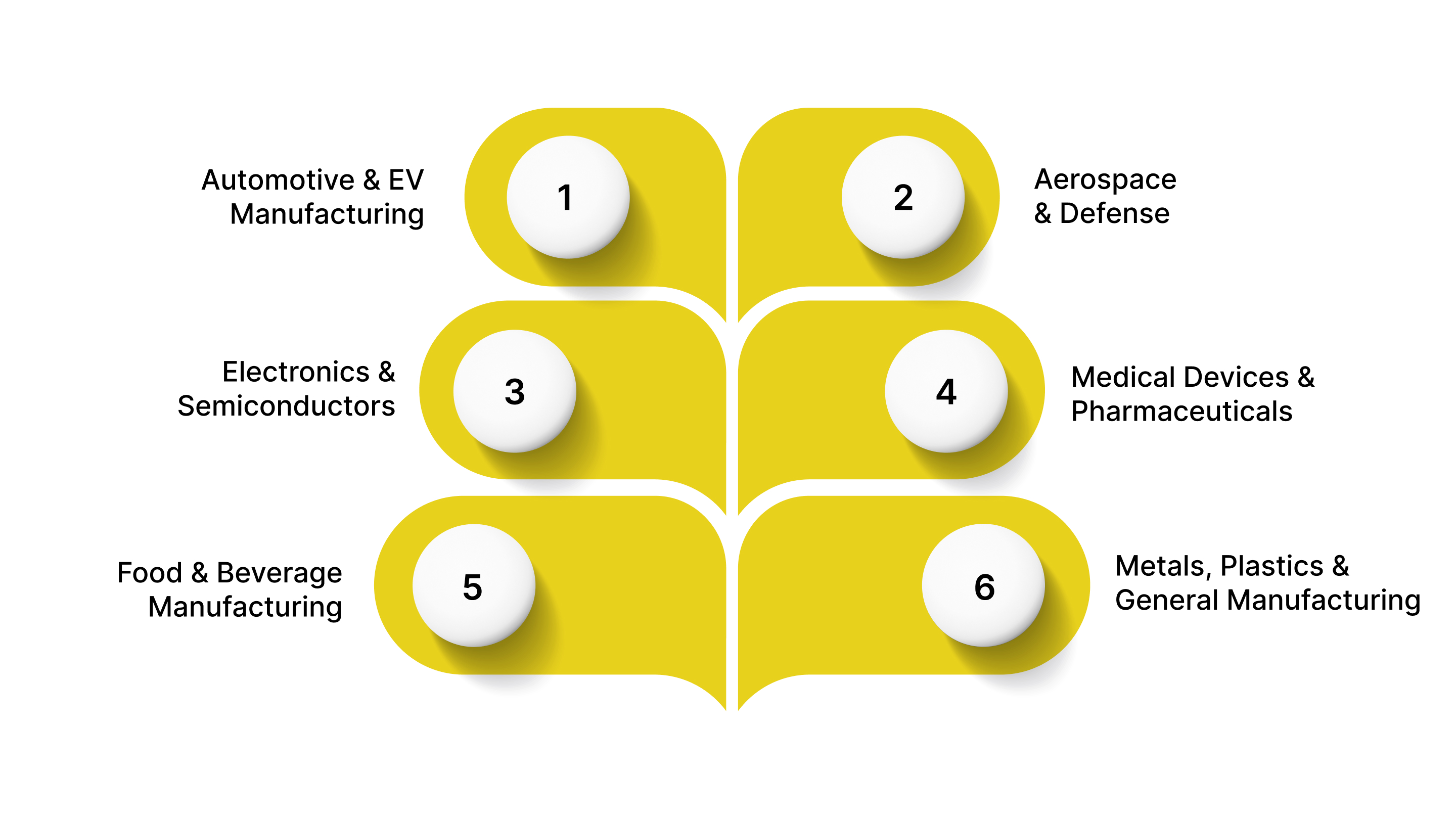
Automated quality inspection systems are now embedded across nearly every major manufacturing sector. Below are the industries where automated inspection delivers the highest impact.
1. Automotive & Electric Vehicle (EV) Manufacturing
The automotive and EV sectors increasingly rely on automated inspection to keep up with high-volume production and strict safety requirements.
Common Applications:
Surface defect detection for body panels, paint, and interiors
Battery pack inspection, including weld integrity and cell alignment
Dimensional checks for structural components, gears, and injection-molded parts
Vision-guided robotic inspection for assembly validation
Impact: Higher production throughput, reduced recalls, and more reliable EV battery quality.
2. Aerospace & Defense
Aerospace manufacturers must meet some of the toughest quality standards in the world, making automated inspection indispensable.
Common Applications:
Composite material inspection to detect voids, cracks, and fiber misalignment
Precision component measurement for turbine blades, engine parts, and landing gear
Non-destructive testing (NDT) using optical and laser systems
Surface integrity monitoring for critical flight components
Impact: Improved reliability, enhanced traceability, and faster certification cycles.
3. Electronics & Semiconductor Manufacturing
As semiconductor nodes shrink and circuit density increases, manual inspection is no longer viable.
Common Applications:
PCB inspection (solder joints, missing components, polarity)
Wafer and die inspection for microcracks, contamination, and pattern defects
Automated Optical Inspection (AOI) for SMT lines
3D metrology for micro-features and packaging
Impact: Higher yields, lower scrap rates, and stronger process reliability.
4. Medical Devices & Pharmaceuticals
Regulated industries rely heavily on automated inspection to meet stringent FDA requirements.
Common Applications:
Surface and dimensional inspection of implants, instruments, and plastic components
Packaging validation (seals, labels, lot/batch codes, tamper evidence)
Particulate and contamination detection in sterile environments
Automated fill-volume and dose verification for pharmaceuticals
Impact: Reduced compliance risk, full traceability, and improved patient safety.
5. Food & Beverage Manufacturing
Automated vision systems help ensure consumer safety and consistent packaging quality.
Common Applications:
Foreign object detection (optical, X-ray, IR methods)
Label and barcode verification
Seal inspection for bottles, pouches, and cans
Fill-level inspection for beverages and liquids
Impact: Fewer recalls, consistent product presentation, and better regulatory compliance.
6. Metals, Plastics & General Manufacturing
High-precision industries use automated inspection for repetitive, complex, and high-tolerance tasks.
Common Applications:
Surface defect detection for cast, machined, or forged components
Dimensional metrology for high-tolerance parts
Injection molding defect inspection (warpage, sink marks, flash)
Weld inspection for structural components
Impact: Better yield, optimized tooling, and reduced production waste.
Types of Automated Quality Inspection Systems
Automated inspection systems come in several forms, each designed to detect specific types of defects, collect dimensional data, or verify product conformity at various stages of production. The right system depends on product geometry, material type, line speed, and required precision.
Type of System | Key Capabilities | What It Detects | Best-Use Industries |
|---|---|---|---|
Automated Optical Inspection (AOI) | High-resolution cameras, controlled lighting | Surface defects, misalignment, missing components, labeling issues, and solder defects | Electronics, packaging, molded parts, consumer goods |
3D Inspection Systems | Laser triangulation, structured light, and stereo vision | Warpage, deformation, height, volume, assembly gaps | Automotive assemblies, aerospace components, EV battery modules, precision machining |
Machine Vision Inspection | 2D/3D cameras, image processing algorithms | Feature recognition, orientation, presence/absence, color, pattern matching | High-speed lines, packaging, consumer goods, robotics integration |
AI-Driven / Deep Learning Inspection | Deep learning, adaptive learning | Subtle, variable, unpredictable defects, texture variations | Welds, textured surfaces, natural materials, complex assemblies |
Laser & Optical Metrology | Laser scanners, interferometry, and confocal microscopy | High-precision dimensional measurement, surface flatness, and microfeatures | Aerospace, medical devices, microfabrication, and semiconductor measurement |
X-Ray & CT Inspection | X-ray imaging, computed tomography | Internal cracks, porosity, voids, hidden components | Castings, batteries, electronics, medical devices |
Infrared (IR) & Thermal Inspection | Thermal cameras, IR imaging | Heat patterns, delamination, electrical shorts, overheating | Electronics, EV batteries, composites |
Robotic Inspection Systems | Robot-mounted sensors, cobots, automated handling | Dynamic positioning, complex geometries, and sorting of defective parts | Automotive, aerospace, heavy equipment, and large structural parts |
Inline vs. Offline Inspection | Placement in production workflow | Inline: real-time defects, immediate correction; Offline: detailed metrology | Inline: high-speed manufacturing, electronics, packaging Offline: aerospace, medical device validation, tooling |
Benefits of Automated Quality Inspection
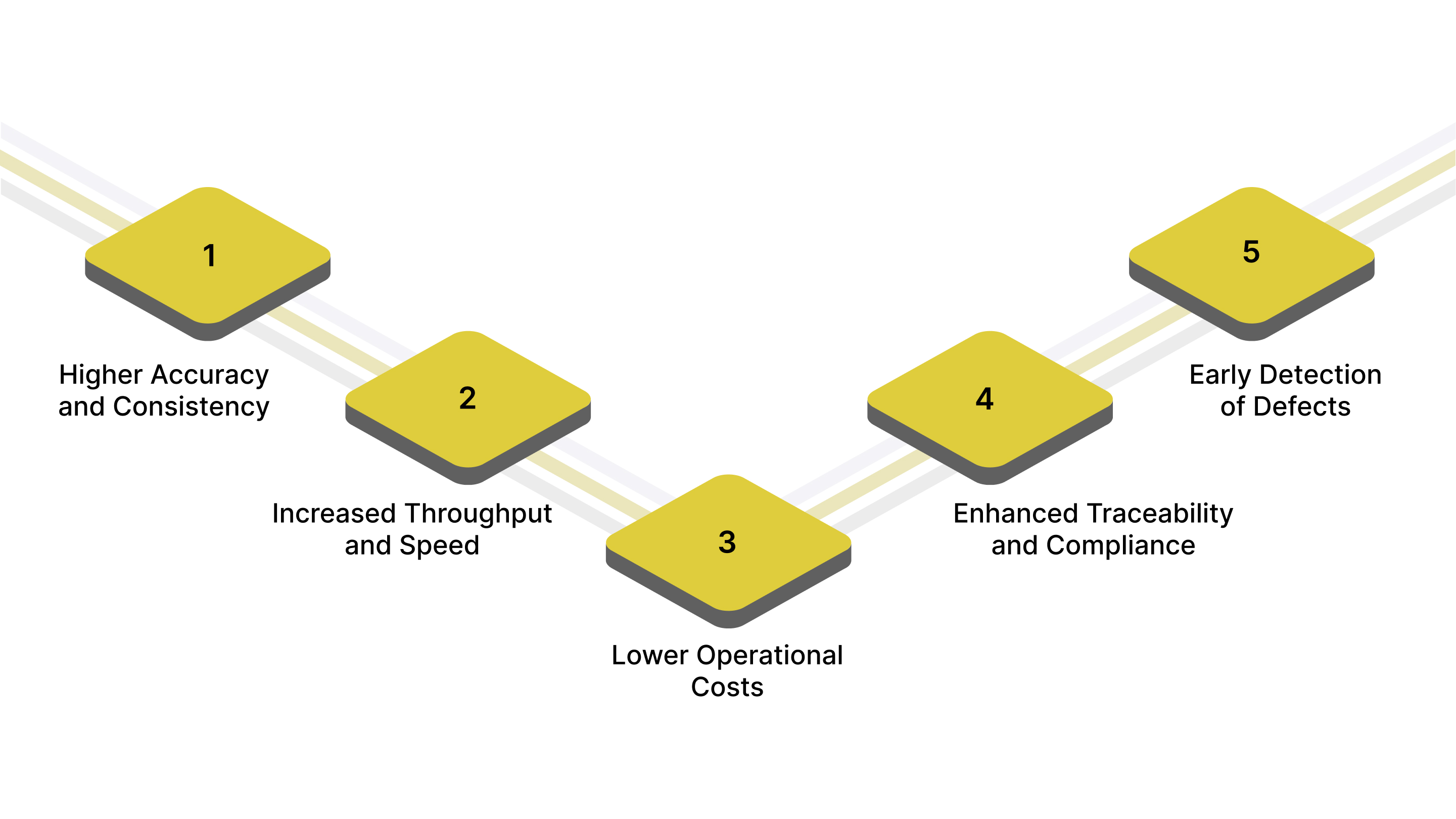
Automated quality inspection systems deliver measurable advantages across productivity, accuracy, cost control, and compliance, such as:
Higher Accuracy and Consistency: Delivers precise, repeatable, objective inspections without human fatigue, reducing errors, improving reliability, and ensuring consistent product quality across all manufacturing shifts.
Increased Throughput and Speed: Inspects products at high line speeds, eliminates manual bottlenecks, accelerates production cycles, and enables real-time quality checks without slowing operations.
Lower Operational Costs: Reduces labor needs, prevents scrap and rework, minimizes recalls, and lowers downtime by catching defects early and stabilizing overall production efficiency.
Enhanced Traceability and Compliance: Automatically records inspection data, supports regulatory compliance, streamlines audits, and provides full traceability across batches, processes, and multi-plant manufacturing environments.
Early Detection of Defects: Identifies defects immediately, prevents defective parts from moving downstream, reduces waste, and improves yield through timely, continuous, and automated quality monitoring.
Challenges & Limitations
Despite their advantages, automated quality inspection systems come with practical challenges that manufacturers must address to ensure smooth adoption and long-term reliability.
High Initial Investment: Automated inspection systems require substantial upfront spending on hardware, software, integration, and training, which can strain smaller manufacturers’ budgets.
Integration Complexity: Connecting new inspection systems with legacy equipment, MES, and ERP platforms can be technically challenging and time-consuming for manufacturers.
False Positives & Over-Detection: Highly sensitive systems may flag acceptable variations as defects, creating unnecessary rework and slowing production lines if not properly calibrated.
Maintenance & Calibration Needs: Cameras, sensors, and lighting require regular upkeep, calibration, and updates to maintain accuracy and reliability in demanding factory environments.
Data Management Overload: High-volume image and sensor data can overwhelm storage and analytics capabilities, requiring strong data pipelines and edge computing solutions.
How to Implement an Automated Inspection System?
Successful implementation requires a strategic, phased approach that ensures the system integrates smoothly with existing operations and delivers measurable quality improvements.
1. Define Objectives and Inspection Requirements
The first step is to clearly articulate what the system needs to achieve. Without well-defined goals, manufacturers often struggle with over-engineered or misaligned solutions.
Key actions:
Identify the exact defect types the system must detect (surface flaws, dimensional issues, assembly errors).
Set measurable targets for detection accuracy, false-reject rate, and inspection speed.
Determine which product lines or stations will be included in the first rollout.
Document reporting needs: pass/fail signals, images, traceability logs, and quality analytics.
Output: A requirements specification guiding vendor evaluation and system design.
2. Conduct a Feasibility & Line Assessment
Before selecting technology, evaluate real production conditions. Environmental factors often determine whether optical, 3D, or AI-based systems will perform reliably.
Assess the following:
Lighting conditions, part reflectivity, vibration, and available mounting space.
Current defect baseline (scrap, rework, customer returns).
Cycle-time constraints and system latency limits.
Sample part and image collection under real operating conditions.
Why this matters: Feasibility findings prevent purchasing a system that works in a demo lab but fails on the factory floor.
3. Select the Technology Stack
Choosing the right combination of cameras, lighting, sensors, AI models, and integration software is critical. Systems must match both inspection needs and future scalability.
Consider factors such as:
Imaging type: 2D vision, 3D metrology, hyperspectral, X-ray, thermal.
AI/ML capability: Ability to detect subtle, variable defects.
Integration: Compatibility with PLCs, robotic systems, MES/ERP.
Environmental robustness: IP ratings, temperature tolerance, dust resistance.
Tip: Always test vendors using your sample parts under your lighting—not stock demo images.
4. Develop System Architecture & Integration Plan
Once technology is selected, engineers and integrators design how everything will work together. This includes both physical layout and digital connections.
System design must define:
Camera/lens placement, illumination angle, and sensor triggers.
Data flows across edge devices, servers, dashboards, and traceability systems.
Reject mechanisms (pneumatic pushers, robotic sorting, conveyors).
Model update and version control workflows.
Outcome: A documented architecture minimizing rework at installation.
5. Build and Test a Pilot (POC)
A pilot is essential to validate accuracy, repeatability, and throughput. It should run on a real production line with actual variability.
Pilot steps:
Install a small-scale version on one station or SKU.
Capture images and label defects to train/tune AI models.
Run extended trials to observe false positives/negatives.
Stress-test the system during line speed fluctuations and shift changes.
Deliverables:
Pilot performance report (accuracy, cycle time, uptime).
Insights for refining lighting, optics, or model thresholds.
6. Validate Performance & Finalize Acceptance Criteria
Before scaling the system, performance must be formally validated against the original goals.
Validation typically includes:
Measuring accuracy against a statistically valid sample size.
Testing the system with rare, edge-case defects.
Confirming seamless data logging and traceability integration.
Ensuring operators can easily interpret results and alerts.
7. Rollout Planning & Workforce Training
A successful rollout requires structured change management. Operators and maintenance teams must understand how the system works and how to interpret results.
Training should cover:
System operation and daily start-up/shutdown procedures.
Lighting and lens cleaning routines.
Reject handling and corrective action workflows.
Troubleshooting steps and when to escalate issues.
Rollout plan: Expand line by line or product by product, ensuring lessons learned from the pilot are applied.
8. Full Deployment & Systems Integration
Deploying the system at scale involves both hardware installation and synchronized software integration.
Integration priorities:
Linking inspection results to MES/ERP for real-time traceability.
Enabling automated triggers (reject bins, alarms, line stops).
Setting up dashboards for quality trends, defect heatmaps, and operator alerts.
Implementing cybersecurity and backup measures for image and model data.
Key metric: System uptime and continuity during shifts.
9. Monitor, Optimize, and Continuously Improve
Automated inspection systems are not “set and forget.” They require ongoing monitoring and optimization to maintain accuracy.
Continuous improvement actions:
Retrain AI models as new defect types emerge.
Recalibrate sensors and lights periodically.
Analyze inspection data for root-cause insights.
Audit performance monthly or quarterly.
Goal: Improve defect detection while reducing false alarms and quality escapes.
10. Maintain Governance & Scale Across Sites
As inspection systems grow across lines or facilities, governance ensures consistency and standardization.
The governance framework includes:
Standard operating procedures (SOPs).
Model version control and approval workflows.
Preventive maintenance schedules.
Cybersecurity and data retention policies.
Scaling: Replicate proven configurations to new lines while adjusting only for product-specific variations.
ROI, Cost, and Performance Metrics
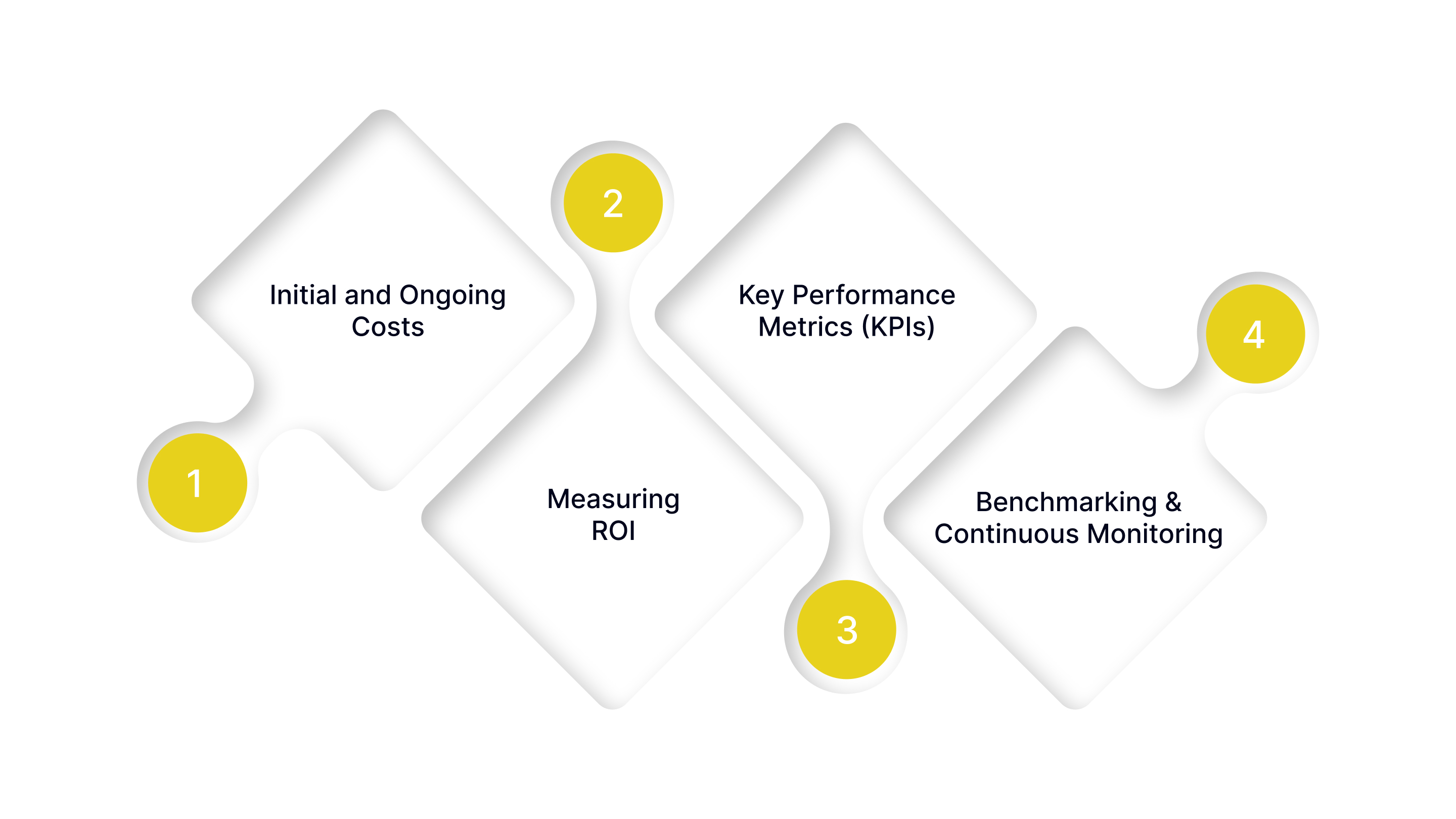
Investing in an automated quality inspection system can be significant, but the long-term returns often justify the upfront costs. Understanding ROI, cost components, and performance metrics helps manufacturers make informed decisions, align expectations, and quantify benefits.
1. Initial and Ongoing Costs
Automated inspection involves both capital and operational expenses. A clear breakdown helps assess feasibility and plan budgets.
Key cost components:
Hardware Costs: Cameras, sensors, lighting systems, robotic arms, and enclosures.
Software Costs: AI models, analytics platforms, visualization dashboards, and system licenses.
Integration Costs: MES/ERP connectivity, PLC/line integration, and vendor installation services.
Training & Workforce Costs: Operator, engineer, and maintenance staff training.
Maintenance & Calibration: Routine sensor calibration, lighting replacement, and software updates.
Scalability & Upgrades: Expansion to additional lines, AI retraining, or advanced analytics modules.
2. Measuring ROI
ROI can be measured by both tangible and intangible benefits.
Tangible ROI drivers:
Reduced Scrap and Rework: Fewer defective products lower material waste and labor costs.
Lower Labor Costs: Fewer manual inspectors required; staff can focus on higher-value tasks.
Reduced Warranty & Recall Costs: Early defect detection prevents costly downstream failures.
Faster Throughput: Increased line speed enables higher output without additional labor or equipment.
Intangible ROI drivers:
Improved customer satisfaction and brand reputation.
Enhanced regulatory compliance and audit readiness.
Better process insights leading to continuous improvement.
3. Key Performance Metrics (KPIs)
To ensure the system delivers expected value, track metrics across accuracy, efficiency, and cost reduction.
Accuracy Metrics:
Detection Accuracy (%) = Defects detected ÷ Total actual defects × 100
False Reject Rate (%) = Acceptable units flagged as defective ÷ Total inspected × 100
False Accept Rate (%) = Defective units missed ÷ Total inspected × 100
Efficiency Metrics:
Throughput (units/hour): Number of parts inspected per hour.
Cycle Time Reduction: Comparison of pre- vs. post-automation inspection time.
Downtime Impact: Number of stoppages caused by inspection or false alarms.
Cost & Savings Metrics:
Cost per Inspection: Total operational cost ÷ units inspected.
Scrap & Rework Savings: Value of material saved by early defect detection.
Labor Savings: Reduction in hours spent on manual inspection tasks.
4. Benchmarking and Continuous Monitoring
Regular KPI tracking ensures long-term ROI and system optimization.
Compare KPIs against baseline pre-automation metrics.
Monitor trends to identify recurring defects and optimize upstream processes.
Evaluate system utilization, maintenance intervals, and downtime to refine cost-effectiveness.
Incorporate predictive analytics for proactive decision-making and continual improvement.
Hammer‑IMS: A Modern Example of Inline Quality Inspection in Action
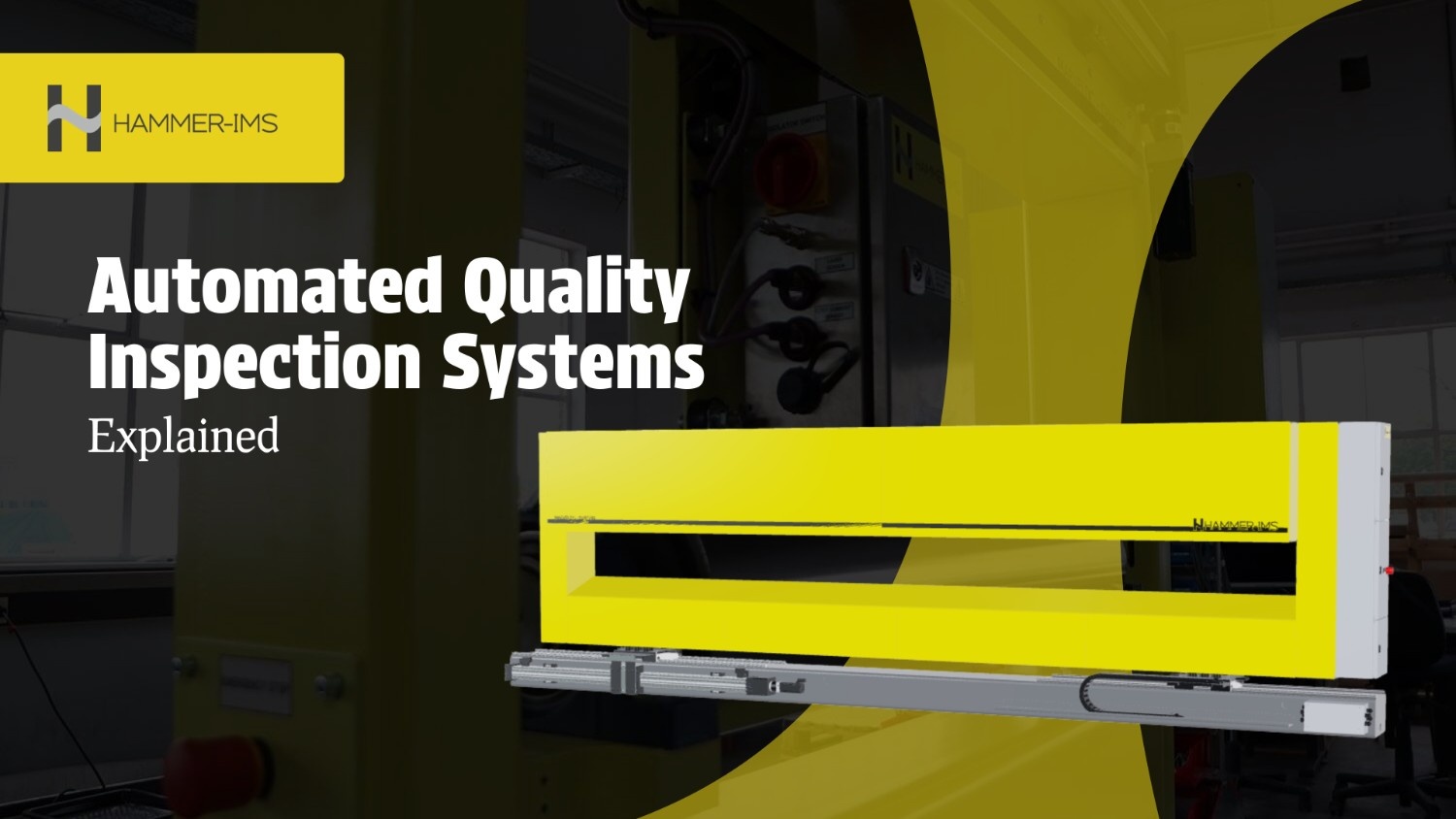
If you’re looking to explore real-world automated inspection solutions, Hammer‑IMS offers a compelling example. Their systems harness advanced technologies to deliver high-precision, inline quality control across materials like plastics, textiles, nonwovens, battery films, and coated sheets.
Radiation-Free Measurement: Their proprietary “M‑Ray” technology eliminates the need for radioactive sources or hazardous emissions, offering a safer alternative for production environments.
Versatile Material Coverage: Whether you’re producing plastic films, non-wovens, coated fabrics, mineral wool, or battery separator films, their sensors and inspection systems adapt to a broad spectrum of materials and thicknesses.
Real-Time, Inline Inspection: Hammer‑IMS’s systems integrate directly into production lines, delivering continuous measurement of basis-weight, thickness and other key quality parameters.
Customizable & Scalable Solutions: Their offering spans modular configurations (fixed sensors or moving‑sensor “curtain” systems), enabling adaptation to different production volumes, product sizes, and line speeds.
If you’re evaluating automated inspection for your facility, especially for complex materials or high-speed production, Hammer‑IMS’s approach illustrates how modern inspection systems combine precision, sustainability, and flexibility. Book a demo today to get started.
Conclusion
Automated quality inspection systems are transforming manufacturing by delivering unmatched accuracy, speed, and consistency while addressing labor shortages and skill gaps.
By integrating machine vision, AI, robotics, and advanced sensing technologies, manufacturers can detect defects early, reduce scrap, and maintain regulatory compliance.
Although implementation requires careful planning, investment, and ongoing maintenance, the long-term ROI, through cost savings, higher throughput, and improved product quality, is significant.
As industries such as automotive, aerospace, electronics, and medical devices continue to evolve, automated inspection will remain a critical tool for achieving operational excellence, traceability, and competitive advantage.
Ready to Elevate Your Manufacturing Quality?
Explore advanced automated inspection solutions today to reduce defects, improve throughput, and ensure compliance. Contact Hammer‑IMS or request a demo now to see how modern inspection systems can transform your production line.
FAQs
1. What industries benefit most from automated inspection besides manufacturing?
Beyond traditional manufacturing, industries such as logistics, packaging, food safety, pharmaceuticals, and electronics assembly also gain efficiency, traceability, and defect reduction through automated inspection.
2. Can small or medium-sized manufacturers implement automated inspection systems?
Yes, modular and entry-level solutions are available, allowing smaller operations to start with limited lines or high-value products and scale gradually.
3. How does automated inspection handle unique or custom parts?
Many systems, especially AI-driven ones, can be trained with images of custom or variable products, enabling accurate inspection without fixed templates.
4. What is the typical lifespan of an automated inspection system?
With proper maintenance, calibration, and software updates, systems can operate effectively for 7–10 years, with AI models updated periodically.
5. How does automated inspection integrate with sustainability goals?
By reducing scrap, rework, and energy use from repeated production runs, automated inspection contributes to waste reduction and resource efficiency.
6. Are automated inspection systems compatible with legacy equipment?
Most modern systems support integration with existing PLCs, conveyors, and MES/ERP systems, though a feasibility study is recommended to ensure compatibility.
7. Can automated inspection detect defects invisible to the human eye?
Yes, advanced imaging, hyperspectral sensors, X-ray, and thermal cameras can detect micro-defects, material inconsistencies, and internal flaws beyond human visual capabilities.