Quality inspection lies at the heart of any manufacturing or production operation. Whether you're producing consumer goods, industrial components, or critical precision parts, ensuring that each item meets your standards and customer expectations can mean the difference between brand trust and costly recalls.
But inspection itself can vary dramatically: from traditional, hands‑on visual and tactile checks by human inspectors, to modern, high‑speed automated inspection using cameras, sensors, AI, and robotics.
A 2025 survey by ETQ found that 49% of manufacturers plan to implement AI in the next two years, while 33% already use it, and only 1% report no plans for AI adoption. Among the intended uses, 45% of respondents said they expect AI to help with defect detection on the factory floor.
That demonstrates a clear and growing industry shift as companies are increasingly turning to automation and AI-driven inspection solutions. This guide aims to help you understand that choice by comparing the strengths, drawbacks, and ideal use‑cases for manual vs. automated quality inspection.
TL;DR:
Manual inspection is highly flexible and ideal for custom, low-volume, or aesthetic products requiring human intuition and subjective evaluation.
Automated inspection delivers unmatched speed, accuracy, and consistency, making it best for high-volume or precision-driven manufacturing lines.
Human inspection faces limitations such as fatigue, inconsistent results, and poor scalability as production demands grow.
Automated systems require higher upfront investment but reduce long-term labor costs and provide advanced traceability, analytics, and real-time insights.
The best inspection strategy depends on product type, defect requirements, production volume, budget, and long-term quality goals, often leading to hybrid approaches.
What is Manual Quality Inspection?
Manual quality inspection refers to the process in which human inspectors evaluate products or components using their senses, experience, and judgment. These checks may involve:
Visual examination
Tactile assessment
Basic measuring tools (calipers, gauges)
Sampling techniques
Manual inspection is still widely used across industries where products have high variability, require subjective evaluation, or involve small-batch production. Common sectors include furniture, textiles, packaging, automotive interiors, and any environment where the inspector’s intuition and adaptability play a crucial role.
Examples of manual inspection tasks include:
Checking surface defects such as scratches, dents, stains, or discoloration
Assessing visual appearance or aesthetic quality (color match, finishing)
Feeling for texture or structural inconsistencies
Measuring parts using analog tools
Identifying irregularities that are difficult to quantify or standardize
Performing spot checks in low-volume or prototype runs
Manual inspection is valued for its flexibility, but it also introduces human variability, fatigue, and potential for oversight.
Advantages of Manual Inspection
Manual inspection continues to play an important role in industries where products require subjective judgment or vary frequently. Some of its core advantages include:
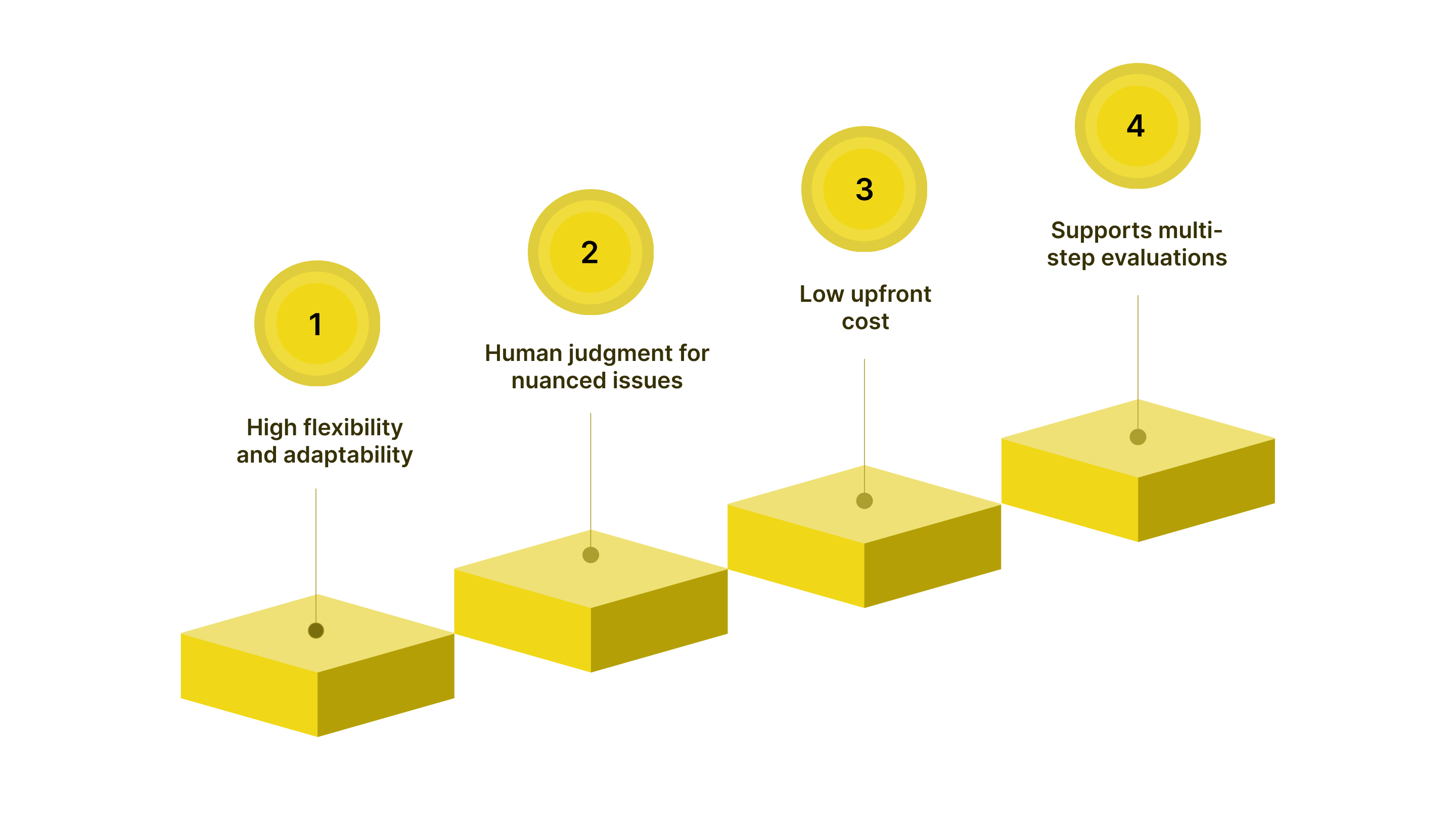
High flexibility and adaptability: Humans can quickly adjust to non-standard, irregular, or unexpected defects without reprogramming or reconfiguring equipment.
Human judgment for nuanced issues: Manual inspectors can assess subtle factors such as texture, feel, overall appearance, and aesthetic elements that machines may struggle to classify.
Low upfront cost: Manual inspection requires minimal investment, making it suitable for small-batch, custom, or low-volume production environments.
Supports multi-step evaluations: Inspectors can easily combine visual checks, tactile assessments, and simple functional tests in one workflow, which is harder to replicate in automated setups.
Drawbacks of Manual Inspection
Despite its strengths, manual inspection carries several inherent limitations that can affect operational efficiency and consistency:
Inconsistency and human error: Fatigue, distractions, and varying skill levels can lead to oversight, incorrect judgments, or inconsistent assessments between inspectors.
Limited speed and poor scalability: Throughput is tied to human capacity, making manual inspection unsuitable for high-volume or fast-paced production lines.
Traceability challenges: Manual logs are often incomplete or inconsistent, making data tracking and root-cause analysis more difficult.
Higher long-term labor costs: As production volume grows, labor requirements increase proportionally, raising total operating costs compared to automation.
What is Automated Quality Inspection?
Automated quality inspection uses machines, sensors, cameras, computer vision, AI/ML algorithms, and robotics to evaluate product quality with speed, consistency, and repeatability.
Instead of human judgment, machine learning models analyze inspection data continuously, adapting to new defect patterns and improving detection accuracy without manual reprogramming.
These systems are commonly deployed in industries requiring high-volume production, tight tolerances, or 100% inspection, such as automotive, pharmaceuticals, semiconductors, packaging, electronics manufacturing, and industrial materials.
Types of automated inspection technologies include:
Camera-based visual inspection systems for pattern, color, or surface defect detection
Laser scanning and 3D profiling for dimensional accuracy
Ultrasonic and infrared sensors to detect internal defects
Robotic inspection stations for standardized, repetitive checks
Sensor-based measurement systems that monitor thickness, density, or material uniformity
AI- and machine-learning–based systems that improve detection accuracy over time
Examples of tasks suited for automation include:
Measuring dimensions and tolerances with high precision
Detecting repetitive or subtle defects that humans may overlook
Performing real-time inspection at high speed on production lines
Classifying products based on visual patterns or defects
Conducting 100% inline inspection without slowing down throughput
Automated inspection delivers consistent quality at scale, making it ideal for manufacturers aiming to reduce waste, improve accuracy, and optimize productivity.
Advantages of Automated Inspection
Automated inspection systems are designed for precision, efficiency, and high-volume environments. Their most significant benefits include:
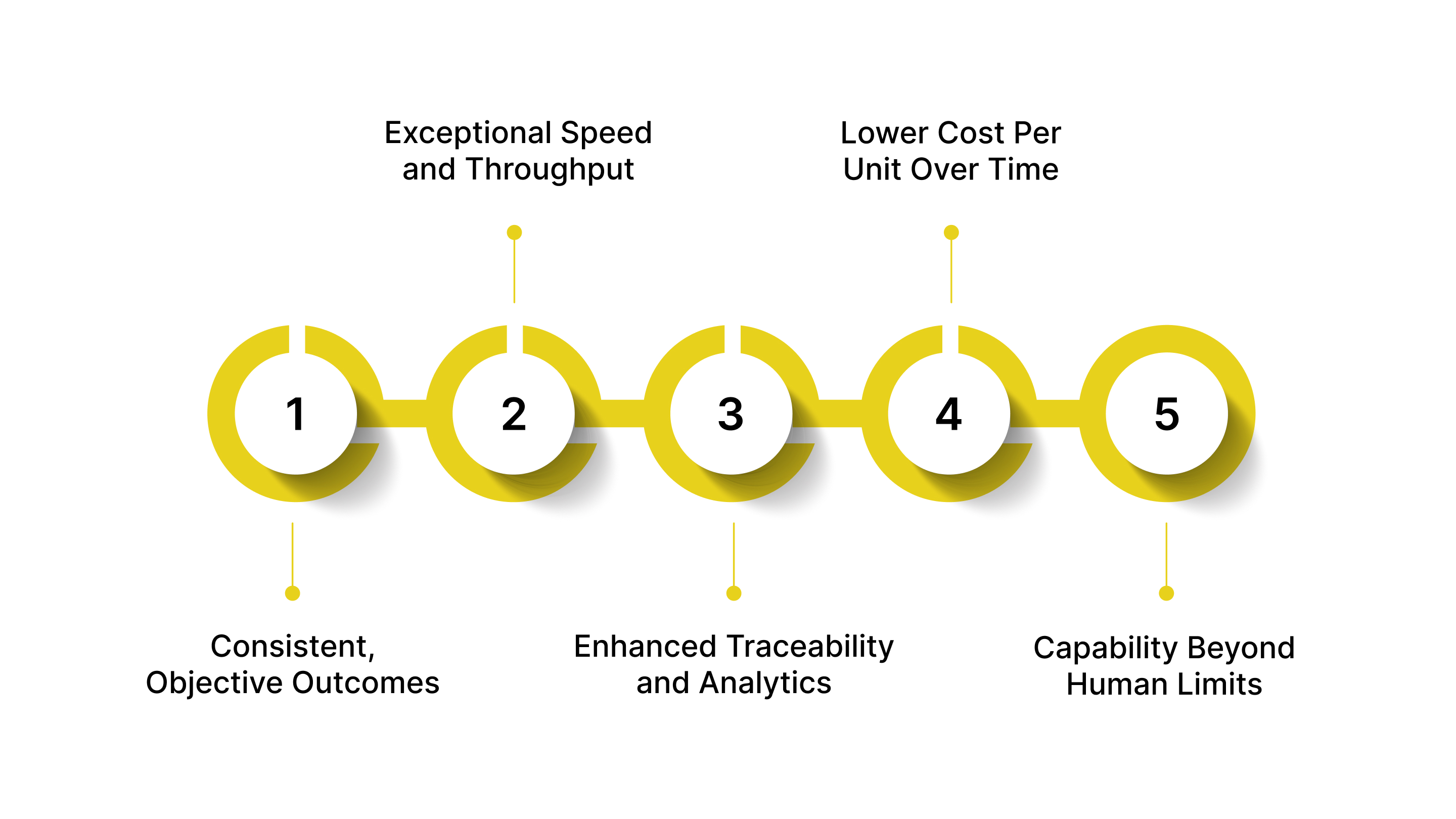
Consistent, objective, and repeatable outcomes: Machines eliminate variability and deliver the same level of accuracy across every inspection cycle.
Exceptional speed and throughput: Automated systems can process parts at line speed, enabling true 100% inspection without slowing production.
Enhanced traceability and analytics: Every measurement and defect can be digitally logged for real-time monitoring, reporting, and long-term quality insights.
Lower cost per unit over time: While initial investment is high, automation reduces labor needs, minimizes rework, and lowers recurring inspection costs.
Capability beyond human limits: Advanced sensors and vision systems can detect micro-defects, measure fine tolerances, and evaluate parameters invisible to the human eye.
Limitations and Challenges of Automated Inspection
Although automation offers strong operational benefits, it also comes with constraints and implementation considerations:
High upfront investment: Equipment costs, integration, calibration, and setup require significant budget and planning.
Reduced flexibility: Automated systems may struggle with irregular, highly variable, or subjective assessments unless reprogrammed or enhanced with AI.
Maintenance and technical expertise required: Systems must be calibrated and serviced regularly, often requiring trained technicians.
Risk of false positives/negatives: Poor calibration, inconsistent lighting, or insufficient training data can affect system accuracy.
Not suitable for every defect type: Aesthetic judgments, texture evaluation, or complex contextual decisions still require human involvement.
Automated vs. Manual Quality Inspection: A Comparison Table
To highlight the key differences between these two approaches, here is a side-by-side comparison of manual and automated quality inspection.
Factor | Manual Quality Inspection | Automated Quality Inspection |
|---|---|---|
Who Performs It | Human inspectors | Machines, sensors, cameras, AI/ML systems |
Consistency & Accuracy | Varies by inspector; prone to fatigue and inconsistency | Highly consistent, repeatable, and objective |
Speed & Throughput | Slower; limited by human capability | Extremely fast; supports 100% inline inspection |
Types of Defects Detected | Good for subjective, aesthetic, or tactile issues | Excellent for measurable, repeatable, surface, and micro-defects |
Best Use-Cases | Low-volume production, prototypes, custom items, aesthetic checks | High-volume production, tight tolerances, consistent product types |
Flexibility | Very flexible; inspectors adapt to new or unusual issues | Less flexible unless reprogrammed or retrained |
Upfront Cost | Low to moderate | High initial investment (equipment + integration) |
Long-Term Cost | High labor costs; requires ongoing staffing | Lower per-unit cost over time; minimal incremental labor |
Human Expertise Required | Skilled inspectors needed; subjective judgment plays a role | Requires trained operators/technicians for setup and maintenance |
Documentation & Traceability | Often manual; may lack detailed data | Strong digital logs, analytics, and traceability |
Error Risks | Human error, fatigue, misinterpretation | False positives/negatives if poorly calibrated or trained |
Scalability | Hard to scale; labor-intensive | Easily scalable; ideal for expanding production lines |
Environmental Sensitivity | Performs well in varied conditions | May require controlled lighting, vibration reduction, or calibration |
Ideal Industries | Furniture, textiles, craft manufacturing, automotive interiors, custom electronics | Automotive, semiconductors, packaging, pharmaceuticals, FMCG, metals, industrial materials |
Critical Comparison Parameters: What to Evaluate When Choosing Between Them
Selecting the right inspection method requires more than comparing technology features. It demands a strategic assessment of operational goals, production volume, cost structure, and quality expectations.
Below are the critical parameters manufacturers should evaluate when deciding between manual and automated inspection.
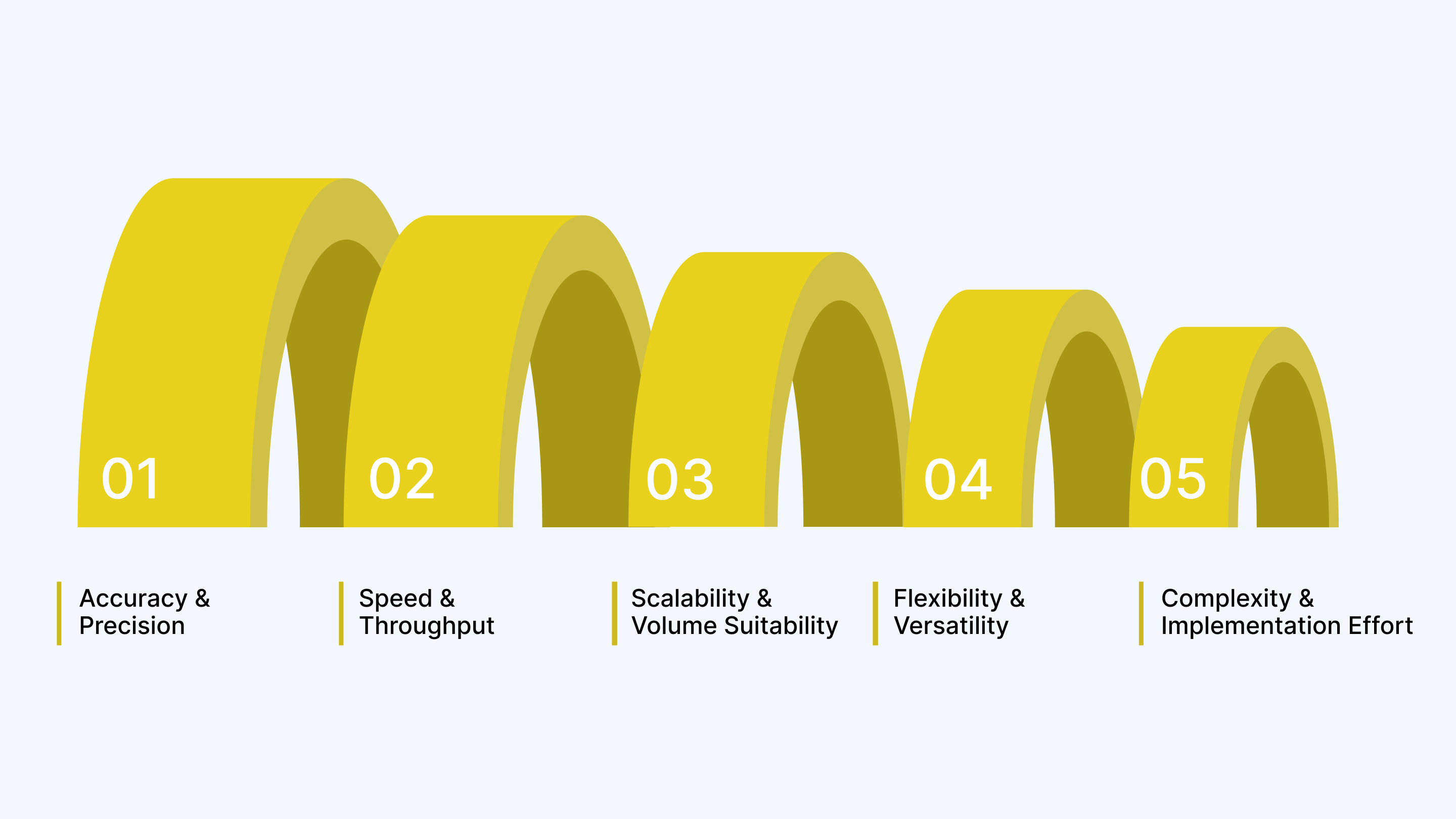
Accuracy & Precision: While skilled operators can identify nuanced or subjective defects, consistency may decline with fatigue or distraction. Automated systems excel in repeatability and precision, delivering stable, objective measurements across every inspected unit.
Speed & Throughput: Manual inspection is inherently limited by human speed and attention span, often creating bottlenecks in high-volume or fast-paced environments.
Automated inspection supports real-time, inline monitoring, significantly reducing cycle time and enabling true 100% inspection without slowing production.Scalability & Volume Suitability: Manual inspection works well for small-batch, prototype, or custom production where flexibility is essential. Automation is ideal for large-scale or continuous production where consistent quality checks must be applied to thousands or millions of units.
Flexibility & Versatility: Humans can quickly adapt to product variation, complex geometries, or unexpected defects without reconfiguration. Automated systems are highly efficient but may require reprogramming, new tooling, or algorithm retraining when product lines change.
Complexity & Implementation Effort: Manual inspection is simple to deploy but relies heavily on consistent training and inspector skill. Automation requires thoughtful implementation, integrating hardware, sensors, software, and operator training, but delivers long-term process stability once established.
When to Use a Manual or an Automated Approach?
Choosing the right inspection method depends on your production volume, product characteristics, and quality expectations. Here’s how to determine the best fit for your operation:
Scenarios Favoring Manual Inspection
Low production volume or products with frequent design variations
Items requiring subjective judgment (color nuance, finish quality, tactile feel)
Prototype builds, pilot runs, custom or handcrafted products
Situations where flexibility and human intuition are more valuable than speed
Scenarios Favoring Automated Inspection
High-volume, repetitive production lines with stable product specifications
Requirements for 100% inspection, ultra-tight tolerances, or continuous monitoring
Environments where speed, consistency, and objective measurement are critical
Long-term operations seeking cost savings, reduced labor dependency, and higher throughput
Risks & Challenges: What to Watch Out For?
Choosing between manual and automated inspection requires careful awareness of the risks associated with each approach. Understanding these challenges helps manufacturers design stronger quality programs, avoid costly errors, and ensure long-term reliability.
Risks in Automated Quality Inspection
Here are some automated quality inspection risks to watch out for:
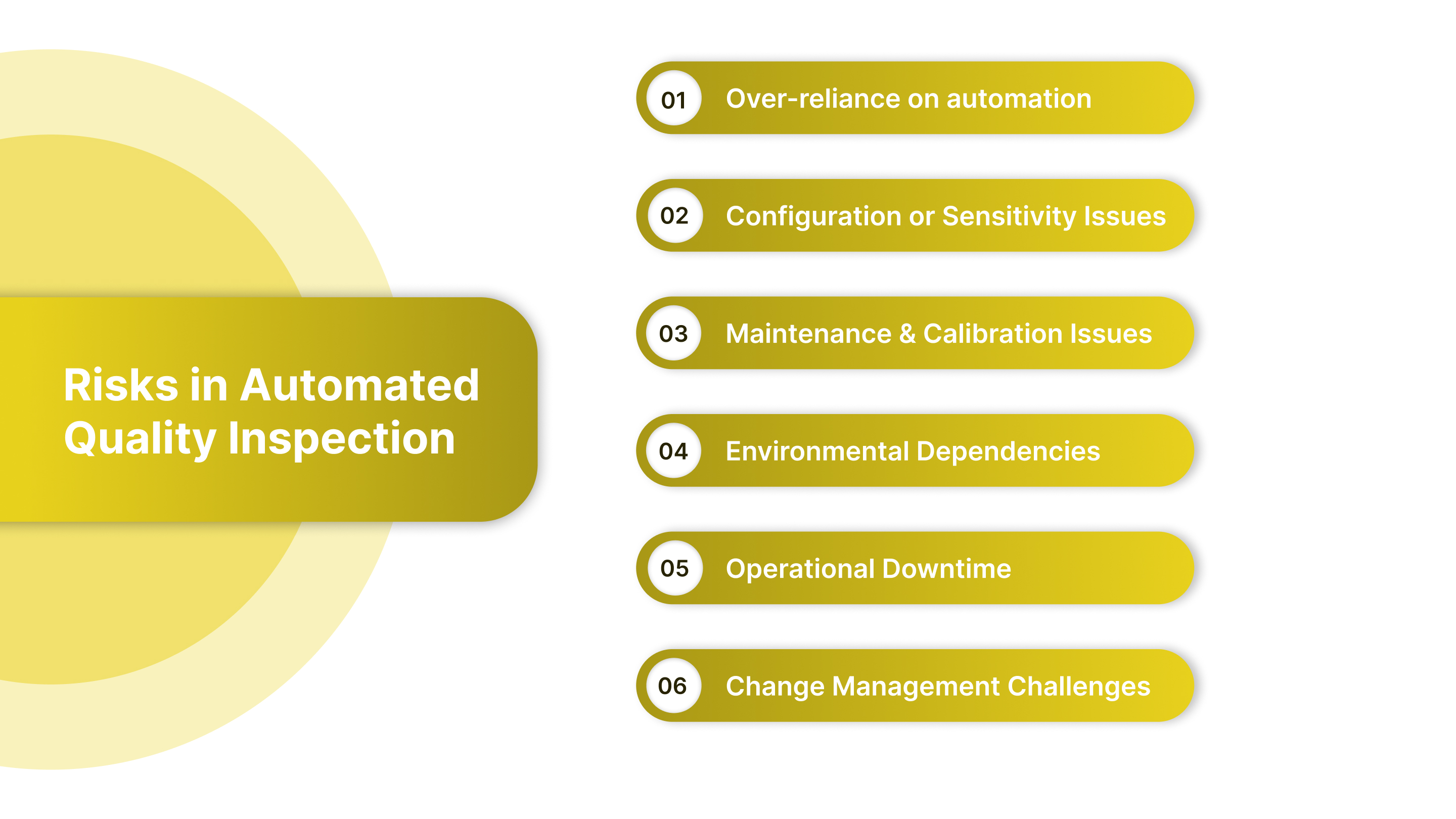
Over-reliance on automation: Automated systems may miss defects that require subjective human judgment, such as surface feel, color nuance, or aesthetic inconsistencies.
Incorrect configuration or sensitivity settings: Poor calibration can lead to excessive false positives (unnecessary waste) or false negatives (missed defects).
Maintenance and calibration issues: Sensor drift, worn components, or outdated software can degrade accuracy over time if not addressed proactively.
Environmental dependencies: Lighting, vibration, dust, temperature, and product positioning can impact vision and sensor performance.
Operational downtime: Equipment failures or upgrade cycles can interrupt inspection workflows if contingency plans aren’t in place.
Change management challenges: Teams may resist automation due to concerns about job changes or retraining requirements.
Risks in Manual Quality Inspection
Here are some manual quality inspection risks to watch out for:
Human error and inconsistency: Fatigue, distractions, and subjective judgment often reduce reliability, especially in repetitive or high-speed environments.
Inspector fatigue: Long shifts or complex products increase the likelihood of missed defects.
Variability between inspectors: Different experience levels and interpretations lead to inconsistent inspection results.
Labor turnover: Training new inspectors frequently can affect inspection continuity and quality.
Limited scalability: As production volume grows, manual inspection becomes slower, costlier, and more prone to bottlenecks.
Why Partnering with Hammer IMS Makes Sense
As manufacturers understand the shift from manual inspection to automated, data-driven quality control, choosing the right technology partner is critical. Hammer-IMS brings deep expertise in non-contact measurement, advanced sensor technologies, and high-precision inspection systems trusted across demanding industries.
Their capabilities include:
Inspection system consulting to analyze current processes, quality challenges, and automation readiness
High-performance measurement and vision technologies, including robust non-contact Metrix systems built for industrial environments
Complete automation solutions, from sensor integration to full in-line inspection setups
Hybrid inspection strategies that combine automated speed with human judgment where needed,
End-to-end implementation support, including installation, calibration, training, and long-term optimization
Hammer-IMS can help you evaluate your current inspection setup and identify the best path, manual, automated, or hybrid, to meet your goals. Get in touch today to schedule a consultation and explore how advanced inspection technology can elevate your production quality.
Conclusion
Choosing the appropriate inspection method requires evaluating factors, such as production volume, product variability, defect criticality, and budget constraints, to align with operational goals.
Manual inspection offers flexibility, human judgment, and low upfront cost, making it suitable for low-volume, highly variable, or aesthetically sensitive products. Automated inspection delivers unmatched speed, consistency, data-driven insight, and long-term cost efficiency, especially for high-volume and precision-driven manufacturing.
There is no one-size-fits-all solution. The right approach depends on your throughput requirements, defect types, tolerance levels, regulatory demands, workforce capacity, and long-term operational strategy.
Ready to Upgrade Your Quality Inspection Strategy?
Whether you're exploring automation for the first time or looking to enhance an existing inspection workflow, Hammer-IMS provides advanced non-contact measurement and high-precision inspection technologies built for demanding industrial environments.
Schedule a consultation today to discover how Hammer-IMS can help you boost accuracy, reduce waste, and modernize your production line.
Frequently Asked Questions (FAQs)
1. How do I determine whether my production line is ready for automation?
Look at factors such as production stability, consistency of product geometry, defect predictability, and the availability of clean, controlled inspection environments. If your process is mature and standardized, automation adoption is typically smoother.
2. What are the early warning signs that my current inspection method is no longer sufficient?
Increasing scrap rates, customer complaints, operator overload, rising labor costs, or variation in defect detection, even when processes haven’t changed, are indicators that your inspection approach may need upgrading.
3. Do automated inspection systems require specialized operators?
Not necessarily. While initial configuration and calibration may require technical expertise, day-to-day operation is often user-friendly. Most systems offer simplified interfaces, preset recipes, and auto-calibration features.
4. What kind of data can automated inspection systems provide?
Beyond defect flags, modern systems provide dimensional data, thickness profiles, trend graphs, heat maps, statistical process control (SPC) metrics, and real-time dashboards that support continuous improvement.
5. What happens if an automated system detects an defects during production?
Depending on the setup, the system may flag the product, trigger alarms, divert defective parts, adjust process parameters automatically, or send data to MES/ERP systems for logging and trend analysis.
6. Does automation eliminate the need for human inspectors?
No. Even highly automated factories typically retain human oversight for edge cases, subjective evaluations, system supervision, and continuous improvement tasks.