
Introduction
Moisture content in rubber is a critical process variable that directly affects vulcanization quality, porosity, and final product performance. Even trace levels of water can cause defects that cascade through production, leading to rejected parts and costly rework. In high-precision Nitrile Butadiene Rubber (NBR) applications, moisture-induced porosity and blistering drive rejection rates as high as 8-15%, representing significant material waste and production inefficiencies.
Controlling that moisture starts with measuring it accurately. Manufacturers have multiple methods available: from traditional lab techniques like Loss on Drying (LOD) to advanced inline systems using microwave and near-infrared technologies.
Choosing the right approach depends on production context, accuracy requirements, and whether you need real-time feedback or periodic validation. This article examines the key methods, their trade-offs, and how inline measurement enables closed-loop process control that reduces waste and improves product consistency.
Key Takeaways
- Excess moisture disrupts vulcanization, creates porosity, and weakens tensile and tear strength
- LOD and TGA deliver high-accuracy offline analysis; NIR and M-Ray sensors measure moisture continuously during production
- Global TSR standards cap volatile matter at 0.80% maximum for natural rubber
- Inline monitoring eliminates sampling lag, enabling closed-loop process corrections in real time
- Microwave-based M-Ray technology measures through the full thickness of rubber sheets, capturing bulk moisture — not just surface conditions
Why Moisture Control Is Critical in Rubber Manufacturing
Moisture content measurement in rubber quantifies the amount of water—free, absorbed, or chemically bound—present in raw rubber, compound mixes, or finished products, expressed as a percentage of total sample weight. Moisture affects rubber at multiple stages. In raw natural rubber, it alters dry rubber content and processability; in compounding, it interferes with filler dispersion and chemical additive performance; during vulcanization, it generates steam pockets that cause porosity or blistering in the cured product.
Downstream Quality Consequences
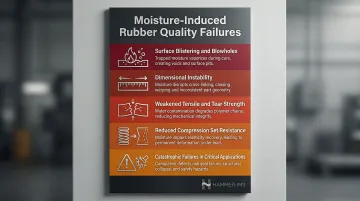
Uncontrolled moisture causes specific, measurable defects:
- Surface blistering and blowholes
- Dimensional instability in finished parts
- Weakened tensile and tear strength
- Reduced compression set resistance
- Catastrophic failures in critical applications (automotive seals, medical devices, O-rings)
In high-pressure hydrogen environments, the consequences are even more severe: moisture permeation contributes to Rapid Gas Decompression (RGD) failure, causing O-rings to blister, swell, and fracture.
The Cost of Catching Problems Late
Defects linked to moisture are typically discovered late in production, when rework costs are highest. A Six Sigma DMAIC case study at an Indian weather-strip manufacturer reduced daily rejection rates from 5.5% to 3.08%, saving Rs. 15,249 per month on compound costs alone.
Regulatory and Standards Context
Moisture measurement isn't optional in most manufacturing environments. Relevant standards covering moisture or volatile content include:
- ISO 248-1:2021 — Volatile matter content in natural rubber (hot-mill and oven methods)
- ASTM D1278 — Volatile matter in natural rubber
- ISO 2000:2020 — TSR grade specifications (0.80% volatile matter maximum)
Key Moisture Measurement Methods Explained
No single method suits every application. The right choice depends on required accuracy, stage of production (incoming QC vs. in-process vs. final), speed of results, and whether inline integration is feasible.
Loss on Drying (LOD) / Gravimetric Method
A rubber sample is weighed, dried at a controlled temperature (typically using a halogen, infrared, or oven-based heater), and reweighed. The mass difference represents moisture lost, expressed as a percentage. ASTM D1278-91a prescribes drying at 100 ± 5°C (or 160 ± 5°C if volatile hydrocarbon oils are suspected); ISO 248-1 uses 105 ± 3°C.
Limitations to keep in mind:
- Cannot distinguish between water and other volatile compounds (solvents, processing oils)
- Results require time — drying cycles range from minutes to hours
- Offline and destructive by nature, unsuitable for real-time production feedback
Thermogravimetric Analysis (TGA)
Where LOD gives a single moisture number, TGA maps the full picture. The sample is heated at a controlled rate while mass loss is continuously measured, producing a curve that separates moisture evaporation from decomposition of other volatile components. ASTM D6370 uses instruments with ± 2 µg sensitivity, heating samples from 50°C to 800°C in nitrogen and air to quantify organics, carbon black, and ash.
TGA is the preferred choice for R&D, compound development, and high-precision quality labs — but it's typically too slow and equipment-intensive for routine inline or high-throughput production environments.
Karl Fischer Titration
When trace-level precision matters, Karl Fischer titration steps in. The rubber sample (or its extracted moisture) reacts with a Karl Fischer reagent; the reagent consumed is directly proportional to water content, enabling measurement down to ppm levels (10 µg to 200 mg range).
For pharmaceutical rubber stoppers, studies recommend a KF oven temperature of 250°C to release both free and bound moisture without decomposing the sample, allowing manufacturers to deduct bound moisture and estimate releasable free moisture that could degrade pharmaceutical products.
This method is best suited for trace moisture analysis in specialty rubbers, silicones, or medical-grade compounds where ultra-low moisture limits must be verified. It is not suitable for inline use — sample preparation and wet chemistry are required.
Near-Infrared (NIR) Spectroscopy
NIR systems direct near-infrared light at the rubber sample. Water molecules absorb light at specific wavelengths (primarily 1450 nm and 1940 nm), and the reflected or transmitted signal is analyzed to calculate moisture content — making inline or at-line deployment feasible.
NIR does require calibration against known reference samples for each rubber formulation. Performance can also be affected by surface texture, sample colour, and compound variability, particularly in carbon black-filled compounds. Recent research using Artificial Neural Network (ANN) models with 1st derivative preprocessing achieved an RMSEP of 0.179% in rubber sheets, showing that advanced signal processing can overcome carbon black interference.
Microwave / Millimeter Wave-Based Measurement (M-Ray)
Unlike the lab-based methods above, microwave and millimeter wave systems are built for the production floor. They transmit electromagnetic waves through or across the rubber material; because water has a significantly higher dielectric constant than rubber, moisture content is derived from the signal's attenuation and phase shift. The result is fully contactless, inline measurement across a moving web or sheet.
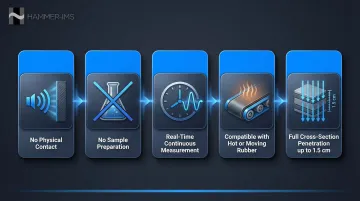
Key production advantages:
- No physical contact with the material
- No sample preparation required
- Real-time continuous measurement
- Compatible with hot or moving rubber
- Measures through the full cross-section, not just the surface — microwave technology penetrates up to 1.5 cm into thick rubber sheets
Hammer-IMS's M-Ray technology operates on this principle, providing accurate inline moisture data for rubber sheet and profile production using millimeter wave electromagnetic measurement.
Inline vs. Lab-Based Moisture Measurement: How to Choose
Lab methods — LOD, TGA, Karl Fischer — deliver superior accuracy and chemical selectivity. Inline methods like NIR and M-Ray deliver speed and continuous coverage. The right choice depends on where in the process you need control: incoming raw material inspection favors lab methods, while active process control requires inline measurement.
Inline systems shift moisture control from reactive to preventive. Specific capabilities include:
- Closed-loop process adjustment — for example, automatically modifying dryer temperature or conveyor speed based on live moisture readings
- Elimination of sampling lag that delays corrective action
- 100% production coverage instead of periodic spot checks
- Defect prevention before out-of-spec material advances downstream
Experimental validation of microwave transmission at 2.36 GHz showed a 0.9996 correlation with dry rubber content, achieving a mean error of just 0.43% when compared to standard gravimetric oven-drying methods.
Neither approach covers every need on its own. That's why high-performing facilities combine both into a single strategy.
The Hybrid Approach
Best-practice facilities use a two-tier strategy:
- Lab methods (LOD, TGA, Karl Fischer) for incoming raw material qualification and periodic calibration validation
- Inline systems (NIR or M-Ray) for continuous in-process monitoring
The two tiers complement rather than replace each other.
Early concerns about inline adoption — calibration complexity, sensitivity to compound variability, and control system integration — have largely been resolved. Modern M-Ray and NIR platforms now include pre-built integrations with common PLC and SCADA systems, along with real-time data logging that simplifies validation.
How to Interpret Moisture Measurement Results in Rubber
Acceptable Moisture Levels
Moisture thresholds vary significantly by rubber type. Two widely referenced benchmarks:
- TSR grades (ISO 2000, ASTM D2227) cap maximum volatile matter at 0.80% across major grades
- Synthetic rubbers like EPDM can be tighter — Dow NORDEL™ IP 4640 requires <0.40 wt%
For compounds, acceptable levels depend on the intended application and processing conditions. Manufacturers should establish their own specification limits through process validation.
LOD vs. True Moisture
LOD values capture all volatile matter lost during drying — not only water. This is why standards like ISO 248 and ASTM D1278 reference "volatile matter content" rather than "moisture content." LOD cannot distinguish between water and other volatile compounds such as solvents, oils, and polymer degradation products.
That distinction matters when evaluating compliance against the thresholds above. For medical-grade compounds or specialty applications where precise water quantification is required, Karl Fischer titration or TGA is needed to isolate water specifically.
LOD in Rubber Testing Context
In the rubber industry, "LOD" in moisture testing refers to Loss on Drying — the standard gravimetric method — not "Limit of Detection." Analytical detection limits are a separate concept, relevant when measuring very low moisture levels in the ppm range using TGA or Karl Fischer.
How Hammer-IMS Can Help
Hammer-IMS builds inline measurement systems for rubber and polymer manufacturers. The company's M-Ray technology—based on millimeter wave electromagnetic measurement—enables contactless, real-time moisture and thickness measurement directly on the production line, without requiring sample extraction or laboratory downtime.
Key Operational Benefits:
- Measures without contact, preventing material damage or contamination even on hot or soft rubber
- Streams continuous inline data to support closed-loop adjustments before moisture excursions cause defects
- Integrates with production monitoring and analytics via Connectivity 3.0 software
- Uses no nuclear or radioactive sources, simplifying regulatory compliance and removing site safety constraints
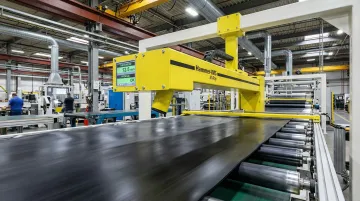
Hammer-IMS solutions give production teams accurate, real-time quality data rather than retrospective lab results — reducing material waste, tightening tolerances, and cutting reject rates.
Conclusion
Moisture measurement in rubber is not a single-method discipline. LOD, TGA, Karl Fischer, NIR, and microwave-based systems each have a defined role, and the best programs combine lab methods for qualification and inline systems for continuous process control.
The right measurement approach delivers measurable gains: fewer defects, less rework, and more consistent product quality. As rubber compounds grow more complex and tolerances tighten, inline real-time moisture monitoring is becoming the standard — not the exception.
Three converging pressures are accelerating that shift:
- Compound complexity — advanced rubber formulations are more sensitive to moisture variation at every processing stage
- Waste reduction targets — continuous monitoring catches drift before it becomes scrap
- Regulatory requirements — critical applications in automotive and medical sectors demand documented process control
Frequently Asked Questions
How do you measure moisture content in rubber?
Moisture in rubber is measured using gravimetric methods (LOD), TGA, Karl Fischer titration, NIR spectroscopy, or microwave/M-Ray inline systems. Method choice depends on required accuracy, speed, and whether inline or lab testing is needed.
What is an acceptable moisture reading for rubber?
Acceptable limits vary by rubber type and application. Global TSR standards (ISO 2000, ASTM D2227) cap volatile matter at 0.80% maximum for natural rubber, while synthetic rubbers like EPDM often require tighter limits (typically <0.40–0.70%), with exact thresholds set by manufacturers based on processing and end-use requirements.
What are the two main types of moisture metres used in the rubber industry?
The two main categories are gravimetric/thermal analysers (used in labs for offline LOD measurement) and inline electromagnetic sensors (such as NIR or microwave systems used for real-time production monitoring).
What is LOD in moisture analysis for rubber?
In rubber moisture testing, LOD stands for Loss on Drying. The sample is weighed before and after drying to determine total volatile content, which serves as a proxy for moisture per standards like ISO 248 and ASTM D1278.
Can moisture measurement in rubber be done inline or does it require lab testing?
Both are possible. Lab methods like LOD and Karl Fischer require sample extraction from the line. NIR and microwave-based systems, such as Hammer-IMS M-Ray, allow continuous, contactless measurement directly on the production line.
How does excess moisture affect rubber vulcanisation?
Excess moisture vaporises during the high-temperature vulcanisation process, creating steam pockets that cause porosity, blistering, and surface defects. This ultimately weakens mechanical properties and increases product rejection rates.