Introduction
Uncontrolled moisture causes costly defects across nearly every industrial sector. Warped construction materials, degraded textiles, and off-specification pharmaceutical products share a common root cause: poor moisture control during production.
The financial stakes are concrete. A single Class I recall in low-moisture food processing can erase €226 million in corporate value, and analysis of 127 industrial sites found average annual losses of €740,000 from corrosion repairs and unplanned halts linked to unmonitored moisture. Catching moisture deviations at the source — during production, not after — is what separates controlled quality from costly rework.
NIR (near-infrared) moisture measurement makes that possible. Unlike traditional lab-based methods that take 15–60 minutes per sample, NIR delivers instant feedback directly to process control systems. It transforms moisture monitoring from a reactive lab test into continuous, in-line quality assurance — without interrupting production.
Key Takeaways
- NIR detects moisture by measuring how water molecules absorb specific near-infrared wavelengths
- Comparing absorption at a water-sensitive wavelength against a stable reference wavelength delivers instant moisture readings
- Upfront calibration against reference samples unlocks highly repeatable, real-time results in production
- Faster and non-destructive compared to LOD and Karl Fischer — no sample removal, no process interruption
- Applied across textiles, nonwovens, food, pharmaceuticals, and construction materials where inline, non-contact measurement is critical
What Is NIR Moisture Measurement?
NIR moisture measurement is an analytical technique that uses near-infrared light (approximately 780–2,500 nm) to detect and quantify water content in materials without physical contact or sample destruction. The technology operates in the spectral region between visible light and mid-infrared radiation, targeting the unique absorption characteristics of water molecules.
Water molecules contain O-H bonds that are strong absorbers of NIR light, with key absorption bands around 1,400–1,550 nm (first overtone) and 1,900–2,000 nm (combination band). This natural sensitivity makes NIR well-suited for moisture detection across solids, liquids, and slurries without requiring sample preparation or chemical reagents.
That versatility extends to how the technology is deployed on the production floor:
- Inline/online sensors mount above conveyors for continuous monitoring during production
- At-line analysers sit near production lines for periodic spot checks
- Handheld/lab units offer portability for quality audits or off-site testing
Each format offers different trade-offs. Inline sensors provide real-time feedback for process control but require integration with production equipment. At-line units balance speed with flexibility, while handheld devices maximise portability at the cost of coverage and automation depth.
How NIR Moisture Measurement Works
NIR moisture measurement operates on a dual-wavelength principle: a broadband light source illuminates the material, and the system compares the intensity of a water-absorbing measurement wavelength against a stable reference wavelength unaffected by moisture levels. The ratio between these two signals reveals the moisture content.
Physical Components
Three core hardware elements work in sequence:
- Broadband light source — typically a quartz halogen lamp providing energy across the NIR spectrum
- Optical filter wheel — rotates at high speed (often 2,000+ RPM) to cycle through selected wavelengths
- Detector — captures reflected or transmitted light intensity at each wavelength
Calibration Requirement
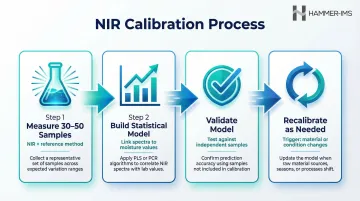
NIR is a secondary measurement method, meaning a prediction model must be developed before routine use. ISO 12099 and ASTM E1655 mandate rigorous multivariate calibration, with ISO 12099 explicitly requiring at least 20 independent samples for solid validation.
Calibration process:
- Measure 30–50 samples with both NIR and a primary reference method (loss-on-drying or Karl Fischer titration)
- Link known moisture values to recorded NIR spectra using statistical modeling
- Validate the model against independent test samples before deployment
- Recalibrate if raw materials, suppliers, or ambient conditions change significantly
Wavelength Selection Strategy
Choosing the right wavelength directly affects measurement sensitivity. For high-moisture samples, a less absorbing NIR wavelength prevents signal saturation (where the detector receives too little reflected light to measure accurately). For low-moisture applications, a more sensitive wavelength maximizes resolution and detection limits.
Practical Walkthrough: NIR in a Nonwoven Production Line
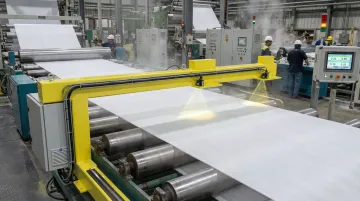
Picture an NIR sensor mounted 18–38 cm above a moving nonwoven web on a conveyor. As the material passes beneath, the sensor continuously fires NIR pulses. The detector captures absorption data at the measurement and reference wavelengths, calculating moisture percentage in real time (typically every few milliseconds).
This output feeds directly to a dryer control system, which automatically adjusts drying intensity to maintain the target moisture band.
Even well-configured systems underperform when these steps are skipped:
- Skipping model validation after changing raw material suppliers
- Not recalibrating when ambient temperature shifts significantly
- Failing to connect sensor output to production adjustments
Each of these gaps turns a real-time measurement system into an expensive data logger — one that flags problems but cannot fix them.
Why Accurate Moisture Measurement Matters in Manufacturing
Product Quality and Consistency
Moisture directly affects the physical and chemical properties of manufactured goods—from tensile strength in nonwoven fabrics and crispness in food products to structural integrity in clay bricks. Even small deviations from the target moisture band cause defects, returns, or batch rejections. Under-drying in pasta production led to mold contamination and a 2024 product recall by Wildly Beloved Foods, demonstrating how moisture failures translate directly into regulatory compliance issues.
Energy Efficiency and Drying Optimisation
Many industrial processes require drying, which is highly energy-intensive. Thermal drying accounts for 22% of total energy consumption in the U.S. pulp and paper sector, costing approximately $856 million annually. NIR-based moisture feedback enables manufacturers to stop drying at the precise target moisture level—avoiding over-drying (which wastes energy and can damage material) and under-drying (which creates downstream quality failures).
Waste Reduction and Yield Improvement
Real-time moisture visibility allows operators to catch deviations immediately rather than discovering off-spec material after further processing. This reduces scrapped batches, rework, and raw material waste—particularly valuable in high-volume production where even a 1% reduction in waste delivers measurable cost savings.
Enabling Closed-Loop Process Control
Unlike offline lab testing, inline NIR sensors provide continuous data that feeds directly back into control systems. This enables automatic adjustment of dryer temperatures, speeds, or material feed rates to maintain target moisture within tight tolerances—turning moisture control into an active, continuous part of the production process rather than a post-hoc audit.
Regulatory and Safety Compliance
In regulated industries such as pharmaceuticals and food processing, moisture specifications are often mandated. Lyophilised pharmaceutical products, for example, carry strict upper limits:
NIR measurement supports documentation, traceability, and audit readiness by providing continuous, timestamped moisture data throughout production.
NIR Moisture Measurement vs. Alternative Methods
NIR vs. Loss on Drying (LOD)
LOD is a primary method requiring no calibration, but takes 15–60 minutes per sample, consumes the sample, and is impractical for inline monitoring. NIR provides near-instant results and is non-destructive, making it the preferred option wherever speed and continuity are priorities. LOD remains the common choice for calibrating NIR models due to its status as a primary reference method.
NIR vs. Karl Fischer (KF) Titration
KF is highly selective (measures only water) with very low detection limits around 10 µg, making it the reference method of choice for trace moisture in complex or variable samples. It does require chemicals, sample destruction, and trained operators, which limits its use in production environments. NIR is the practical choice when the same material type is measured repeatedly at speed; KF is better reserved for variable or unknown samples where absolute accuracy is non-negotiable.
NIR vs. Capacitance/Resistance and Microwave Methods
Capacitance and resistance sensors are low-cost but measure surface moisture only and are prone to interference from temperature, material density, and composition changes. Microwave/RF methods penetrate deeper into bulk materials—often several centimeters—making them better suited for thick, dense products.
A quick comparison across all four methods helps clarify where each fits:
| Method | Speed | Destructive? | Best For |
|---|---|---|---|
| NIR | Near-instant | No | Repeated inline measurement of consistent materials |
| LOD | 15–60 min | Yes | Reference calibration, lab use |
| Karl Fischer | Minutes | Yes | Trace moisture in variable or unknown samples |
| Capacitance/Microwave | Fast | No | Bulk or thick materials where surface readings fall short |
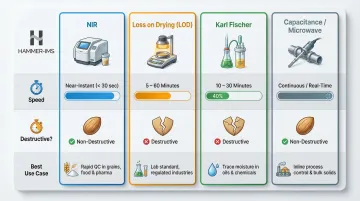
For most continuous manufacturing environments, NIR offers the strongest combination of speed, non-contact measurement, and integration into automated process control.
How Hammer-IMS Can Help
Hammer-IMS specialises in non-contact, non-nuclear quality and process control measurement for industrial applications—serving manufacturers in textiles, nonwovens, plastics, construction materials, and automotive sectors who need accurate, real-time measurement integrated into live production lines.
Where NIR's surface-limited measurement or calibration sensitivity creates constraints, Hammer-IMS's M-Ray technology offers a practical alternative or complementary approach. M-Ray uses millimetre wave-based, contactless measurement to provide deeper material penetration without nuclear or radioactive components.
It is particularly well-suited for:
- Thick, dense, or highly variable web materials
- Opaque materials that block optical measurement
- High-temperature production environments where optical systems struggle
- Applications requiring full cross-section measurement rather than surface-only readings
Hammer-IMS's Connectivity 3.0 software platform enables real-time data output and closed-loop production adjustment through industry-standard protocols including OPC UA, PROFINET, and Modbus TCP/IP. This converts measurement data into immediate process corrections, shifting moisture monitoring from passive reporting into active quality control.
Frequently Asked Questions
What is NIR moisture?
NIR (near-infrared) moisture measurement is a non-contact analytical technique that quantifies water content by measuring how much near-infrared light a material absorbs at wavelengths specific to O-H bonds in water molecules.
Can an infrared thermometer detect moisture?
No. Standard infrared thermometers measure surface temperature by detecting emitted heat radiation, not moisture. They operate on a different measurement principle than dedicated NIR moisture sensors, which measure light absorption rather than thermal emission.
What moisture reading is too high?
Acceptable moisture thresholds are highly material- and industry-specific. For example, pharmaceuticals may require below 2%, while rice specifications mandate a maximum of 15%. Exceeding the target range typically risks product defects, spoilage, or structural failure.
Does NIR moisture measurement require calibration?
Yes. NIR is a secondary measurement method requiring an initial calibration model built from known moisture reference samples. Periodic recalibration may be needed if material composition or process conditions change significantly.
What industries use NIR moisture measurement?
NIR moisture measurement is used across any sector where moisture content directly affects product quality or process efficiency. Key industries include:
- Textiles and nonwovens
- Food and beverage processing
- Pharmaceuticals
- Wood and biomass
- Construction materials
- Paper, chemicals, and tobacco
What are the main limitations of NIR moisture measurement?
NIR has three key limitations to consider:
- Measures surface or near-surface moisture, not bulk content
- Requires calibration development for each new material type
- Sensitive to changes in temperature, surface colour, or particle size
This makes it less reliable for highly variable or unknown sample types.