Introduction
Modern industrial processes generate data at an unprecedented 30% annual growth rate—yet up to 90% remains unused "dark data", collected but never analyzed for process improvement. The real gap is conversion: turning raw measurements into decisions that adjust production in real time. Smart sensor technology closes that gap by linking physical measurement directly to process control.
Manufacturers in textiles, plastics, nonwovens, and steel face persistent measurement problems: inconsistent product thickness across web widths, excessive material waste from safety overage, manual quality checks that achieve only 60–70% defect detection under production fatigue, and offline sampling delays of up to 72 hours between process deviations and lab results.
Smart sensors address these directly — enabling continuous inline measurement, immediate feedback loops, and automated process adjustment without waiting for end-of-line sampling.
This article covers:
- What defines smart sensor technology and how onboard processing works
- How these systems communicate measurement data across production networks
- Key applications from thickness profiling to predictive maintenance
- Quantifiable benefits: waste reduction, compliance, and scrap rate improvements
- How to select the right sensor technology for your manufacturing environment
TLDR:
- Smart sensors combine onboard processing and networked communication to convert physical measurements into actionable data
- Inline measurement eliminates 72-hour laboratory delays and reduces scrap rates from 10-15% to as low as 0.5%
- Non-nuclear technologies like millimeter-wave sensors remove radiation licensing burdens and environmental disposal costs
- Real-time closed-loop control automatically adjusts production parameters to maintain specifications
- Connectivity platforms integrate sensor data into PLCs, SCADA, and ERP systems for factory-wide visibility
What Is Smart Sensor Technology?
A smart sensor does more than detect a physical quantity—it processes that data onboard and communicates it for immediate action. The IEEE 1451 standard defines a smart transducer as one that "provides functions beyond those necessary for generating a correct representation of a sensed or controlled quantity," specifically simplifying integration into networked environments. Unlike basic sensors that output raw analog signals requiring external interpretation, smart sensors deliver calibrated, processed digital data ready for control systems.
The Evolution to Sensor 4.0
The industrial sensor landscape has evolved through distinct generations. Mechanical indicators gave way to analog electrical sensors in the mid-20th century, which transmitted voltage or current signals proportional to measured values. Today's "Sensor 4.0" devices—aligned with Industry 4.0 principles—feature embedded intelligence, self-monitoring, self-configuration (plug-and-play capability), and direct communication with enterprise business systems. The VDI/VDE Sensor 4.0 concept describes devices that not only measure but actively participate in process optimization and predictive maintenance.
Core Smart Sensor Components
What makes a sensor "smart"? Four essential components work together:
- A physical transducer (capacitive, electromagnetic, optical, or ultrasonic) detects the target variable—thickness, temperature, pressure, or position
- An onboard microprocessor filters noise, converts analog signals to digital, and applies stored calibration algorithms before any data leaves the device
- Built-in communication supports standard industrial protocols (PROFINET, EtherNet/IP, OPC UA, Modbus TCP) for direct integration with control systems
- Self-monitoring logic stores calibration data in Transducer Electronic Data Sheets (TEDS), diagnoses sensor health, and adjusts filtering parameters in real time
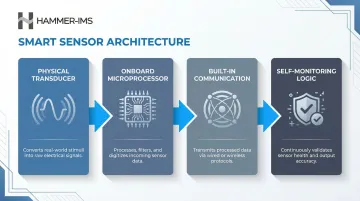
Together, these components allow a smart sensor to deliver verified, actionable data rather than raw signals—reducing the processing burden on downstream control systems.
How Do Smart Sensors Work?
Signal Processing Chain
The measurement process follows a clear sequence. First, the base sensor captures an analog physical signal—for example, reflected millimeter waves indicating material thickness. The onboard processor then filters electrical noise, compensates for temperature drift using stored calibration curves, and converts the analog signal to a digital format. IEEE 21451-001 (2017) outlines recommended practices for signal treatment, defining algorithms that convert raw measurements into standardized digital data structures.
The processed data then transmits via industrial protocols to PLCs, SCADA systems, or cloud platforms. Hammer-IMS's M-Ray millimeter-wave sensors, for example, send a signal through the measured material, analyze the reflected wave to determine thickness or density, and transmit calibrated measurements through Modbus TCP/IP or OPC UA to production control systems. The entire cycle completes within milliseconds.
Key Operational Capabilities
Three capabilities distinguish smart sensors from passive measurement devices:
- Self-calibration: IEEE 1451.4 uses TEDS stored in EEPROM to hold calibration data, measurement ranges, and manufacturer specifications. The data acquisition system automatically applies custom polynomial calibration curves to correct for temperature drift and system aging, eliminating manual recalibration over years of operation.
- Self-diagnosis: Sensors continuously monitor internal health indicators—signal strength, temperature stability, component status—and issue warnings before failures occur, preventing unexpected downtime.
- Adaptive filtering: In environments with vibration, electromagnetic interference, or temperature swings, smart sensors adjust filtering algorithms dynamically to maintain measurement accuracy.
Communication Protocols and Integration
Industrial smart sensors communicate through standardized protocols that enable seamless integration:
| Protocol | Market Share | Key Characteristics |
|---|---|---|
| PROFINET | 27% (78.8M nodes) | Leading Ethernet protocol; added 9.5M nodes in 2024 |
| EtherNet/IP | 23% | Dominant in North America; relies on standard IEEE 802.3 and TCP/IP |
| EtherCAT | 17% | High-speed deterministic network; strong growth trajectory |
| IO-Link | 61M nodes | Point-to-point protocol (IEC 61131-9) for sensors; added 9.7M nodes in 2024 |
| Modbus TCP/RTU | ~9% combined | Legacy protocol still widely used for basic integration |
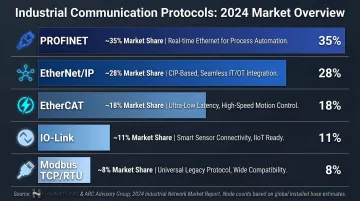
This standardization means a smart thickness sensor can communicate directly with existing PLCs without custom hardware adapters or proprietary gateways.
Key Industrial Applications of Smart Sensors
Thickness and Basis Weight Measurement
For continuous web materials—textiles, nonwovens, plastic films, and sheet products—area density (basis weight, g/m²) is the critical metric governing material consumption and product uniformity. ISO 9073-1 (nonwovens) and ASTM D3776 (fabrics) strictly define measurement requirements for these applications.
Contactless, real-time measurement across the full web width is essential for three reasons:
- Consistency assurance — Detecting thickness variations of ±2-3% across 3-5 metre production widths
- Waste reduction — Enabling tighter production margins without risking out-of-spec material
- Immediate feedback — Eliminating the 72-hour delay between process deviations and offline laboratory results
Peer-reviewed research validates Frequency-Modulated Continuous-Wave (FMCW) millimeter and terahertz radar for non-destructive thickness measurement. Systems operating at 100-175 GHz achieve measurement rates of 5 kHz and resolve multilayer dielectric thicknesses with precision below the Rayleigh limit through model-based signal processing.
Hammer-IMS's M-Ray millimeter-wave technology applies this principle directly on the production line, measuring thick plastic sheets, nonwovens, and coatings at centimetre-range capability while operating at high standoff distances to avoid contact with hot, freshly extruded materials.
Predictive Maintenance and Condition Monitoring
Unplanned downtime costs the world's 500 largest companies approximately $1.4 trillion annually—representing 11% of revenues. In automotive manufacturing alone, hourly downtime costs have reached $2.3 million per incident, double the 2019 rate.
Smart sensors detect early warning signs before catastrophic failures:
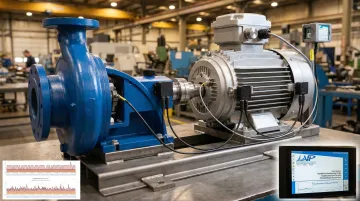
- Vibration sensors on motors and bearings identify abnormal frequency patterns indicating worn components
- Temperature sensors on electrical panels detect overheating circuits days before failure
- Pressure sensors in hydraulic systems reveal seal degradation through gradual pressure drops
Implementing AI-driven condition monitoring using these sensors can reduce unplanned downtime by 50% and cut maintenance costs by 40%. The global predictive maintenance market is projected to grow from $14.29 billion in 2025 to $98.16 billion by 2033—a CAGR of 27.9%—driven by the proven ROI of sensor-based monitoring.
Quality Control and Inline Inspection
Traditional sampling-based quality control inspects 1-5% of production output, creating blind spots where defects pass undetected. Smart sensor-based inline inspection enables 100% product inspection at line speed, catching defects before they become waste or customer returns.
Automated visual inspection systems consistently achieve 99%+ defect detection rates, compared to 60-70% for fatigued human inspectors. Applications include:
- Surface defect detection (scratches, pinholes, stains) on plastic films and coated textiles
- Dimensional verification of extruded profiles and stamped parts
- Colour consistency monitoring in printing and coating processes
- Edge detection and width control on slitting and converting lines
Integration with production control is direct—defect signals trigger waste diversion or process correction within milliseconds, before non-conforming product advances down the line.
Automotive and Steel Manufacturing
High-speed manufacturing with zero-tolerance requirements demands smart sensor precision:
Automotive welding: Hybrid optical and thermal sensors monitor weld quality in real time — optical sensors detect surface cracks and spatter, while infrared cameras and pyrometers track heat distribution to catch lack of penetration or incomplete fusion before parts enter assembly.
Metal forming and rolling: Linear Variable Displacement Transducers (LVDTs) and ultrasonic sensors embedded in rollers measure roll gap, strip thickness variations, and roller deformation under harsh conditions—high temperatures, metal dust, and vibration—maintaining dimensional tolerances in steel sheet production where manual inspection is not feasible.
Emerging Applications
Medical device manufacturing: White light interferometry and optical profilometry verify stringent dimensional tolerances on orthopedic implants compliant with ISO 7206 and ASTM F2033, ensuring part longevity and preventing recalls.
Construction materials: Mineral wool and insulation board manufacturing rely on density and thickness measurements to ensure thermal resistance (R-value) and acoustic performance, governed by standards like EN 13162 and EN 1602.
Benefits of Smart Sensors in Manufacturing
Real-Time Process Feedback and Closed-Loop Control
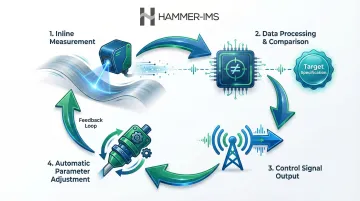
Smart sensors don't just report measurements—they drive automated process correction. Closed-loop systems continuously compare measured values against target specifications and automatically adjust production parameters within milliseconds:
- Die gap adjustment in extrusion to maintain uniform film thickness
- Coating knife positioning to control latex or adhesive application rates
- Line speed modulation to compensate for material property variations
- Temperature control in calendering to stabilize sheet formation
This automation reduces human intervention, stabilises output quality, and enables production at tighter tolerances. For example, systems using PI (Proportional-Integral) controllers can automatically switch from manual recipe-based operation to closed-loop feedback control when thickness profiles reach acceptable tolerance levels.
Waste Reduction and Material Savings
Continuous inline thickness profiling allows manufacturers to tighten control limits, reducing the "safety overage" added to guarantee minimum specification compliance. One documented film converter reduced rejection rates from 10-15% down to 0.5%, saving over £150,000 by implementing inline capacitance profiling. Similarly, upgrading to automatic dies with downstream gauging improved transverse thickness tolerances by 30% while accelerating startup times.
The numbers make the case directly: if a nonwoven manufacturer produces 10,000 tonnes annually with 3% overage to ensure minimum weight compliance, and inline measurement enables reducing that overage to 1.5%, the material savings equal 150 tonnes—representing €200,000-€300,000 at typical raw material costs.
Contactless and Non-Nuclear Measurement
Contactless measurement preserves product integrity. Unlike mechanical gauges that can mark or deform materials, electromagnetic and optical sensors operate at standoff distances of 50-500 mm, making them ideal for delicate films, hot extruded sheets, and sensitive coatings.
Non-nuclear technologies eliminate significant regulatory burdens. Industrial gauges using radioactive isotopes (Krypton-85, Promethium-147) are strictly regulated: in the US, the NRC governs licensing under 10 CFR Part 30, requiring specific licences, leak testing, and designated Radiation Safety Officers.
In the EU, EURATOM Directive 2013/59 mandates strict tracking, training, and authorisation for sealed sources.
End-of-life disposal carries additional administrative burdens. NRC NUREG-1757 outlines decommissioning requirements, including radiation surveys, secure transfer to authorised disposal facilities, and maintenance of Decommissioning Funding Plans. These total-cost-of-ownership burdens are accelerating the shift to non-nuclear electromagnetic alternatives that carry no radiation hazards and need no licensing.
Data Logging, Analytics, and Traceability
Smart sensors continuously record measurement data that extends far beyond real-time process control:
- Quality audits — Searchable production history proving compliance with customer specifications
- Process optimization — Statistical analysis identifying optimal parameter combinations for different materials
- Regulatory compliance — Documented evidence meeting ISO, FDA, or industry-specific requirements
- Root cause analysis — Correlation of quality deviations with process conditions, raw material lots, or equipment maintenance events
Modern platforms integrate with Microsoft SQL databases, enabling historical trend analysis, and support OPC UA for semantic data exchange directly to ERP systems where production data feeds production dashboards and reporting.
Scalability and Remote Connectivity
Production engineers and quality managers can monitor multiple lines or facilities remotely through cloud-connected software platforms. This reduces on-site staffing requirements and enables faster response to out-of-tolerance events. Hammer-IMS's Connectivity 3.0 platform, for instance, delivers:
- Real-time thickness visualisation across multiple production lines
- Bolt mapping for precise die adjustment without stopping the line
- Integrated TeamViewer for remote technical support from any location
This lets a single specialist oversee thickness control across geographically distributed plants.
Smart Sensors and Industry 4.0: The Connected Factory
Smart sensors are the foundational data-gathering nodes in Industrial Internet of Things (IIoT) architectures. Without reliable, intelligent sensing at the process level, higher-level analytics and AI systems have nothing meaningful to work with. The global industrial sensor market is forecast to grow from $24.63 billion in 2025 to $36.85 billion by 2030 (CAGR of 8.3%), driven by IIoT integration and AI-powered analytics.
OPC UA and Semantic Data Exchange
OPC UA provides platform-independent, service-oriented architectures that standardize semantic data exchange from the sensor level directly to ERP and cloud systems. Where legacy protocols transmit only raw numerical values, OPC UA embeds metadata alongside each reading: measurement units, calibration status, sensor location, and quality indicators. Enterprise systems can then interpret and act on that data without custom programming.
Edge Computing and AI Integration
To reduce latency and cloud traffic, modern industrial sensors incorporate edge computing. Onboard processing lets sensors run local AI inference directly on the factory floor, triggering immediate control responses without depending on cloud connectivity. In high-speed manufacturing, even a 100-millisecond delay can waste metres of material.
Typical edge AI tasks include:
- Classifying product quality defects against trained reference profiles
- Predicting maintenance needs before failures occur
- Detecting process anomalies and flagging them in real time
For example, models trained on historical "good" and "defective" thickness profiles can be deployed to sensors that autonomously accept or reject production runs without any cloud roundtrip.
How to Choose the Right Smart Sensor for Your Process
Measurement Principle and Technology
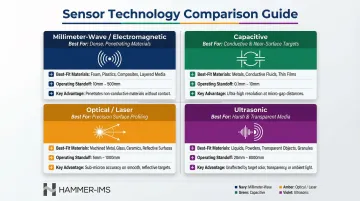
Select the measurement technology suited to your material and application:
Contactless electromagnetic (millimetre-wave, terahertz): Ideal for thick plastic sheets, nonwovens, and materials where optical transparency varies. Operates at high standoff distances and measures through dust, steam, or high temperatures. Hammer-IMS's M-Ray technology uses this principle across materials ranging from fully transparent to completely opaque.
Capacitive: Works well for thin films and coatings where dielectric properties differ between layers. Close proximity to the measured surface is required.
Optical (laser, white light interferometry): Excellent for smooth, reflective surfaces requiring micrometre-level precision. Less effective on textured, opaque, or translucent materials.
Ultrasonic: Suitable for metal thickness measurement and multilayer materials where acoustic impedance differences enable layer detection.
Measurement Range, Accuracy, and Coverage
Define your technical requirements:
- Range: Measuring 0.1-1 mm film requires different technology than 10-50 mm plastic sheets
- Accuracy: ±0.5% may suffice for insulation; medical devices may demand ±0.1%
- Scan width: 1-metre lab samples versus 5-metre production webs require different sensor configurations
Multi-head scanning systems provide near-100% material coverage by positioning multiple sensors across the web width, enabling detection of localized thickness variations that single-point sensors would miss.
Environmental Tolerance and Compliance
Evaluate sensors against actual operating conditions:
| Criterion | Standard/Guidance | Failure Modes if Inadequate |
|-----------|-------------------|----------------------------|
| Environmental sealing | IEC 60529 (IP ratings) | Water/moisture ingress causing short circuits and measurement drift |
| Thermal resilience | IEC 60068-2-1 / 2-2 | Material embrittlement in cold; electronic drift and calibration loss in heat |
| Electromagnetic compatibility | IEC 61000 Series | EMI from factory motors distorts signals and induces false readings |
| Mechanical robustness | Application specific | Vibration and shock cause wear, loosen connections, damage components |
Sensor failures in the field are rarely due to inherent inaccuracy. Most failures trace back to improper application and overlooked environmental stressors.
Regulatory compliance is a separate layer beyond IEC standards. If replacing nuclear gauges, confirm the alternative requires no radiation licensing. Non-nuclear technologies eliminate NRC/EURATOM licensing, periodic leak testing, radiation safety officer designation, and decommissioning fund requirements.
Integration and Software Capabilities
Beyond hardware specifications, evaluate:
- Industrial protocols supported: Does the sensor communicate via your facility's standard (PROFINET, EtherNet/IP, OPC UA, Modbus)?
- Plug-and-play capability: IEEE 1451 TEDS support enables automatic sensor recognition and configuration
- Software platform features: Real-time visualization, historical data logging, SQL database integration, closed-loop control capability, remote access
- Vendor support: Installation services, training, remote troubleshooting, and application engineering assistance
Hammer-IMS's Connectivity 3.0 platform goes beyond data collection: it enables remote monitoring, bolt mapping for die adjustment, and direct PLC integration so measurement feeds directly into process correction rather than stopping at reporting.
Frequently Asked Questions
What is smart sensor technology?
Smart sensor technology combines physical measurement elements with onboard microprocessors and network communication to convert raw signals into processed, calibrated digital data. Unlike passive sensors that output raw analog voltages, smart sensors handle filtering, self-calibration, and diagnostics onboard — delivering actionable data directly to control systems without external conditioning.
What is the cost of a smart sensor system?
Cost varies widely based on sensor type (optical, electromagnetic, ultrasonic), measurement technology, number of sensors for width coverage, software tier, and integration complexity. While upfront costs exceed basic sensors by 2-5x, ROI from waste reduction (5-10% material savings), reduced downtime (30-50% reduction), and quality improvements typically justifies investment within 12-24 months.
How do smart sensors differ from traditional sensors?
Traditional sensors output raw analog signals requiring external conditioning, calibration, and interpretation. Smart sensors handle all of this onboard: they apply calibration curves, filter noise, convert to digital formats, and communicate via standardised industrial protocols. The result is a self-contained, networkable device capable of autonomous decision-making.
What industries benefit most from smart sensor technology?
Manufacturing-heavy sectors see the greatest impact, including:
- Textiles and nonwovens (basis weight control)
- Plastics (film and sheet thickness)
- Steel (strip thickness and flatness)
- Automotive (dimensional inspection and weld quality)
- Rubber, medical devices, and construction materials
Any process where real-time measurement directly drives quality and efficiency stands to benefit.
Can smart sensors integrate with existing production lines?
Yes. Most modern smart sensors support standardised industrial interfaces such as OPC UA, PROFINET, and Modbus TCP, enabling connection to existing PLCs without full line redesigns. IEEE 1451 TEDS plug-and-play capabilities simplify retrofitting further by allowing automatic sensor recognition and configuration.
What should I look for when choosing a smart sensor for manufacturing?
Key criteria to evaluate:
- Measurement accuracy suited to your specific material and tolerance requirements
- Contactless, non-nuclear operation for safety and regulatory compliance
- Real-time feedback capability for closed-loop production control
- Environmental resilience matched to your conditions (IP rating, temperature range, EMI immunity)
- Software integration supporting data logging, remote monitoring, and factory automation connectivity