What if your production line could immediately catch even the smallest defect, right at the moment it happens, instead of relying on manual sampling at the end? With modern inline measurement systems, that’s now a reality. These tools bring precision sensors, real-time analytics, and automated inspection directly into the manufacturing flow, not after it.
The momentum behind inline quality control is surging. The Global Inline Metrology Market is projected to grow to $2.16 billion by 2035. For U.S. manufacturers grappling with tight margins and regulatory pressures, inline measurement is fast becoming a strategic necessity.
In this guide, we explain what inline measurement systems are, how they work, and why they’re increasingly vital for process quality control, helping you decide if they’re right for your production line.
TL;DR
Inline measurement systems enable real-time, automated quality control, catching defects instantly instead of relying on delayed, end-of-line inspection.
Modern technologies include vision systems, laser/optical sensors, contact/non-contact gauges, 3D scanners, and spectroscopy, each suited for different materials and accuracy requirements.
Real-time feedback reduces scrap, rework, and operational costs, making inline measurement a core strategy for improving yield and maintaining tight tolerances.
Inline systems support compliance with U.S. standards such as FDA, NIST and ASTM.through digital traceability and consistent, calibrated inspection.
Key KPIs to track include accuracy, repeatability, resolution, response time, uptime, and total cost of ownership, ensuring systems deliver measurable ROI.
What Are Inline Measurement Systems?
Inline measurement systems are real-time inspection and monitoring tools integrated directly into the production line. Instead of stopping the process, removing samples, or waiting for end-of-line checks, these systems measure dimensions, surface characteristics, composition, or defects as products move through manufacturing.
The primary purpose is to deliver instant feedback to operators and control systems, enabling automatic adjustments, reducing scrap, and ensuring consistent product quality without interrupting throughput.
Key Components of an Inline Measurement System
Inline measurement systems typically include:
Sensors: Detect dimensions, surface variations, defects, color, thickness, shape, or chemical properties. Common sensor types include lasers, cameras, spectrometers, lidar, tactile probes, and thermal sensors.
Controllers or Processing Units: These devices interpret sensor signals, run algorithms, and make decisions in milliseconds. They may trigger alarms, activate actuators, adjust machine parameters, or communicate with the Manufacturing Execution System (MES)/ Programmable Logic Controllers (PLC).
Software: Software converts raw data into actionable insights and enables trend monitoring. They include analytics tools, visualization dashboards, calibration modules, Artificial Intelligence (AI)/Machine Learning (ML) algorithms, and quality-rule engines.
Data Integration Layer: Ensures seamless communication with PLCs, Supervisory Control and Data Acquisition (SCADA), MES, Enterprise Resource Planning (ERP), or cloud platforms using industrial protocols such as OPC UA, Ethernet/IP, Modbus, or MQTT. This layer supports traceability, reporting, and automated quality control loops.
Inline Measurement Technologies & System Types
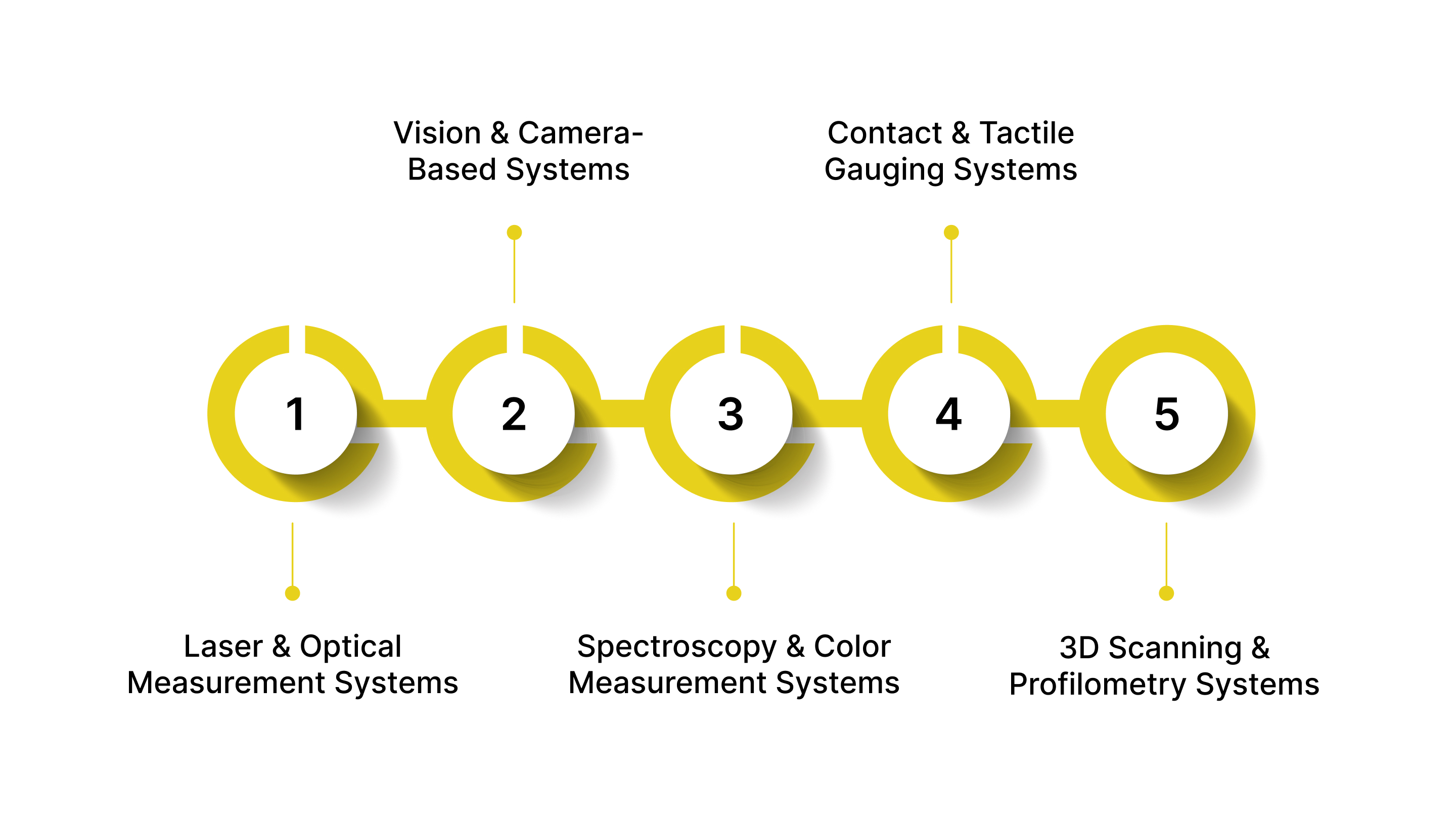
Inline measurement systems use a variety of sensing technologies, each suited for specific materials, accuracy requirements, and production environments. Below is a unified overview of the core technology categories used in modern manufacturing.
1. Laser & Optical Measurement Systems
Laser and optical sensors are widely used for high-speed, non-contact dimensional measurement of metals, plastics, films, and extrusion lines.
Core Technologies:
Laser triangulation: Measures height, surface profile, and thickness with high accuracy.
Laser micrometers: Provide precise, non-contact diameter or width measurements.
Confocal sensors: Ideal for transparent or glossy materials and multilayer structures.
Best For: Sheet materials, films, metals, cables, extrusion, and precision dimensional control.
2. Vision & Camera-Based Systems
Vision systems use 2D or 3D imaging to detect surface defects, verify part geometry, and ensure assembly accuracy.
Core Technologies:
2D machine vision: Checks labels, surface marks, edges, and completeness.
3D vision / structured light: Captures height maps for contour, flatness, and shape verification.
AI-based defect detection: Uses deep learning to classify patterns and detect subtle defects.
Best For: Automotive parts, electronics (PCBs), packaging, consumer goods, and complex assemblies.
3. Spectroscopy & Color Measurement Systems
Spectroscopy identifies chemical, moisture, coating, and material composition in real time.
Core Technologies:
NIR (Near Infrared), Raman, UV-Vis: Provide molecular-level insights.
Coating & moisture analysis: Ensures correct material properties and uniformity.
Best For: Food processing, pharmaceuticals, coatings, paper, textiles, and chemical production.
4. Contact & Tactile Gauging Systems
Contact gauges provide precise, repeatable measurement when physical touch does not damage the product.
Core Technologies:
Probes, dial gauges, LVDTs, and tactile sensors: Ideal for high-accuracy dimensional checks.
Best For: Machined parts, metal components, small mechanical assemblies, and slow-moving lines.
5. 3D Scanning & Profilometry Systems
Advanced scanning systems reconstruct full 3D geometry for high-resolution inspection.
Core Technologies:
Laser scanners, structured light, 3D profilometers: Capture width, thickness, curvature, and form.
Best For: Complex shapes, molded parts, castings, additive manufacturing, and aerospace components.
Inline Measurement System Integration
Successful integration is one of the most critical factors in deploying an inline measurement solution. To deliver real-time quality control, the system must connect smoothly with existing production equipment, automation layers, and plant-wide data platforms commonly used in U.S. factories.
Requirements for Integrating Inline Systems With Existing U.S. Factory Equipment
Inline measurement systems must work seamlessly with legacy machinery, modern automation platforms, and multi-vendor control architectures. Key requirements include:
Mechanical Compatibility: Ensuring sensors fit existing conveyors, extruders, machining centers, or robotic cells without redesigning the entire line.
Electrical & Power Compatibility: Supporting industrial voltages, safety circuits, grounding, and shielded wiring for noise protection.
Control Logic Alignment: Integration with existing line controls to trigger measurements, adjust parameters, or stop the line if limits are exceeded.
Latency Requirements: Making sure measurements and feedback occur quickly enough to support high-speed U.S. production lines.
The goal is to embed quality checks without disrupting throughput or requiring major redesigns.
PLC, MES, SCADA, and ERP Compatibility
Inline systems typically communicate with multiple automation layers, each with its own purpose:
Programmable Logic Controller: Controls real-time machine operations. Inline systems must communicate measurement outputs instantly for closed-loop adjustments.
Supervisory Control and Data Acquisition: Used for visualization, alarms, and supervisory control. Measurement data flows into SCADA for operators to view trends or deviations.
Manufacturing Execution System: Tracks production performance, quality records, and traceability. Inline data helps improve batch tracking and lot-level compliance.
Enterprise Resource Planning: Higher-level business systems use aggregated quality data for planning, maintenance, costing, and reporting.
A well-integrated inline measurement setup ensures that all these layers receive synchronized, validated data.
Data Communication Standards
U.S. factories rely on standardized industrial communication protocols to ensure interoperability across automation vendors.
Common standards include:
Ethernet/IP: Widely used in North American factories, especially those with Rockwell Automation and Allen-Bradley PLCs.
Modbus (TCP/RTU): A simple, robust protocol used for sensors, gauges, and legacy equipment.
OPC UA: The universal standard for secure, platform-independent communication. Essential for Industry 4.0 integration and cross-vendor interoperability.
MQTT: Lightweight IoT messaging protocol used in modern smart factories for cloud connectivity and predictive analytics.
These protocols ensure fast, reliable communication between measurement sensors, controllers, PLCs, and IT systems.
Considerations for Industry 4.0 and Smart Factories
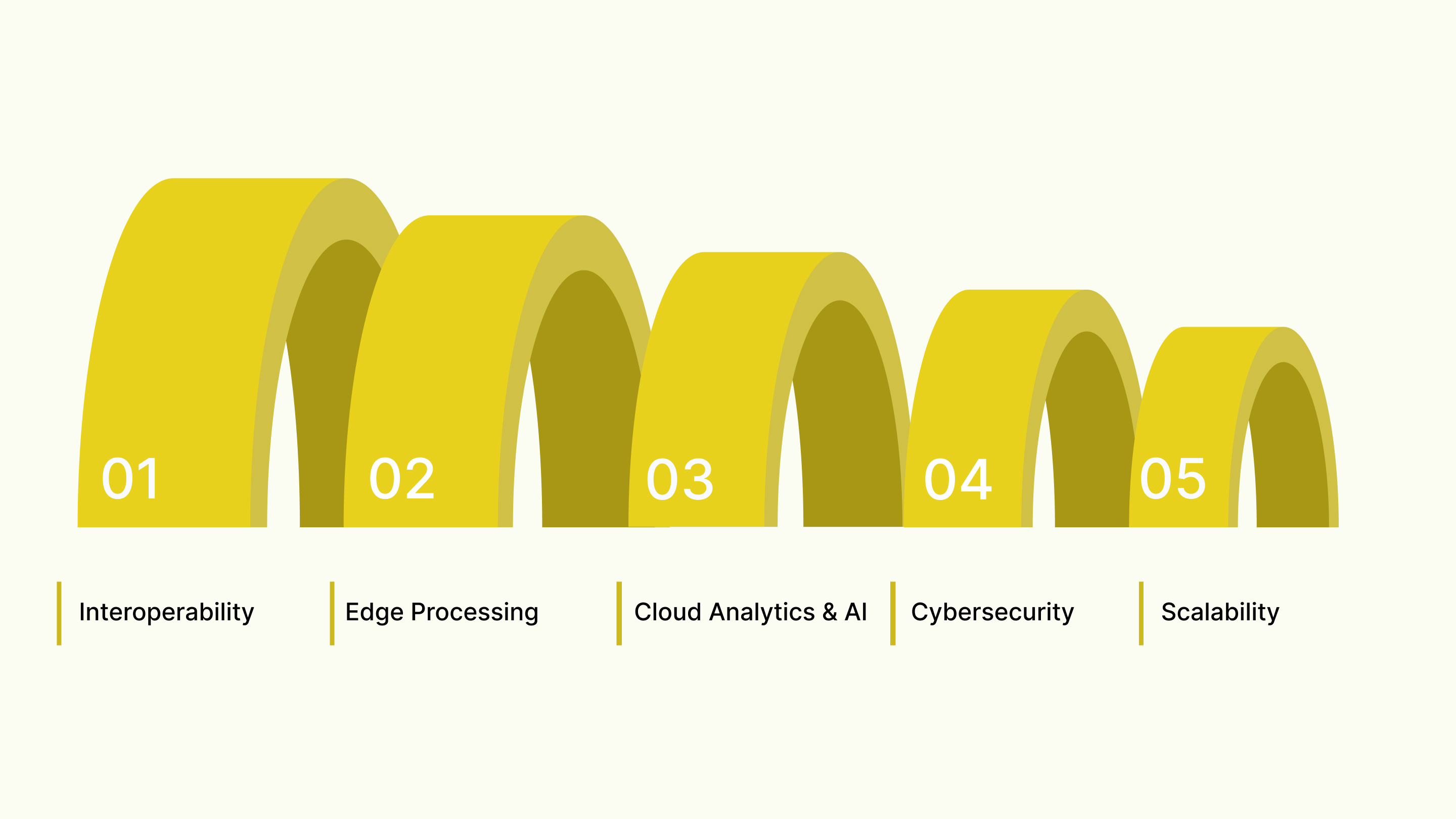
Inline measurement plays a central role in digital transformation initiatives. When integrated correctly, it becomes a core element of the smart factory ecosystem.
Key considerations include:
Interoperability: Ensuring systems can communicate across vendors, machines, and software platforms.
Edge Processing: Using edge devices to preprocess measurement data for faster decision-making.
Cloud Analytics & AI: Enabling predictive maintenance, defect prediction, and advanced statistical control using cloud platforms.
Cybersecurity: Securing sensor data, PLC communication, and IT/OT connections according to NIST and ISA/IEC 62443 guidelines.
Scalability: Allowing plants to add new production lines, sensors, or analytics tools without redesigning the integration architecture.
By aligning inline measurement with Industry 4.0 principles, U.S. manufacturers gain real-time visibility, reduce operational risk, and improve long-term process reliability.
How Inline Measurement Enhances Process Quality Control?
Inline measurement transforms quality control from a reactive activity into a proactive, data-driven process. By capturing dimensional, visual, or material information in real time, manufacturers can prevent defects, optimize performance, and maintain consistent product standards without slowing down production.
1. Real-Time Detection and Immediate Feedback
Instead of discovering defects at the end of the production line, when materials, labor, and time are already wasted, inline systems flag deviations instantly. This allows technicians or automated controls to correct parameters such as speed, temperature, tension, or pressure within seconds.
2. Reduction in Defects, Scrap, and Operational Costs
Continuous measurement ensures that issues are corrected before they escalate. Even a small reduction in scrap rates can produce substantial cost savings, especially in high-volume U.S. industries like automotive, plastics, food packaging, and metals.
3. Ensuring Compliance With U.S. Standards and Regulations
Inline systems help manufacturers meet quality benchmarks set by agencies such as the FDA, NIST and ASTM. Automated measurement reduces human variability and provides digital traceability that auditors often require.
4. Minimizing Human Error and Operator Variability
Manual inspections depend on operator skill, consistency, and attention, and errors can easily occur under time pressure or fatigue. Inline measurement standardizes inspection using calibrated sensors and algorithms.
5. Enabling Predictive and Prescriptive Quality Control
Modern inline systems generate continuous data streams that feed analytics platforms or AI models. This enables:
Early detection of process drifts,
Prediction of future defects, and
Automatic adjustment of machine parameters.
Key Performance Metrics (KPIs) to Track
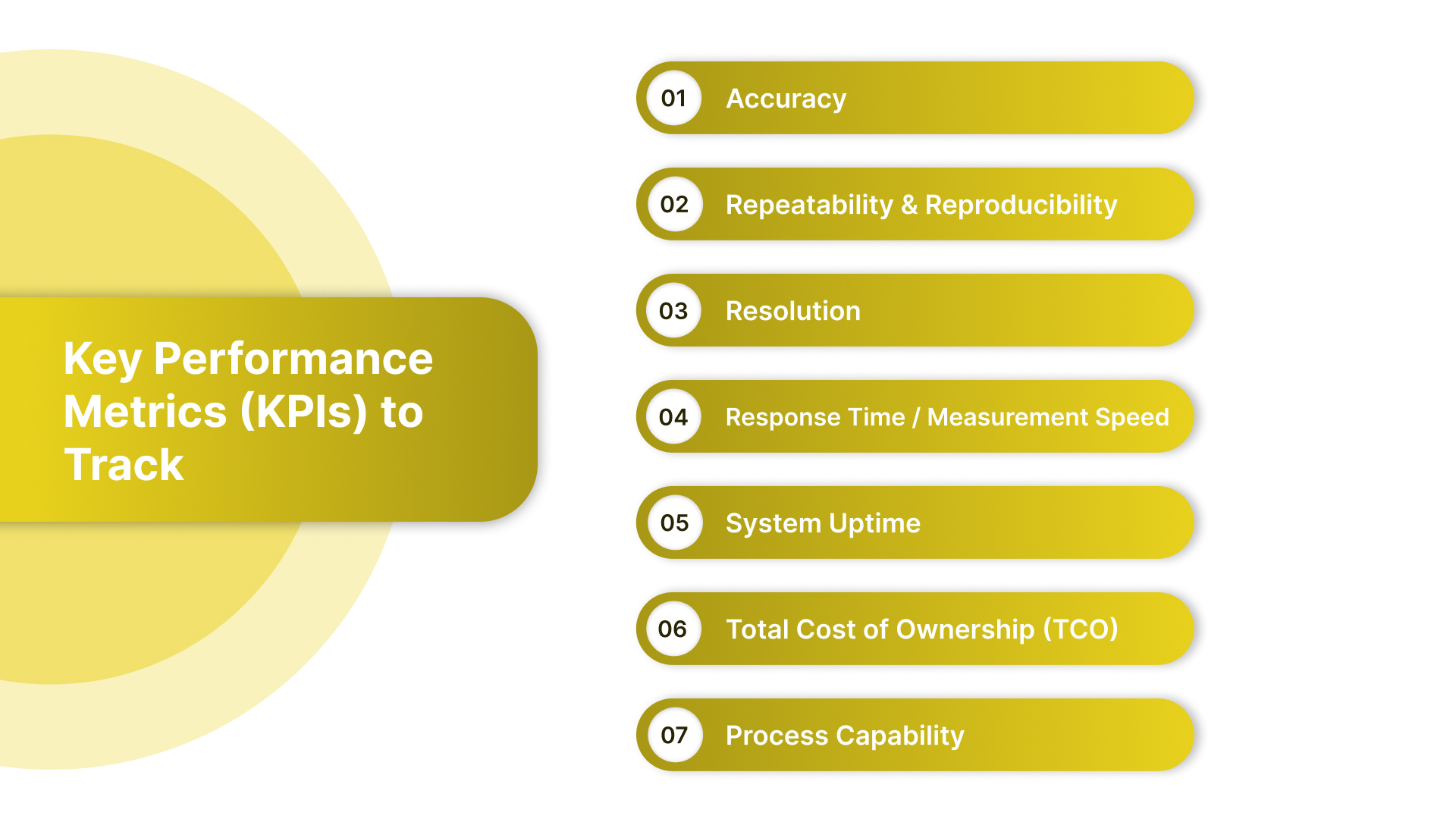
Tracking the right KPIs helps manufacturers evaluate whether an inline measurement system is improving quality, reducing defects, and stabilizing process performance. The most important metrics include:
Accuracy: How closely the measurement matches the true value. Critical for tight tolerances.
Repeatability & Reproducibility (R&R): Ensures consistent measurements across time, operators, and equipment.
Resolution: The smallest detectable change in measurement, important for thin materials or micro-dimensions.
Response Time / Measurement Speed: Determines whether the system can keep up with fast-moving production lines.
System Uptime: Indicates reliability and how frequently the equipment is unavailable due to maintenance or faults.
Total Cost of Ownership (TCO): Covers hardware, calibration, software, training, consumables, and long-term operational expenses.
Process Capability (Cp, Cpk): Inline measurement data directly supports SPC metrics such as Cp and Cpk, helping manufacturers verify whether processes remain capable and within control limits over time.
Common Use Cases in U.S. Manufacturing
Inline measurement systems are versatile and have found applications across a wide range of U.S. manufacturing sectors. By providing real-time data and automated feedback, these systems improve product quality, reduce scrap, and increase process efficiency.
Metal Thickness Measurement in Rolling Mills: Laser and optical sensors are used to measure the thickness of steel, aluminum, or copper as it moves through rolling mills. Real-time monitoring ensures uniform thickness and prevents material defects.
Automotive Component Verification: Vision systems and 3D scanners inspect critical automotive parts such as engine blocks, transmissions, and assembled subcomponents. Measurements include dimensional accuracy, surface defects, and proper assembly alignment.
PCB Inspection in Electronics: Inline vision systems, combined with AI-based defect detection, inspect printed circuit boards (PCBs) for soldering defects, misaligned components, or trace inconsistencies.
Bottle and Label Inspection in Packaging: Vision systems verify label placement, text legibility, color consistency, and cap alignment on bottles, cans, or containers in packaging lines.
Surface Defect Detection in Plastics and Films: Laser and vision-based systems detect scratches, dents, bubbles, or contamination in plastic sheets, films, and coatings during production.
How to Choose the Right Inline Measurement System
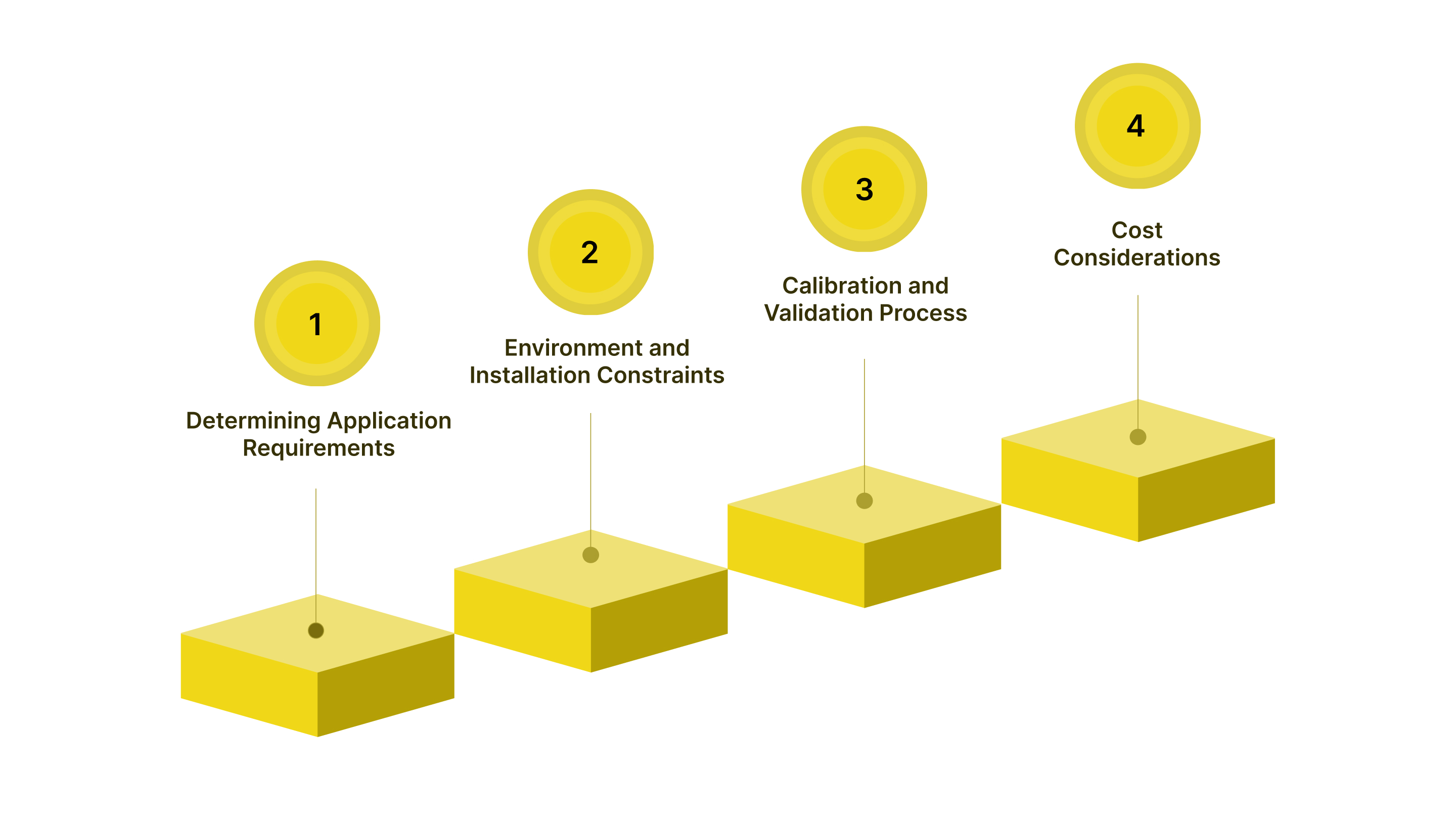
Selecting the right inline measurement system is crucial for achieving accurate, real-time quality control while maximizing return on investment. The process involves evaluating your production needs, environmental conditions, system capabilities, and vendor support.
Determining Application Requirements: Begin by defining exactly what you need the system to measure and monitor:
Dimensions, surface defects, chemical composition, coating thickness, or moisture content
Required measurement accuracy and resolution
Production speed and throughput considerations
Integration needs with existing machinery or automation systems
Tip: Map out all critical quality parameters to ensure the system addresses the most impactful areas of your process.
Environment and Installation Constraints: The production environment significantly affects system performance:
Space limitations and sensor placement options
Temperature, humidity, vibration, dust, and lighting conditions
Line speed and product orientation
Access for maintenance and calibration
Tip: Choose systems rated for industrial conditions and consider protective housings or environmental enclosures when necessary.
Calibration and Validation Process: Ensure the system can be calibrated accurately and easily maintained over time:
Regular calibration schedules and methods
Traceable reference standards
Validation protocols to confirm ongoing measurement accuracy
Tip: Systems with automated or self-calibrating features reduce downtime and maintain consistent accuracy.
Cost Considerations: Evaluate the total cost of ownership, not just the initial purchase price:
Hardware costs: Sensors, cameras, probes, and supporting electronics
Software costs: Analytics, visualization, and integration tools
Training: Operator and maintenance training requirements
Maintenance and consumables: Replacement parts, calibration, and service contracts
Tip: Balance cost against potential savings from reduced scrap, rework, and improved process efficiency.
Hammer-IMS: A Leading Provider of Inline Quality Control Solutions
If you’re evaluating inline measurement systems for your production line, Hammer-IMS stands out as a strong candidate, especially for manufacturers looking for non-nuclear, flexible, and highly accurate solutions suitable for modern U.S. industry conditions.
Innovative & Safe Sensing Technology: Hammer-IMS is built around its proprietary “M-Ray” measurement technology, which uses millimeter-wave (and related high-frequency) electromagnetic sensing combined with sophisticated software algorithms and mechanical platforms.
Versatile Across Industries & Materials: Their systems support a wide variety of materials, including nonwovens, textiles, plastics, films, mineral wool, coatings, composite materials, and more.
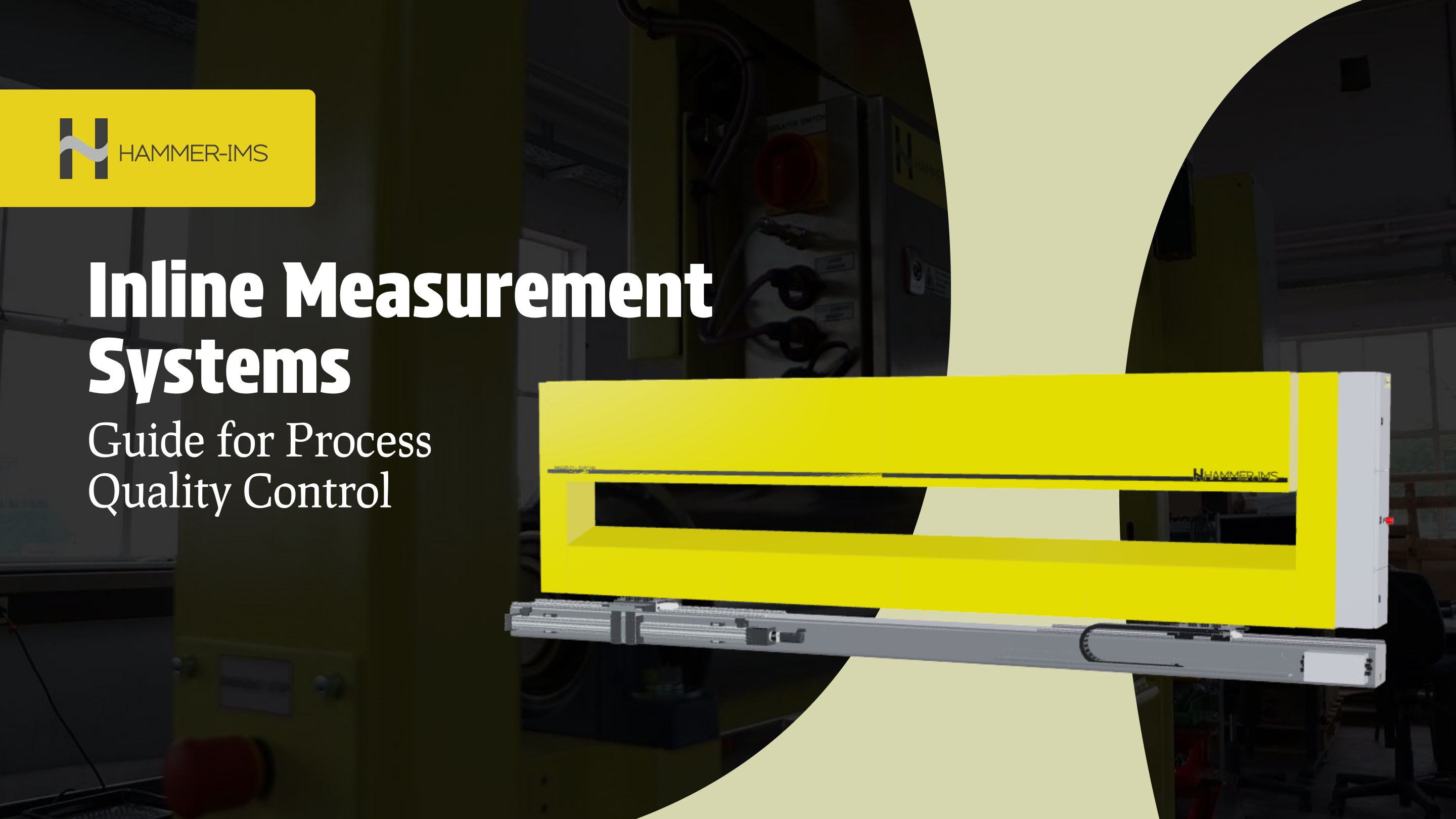
Modular & Scalable Platforms: Hammer-IMS offers both large-frame (CURTAIN) and compact (CHARIOT) scanner platforms, enabling adaptation to wide production lines as well as tight spaces, depending on your facility layout and throughput needs.
Real-Time, Multi-Sensor & 100% Coverage Capabilities: Their systems can combine multiple sensors for comprehensive measurement, and scan entire sheet widths in real time, giving near-100 % coverage rather than spot checks.
If you’re looking to improve quality, reduce waste, and modernize your production line, now is the time to invest in a smarter measurement solution. Explore advanced, non-nuclear inline systems with Hammer-IMS and discover how precision, automation, and reliability can transform your manufacturing performance.
Conclusion
Inline measurement systems are transforming U.S. manufacturing by shifting quality control from reactive inspection to real-time, data-driven process management. By integrating sensors, vision systems, spectroscopy, or 3D scanning directly into production lines, manufacturers can detect defects instantly, reduce scrap, improve compliance, and optimize throughput.
Choosing the right system requires a careful assessment of application requirements, environmental conditions, calibration needs, total cost, and vendor support. When implemented effectively, inline measurement not only ensures consistent product quality but also enhances operational efficiency, supports Industry 4.0 initiatives, and strengthens competitive advantage.
For manufacturers striving to meet stringent quality standards while maintaining productivity, investing in an inline measurement system is no longer optional. It’s a strategic necessity.
Take the Next Step Toward Smarter Quality Control.
Don’t let outdated inspection methods slow down your production or compromise product consistency. Upgrade to advanced inline measurement technology and unlock higher accuracy, better efficiency, and long-term cost savings.
Contact Hammer-IMS today to explore solutions tailored to your manufacturing needs.
FAQs
1. What industries benefit most from inline measurement?
Industries with tight tolerances and high-volume production, such as automotive, aerospace, electronics, packaging, pharmaceuticals, metals, and plastics, benefit most, improving quality, compliance, and throughput while reducing scrap and rework.
2. How accurate are modern inline measurement systems?
Modern inline systems achieve micrometer-level accuracy for dimensional measurements and sub-percentage precision for chemical or coating analysis, making them suitable for high-speed production while maintaining consistent, repeatable results.
3. Can inline systems replace manual inspection?
Inline systems complement or often replace manual inspection, especially in high-speed or high-volume lines, reducing human error and variability, but manual checks may still be used for final verification or complex tasks.
4. How often do inline systems require calibration?
Calibration frequency depends on system type, production speed, and environmental conditions. Typically, major recalibration occurs every 6–12 months, with minor checks or automated calibrations performed weekly or daily.