
Introduction
A sagging shelf under load. A panel that buckles mid-installation. These aren't just quality failures—they're costly project setbacks that trace back to a single decision: choosing the wrong MDF board thickness. For builders, this means rework, material replacement, and frustrated clients. For manufacturers, it translates to rejected panels, production waste, and margin erosion.
MDF thickness affects far more than structural performance. It shapes material cost, production waste, and downstream processing quality: lamination adhesion, CNC routing accuracy, and panel stability all depend on getting the specification right. Over-specifying thickness adds unnecessary expense; under-specifying invites premature failure.
Getting the selection right means understanding how thickness interacts with load, span, moisture exposure, and budget. For manufacturers, thickness consistency within tolerances directly determines output quality and material yield.
This guide covers standard thickness ranges, the factors that match boards to specific applications, and why thickness control during manufacturing is as important as the specification itself.
Key Takeaways
- MDF thickness ranges from 3mm to 50mm, with each range engineered for specific structural and aesthetic demands
- Thin boards (3–6mm) suit decorative overlays; medium (9–15mm) handle light furniture; standard (18–25mm) support structural cabinetry; heavy-duty (30–50mm) are for load-bearing applications
- Selection depends on structural load, span length, moisture exposure, surface finish, and budget — not habit or convention
- Thickness tolerances of ±0.2mm to ±0.5mm directly affect lamination quality, CNC accuracy, and panel rejection rates
- Real-time, contactless measurement systems allow manufacturers to correct thickness deviations before they cascade into waste
What is MDF Board Thickness?
MDF board thickness is the cross-sectional depth of engineered wood panels made from compressed wood fibers and resin binders. This single dimension determines a board's structural stiffness, load capacity, weight, and cost. Commercially available MDF boards span 3mm to 50mm, and selecting the right value requires matching board properties to the mechanical and environmental demands of the application—not defaulting to the thickest option available.
Core Thickness Categories
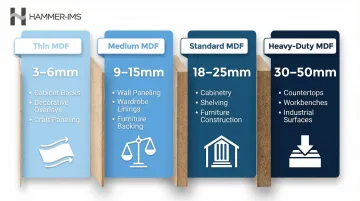
Thin MDF (3–6mm): These lightweight, flexible boards serve decorative and non-structural roles. Common applications include:
- Cabinet backs and drawer bottoms
- Decorative overlays and veneered panels
- Curved or radius work where flexibility matters more than strength
- Craft projects and display fixtures
Medium MDF (9–15mm): This mid-range balances rigidity with ease of handling, making it the workhorse for interior applications:
- Interior wall paneling and wainscoting
- Wardrobe linings and closet shelving
- Lightweight door panels
- Small furniture components where moderate strength suffices
Standard MDF (18–25mm): The most widely used structural range, accounting for the majority of furniture and cabinetry applications:
- Kitchen and bathroom cabinetry carcasses
- Bookshelves, desks, and bed frames
- Shelving units that resist sagging under sustained loads
- Applications requiring reliable fastener-holding strength
18mm is the established baseline thickness for furniture carcasses and cabinetry across global markets.
Heavy-Duty MDF (30–50mm): Reserved for high-load applications where maximum stiffness is non-negotiable:
- Kitchen islands and commercial countertops
- Workbenches subjected to concentrated loads
- Long-span shelving requiring minimal deflection
- Structural cores in composite assemblies
The trade-off: considerably higher weight, material cost, and handling complexity.
Benefits of Selecting the Right Thickness
Correct thickness selection prevents deflection, fastener pull-out, and premature failure. A 12mm shelf spanning 900mm will sag visibly under load; an 18mm board in the same application holds firm. Getting this right eliminates rework, material replacement, and project delays.
Specifying the minimum thickness that meets structural and aesthetic requirements also avoids over-engineering. For large production runs, reducing specified thickness by just 3mm across a batch can yield real cost savings without compromising performance. The reduction cuts material expenditure, shipping weight, and downstream waste in one move.
Key Factors to Consider When Choosing MDF Board Thickness
MDF thickness isn't a single-variable decision. Structural performance, application context, environmental conditions, and cost all pull in different directions. The factors below translate those competing requirements into a specific thickness specification.
Structural Load and Span Length
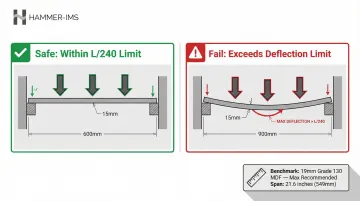
Longer unsupported spans and heavier applied loads demand greater board thickness to prevent deflection. The Composite Panel Association establishes the visual deflection limit for MDF shelving at L/240—meaning a shelf should not deflect more than its span divided by 240 under load.
Under a 50 psf uniform load, a 3/4" (19mm) Grade 130 MDF shelf can span 21.6 inches before exceeding this limit. For heavy loads, spans exceeding 24 inches require thicker material (typically 25mm), continuous back support, or rigid edge-lipping to prevent sagging.
Failure to account for span-to-thickness ratio is the primary cause of shelf sag and panel failure in both residential and commercial installations. A 15mm board adequate for a 600mm span will fail visibly at 900mm under the same load.
Intended Application and Function
Match thickness to what the board actually needs to do:
- Cabinet backs, decorative panels, and overlays prioritize appearance over load capacity — thinner boards work fine
- Furniture frames, shelving, and cabinetry under sustained loads require thicker boards with higher internal bond strength
- Wall cladding and acoustic panels sit in between, where rigidity matters but full structural loading doesn't apply
Application type also determines whether surface-grade MDF (standard, melamine-faced, veneered) or specialty grades (moisture-resistant, fire-retardant) belong in the specification. These grades don't replace thickness requirements; they supplement them.
Environmental and Moisture Conditions
Standard MDF absorbs moisture and swells, making moisture-resistant (MR/HMR) grades essential in kitchens, bathrooms, or high-humidity environments. Thin MDF is significantly more vulnerable to moisture swelling than thick MDF — EN 622-5 allows up to 45% thickness swell for 1.8–2.5mm boards, compared to just 6% for boards over 45mm.
Moisture-resistant grades are explicitly required for kitchen furniture, bathroom furniture, architectural mouldings, and window boards — environments where standard MDF breaks down rapidly within 600mm of water sources.
Critical point: MR grade selection must accompany the thickness decision, not replace it. A 12mm moisture-resistant board will still fail structurally if the application requires 18mm thickness for span and load.
Budget and Material Cost Efficiency
Board cost, shipping weight, and cutting waste all scale with thickness. Over-specifying thickness adds cost without proportional performance gain in many applications.
For large production runs or commercial fit-outs, even a 3mm reduction in specified thickness across a batch produces measurable savings. Getting the specification right — not over-engineering, not under-specifying — is where the real cost control happens.
Thickness Tolerance and Consistency
MDF boards are manufactured within defined thickness tolerance ranges — typically ±0.2mm to ±0.5mm depending on grade and standard. North American ANSI A208.2 mandates a strict ±0.125mm tolerance for sanded panels.
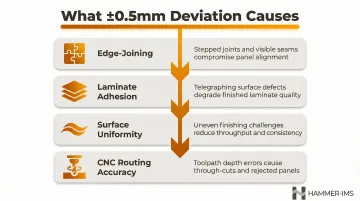
This variation affects:
- Edge-joining accuracy: Inconsistent thickness creates stepped joints and visible seams
- Laminate adhesion: Variations push flaws through thin laminates, causing "telegraphing" (visual surface defects)
- Surface uniformity: Uneven boards create finishing challenges
- CNC routing accuracy: Thickness variations cause toolpath depth errors — dados cut too shallow in thicker areas, or through-cuts that leave a paper-thin skin
For industrial-scale applications, specify boards with tolerance data from the manufacturer. Asking for a tolerance certificate before committing to a batch is standard practice on precision joinery and CNC-routed panel work.
Why Thickness Consistency Matters in MDF Manufacturing
In industrial panel production, thickness consistency is not merely a product specification—it's a key production quality indicator. Boards that deviate from target thickness, even by fractions of a millimetre, create cascading problems downstream:
- Lamination failure at bonding surfaces
- Surface finish defects that fail visual inspection
- Processing errors in CNC routing and edge-banding operations
Approximately 25% of produced MDF converts into waste due to machining errors, leftovers, and transport/storage losses, with sanding waste alone constituting roughly 11% of total weight. While not all waste traces to thickness variation, out-of-spec boards amplify rejection rates across the production chain.
Closed-loop thickness monitoring during production (where real-time measurement data feeds directly back to the press or forming process) enables manufacturers to correct deviations before they propagate across an entire production run. This cuts rejection rates, improves material yield, and reduces the sanding margin required to bring boards within tolerance.
The global MDF market exceeded 110 million cubic metres in 2023, valued at approximately €31–40 billion. At this scale, even a 1% reduction in thickness-related rejection represents hundreds of millions in recovered yield.
How Hammer-IMS Can Help
Hammer-IMS provides non-nuclear, contactless industrial measurement solutions specifically designed for production-line thickness control—positioned for manufacturers who need real-time precision without the regulatory complexity of nuclear gauging systems.
M-Ray Technology: Contactless Millimeter Wave Measurement
M-Ray technology is a millimeter wave-based measurement approach that delivers contactless, high-accuracy thickness readings at production line speed. Unlike nuclear systems, M-Ray uses electromagnetic millimeter waves (30–300 GHz) to penetrate materials up to 30 centimeters thick, enabling continuous inline measurement without slowing or interrupting production.
The system measures both thickness and basis weight. Multiple traveling sensors move across the material in the cross-machine direction, delivering nearly 100% coverage and catching local deviations that correspond to individual press components.
These capabilities translate directly into tighter process control—which is where the operational benefits for MDF manufacturers become concrete.
Key Operational Benefits for MDF Manufacturers
- Feeds thickness data directly to the press via Modbus TCP/IP and OPC/UA protocols, enabling automatic corrections that keep boards within tolerance
- Scans the complete panel width in a single pass, catching thickness variations that fixed-point sensors miss
- Allows manufacturers to target tighter tolerances, reducing sanding margin and lowering material waste
- Eliminates nuclear gauging requirements—no emission licenses, no radiation training, no waste processing costs
- Connects to existing quality management systems via Profinet and TCP/IP, supporting data logging, production trend tracking, and Industry 4.0 analytics
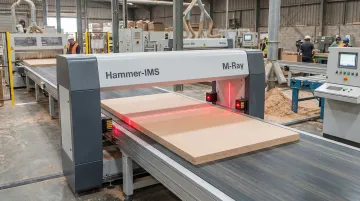
For MDF manufacturers running continuous press lines, that combination of coverage, speed, and closed-loop feedback is what keeps panel thickness consistent from the first board to the last.
Conclusion
The right MDF board thickness is determined by the specific demands of the application—structural load, span, moisture conditions, and budget—not by convention or default choices. Misjudging this decision costs time, money, and material, whether through sagging shelves, lamination failures, or CNC routing errors.
For manufacturers and industrial producers, thickness selection at the specification stage must be matched by consistent thickness delivery at the production stage. Boards manufactured outside tolerance limits cascade into downstream processing failures, rejected panels, and margin erosion.
Real-time measurement systems ensure that boards leaving the line match the target spec. When they do, material waste, rework, and rejection rates all fall — and in high-volume production, even small yield gains compound quickly into meaningful cost recovery.
Key takeaways for MDF producers:
- Match thickness specification to load, span, and end-use conditions
- Hold production tolerances tight — out-of-spec boards create cascading downstream failures
- Use real-time, inline measurement to catch deviations before they become rejections
Frequently Asked Questions
What is non-destructive thickness measurement?
Non-destructive thickness measurement assesses board dimensions without cutting, pressing, or damaging the material. It uses technologies such as ultrasonic or millimeter-wave methods to enable continuous inline quality control without interrupting the manufacturing process.
What is the most common MDF board thickness for furniture?
18mm (approximately 3/4") is the most widely used thickness for furniture carcasses, shelving, and cabinetry worldwide. It balances structural rigidity, fastener-holding strength, and weight — making it the go-to choice for furniture-grade applications.
How is MDF thickness tolerance defined in manufacturing?
MDF thickness tolerances are typically specified as ±0.2mm to ±0.5mm depending on product grade and applicable standard (such as EN 622-5 in Europe). North American ANSI A208.2 requires ±0.125mm for sanded panels.
Can MDF be used in moisture-prone environments, and does thickness matter?
Standard MDF is not suitable for humid environments — moisture-resistant (MR/HMR) grades are required for kitchens, bathrooms, and similar areas. Specifying MR grade does not replace the need to match thickness to structural load requirements.
What is the difference between thin and standard MDF in terms of structural strength?
Thicker MDF boards have significantly higher modulus of rupture and resistance to deflection under load. Thin boards (3–6mm) are not rated for structural use and will flex or fail under loads that standard 18–25mm boards handle without issue.
Why does MDF thickness sometimes vary within the same production batch?
Thickness variation within a batch results from press pressure inconsistencies, fiber density fluctuations, or moisture content variation during manufacturing. Inline measurement systems that catch these deviations in real time are the most reliable way to keep output within tolerance and minimize material rejection.