Introduction
Gypsum board thickness directly governs structural performance, fire resistance, acoustic properties, and code compliance. Selecting the wrong thickness—or manufacturing board outside specified tolerances—leads to compromised building safety, increased installation costs, and failed regulatory approvals.
For gypsum board manufacturers, thickness control in production is just as demanding. According to ASTM C1396, standard wallboard must maintain a strict tolerance of ±0.015 inches—deviations beyond this threshold result in boards that cannot be certified, waste raw materials, and create costly installation problems downstream.
This guide covers standard gypsum board thicknesses, their structural and fire-resistant properties, and the production control systems that keep boards on-spec from manufacturing through installation.
Key Takeaways
- Standard thicknesses range from 6.4 mm to 25.4 mm (1/4" to 1"), with 1/2" and 5/8" dominating residential and commercial applications
- Thickness selection is driven by application type, stud spacing, fire rating requirements, and building codes
- Standard sheets are 4 feet wide with lengths of 8, 12, or 16 feet
- Flexural strength and thermal resistance scale with thickness, but not at a fixed rate — thicker boards deliver disproportionate performance gains
- Manufacturing tolerances hold to ±0.015 inches for standard wallboard, making inline measurement systems essential for quality control
What Thickness Represents in Gypsum Board
Thickness is defined as the nominal dimension from the paper face to the paper back of the gypsum core panel. During production, thickness is controlled by two primary variables: the press roll gap setting and the gypsum slurry feed rate. Boards must conform to ASTM C1396 dimensional tolerances before they can be certified for distribution.
Thickness functions on three levels:
- Determines applicable use (walls vs. ceilings, single-layer vs. multi-layer assemblies)
- Governs flexural and compressive load capacity under installation and service conditions
- Establishes fire resistance hour ratings and building code acceptability
Nominal vs. Actual Thickness
Is 1/2-inch drywall actually 1/2 inch thick? Not exactly. Boards are manufactured to a tolerance band around the nominal value, not precisely at it. For standard wallboard, ASTM C1396 permits a tolerance of ±0.015 inches (±0.38 mm), with local variations allowed up to ±0.030 inches. A 1/2-inch board can measure anywhere from 0.485 to 0.515 inches and still conform to specification.
Factors That Influence Thickness in Real-World Production
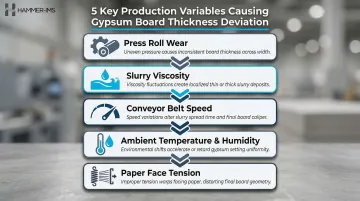
During continuous gypsum board manufacturing, several process variables cause thickness to deviate from the nominal target:
- Press roll wear — gradual erosion of roll surfaces changes the effective gap over time
- Slurry viscosity and consistency — variations in water content and gypsum particle distribution affect core density
- Conveyor belt speed — faster lines reduce dwell time under press rolls, affecting compaction
- Ambient temperature and humidity — environmental conditions alter gypsum set time and water evaporation rates
- Paper face tension — uneven tension across the width can create localized thickness variations
Downstream finishing operations—taping, skim coating, texture application—may appear to change installed thickness, but they do not alter the board's specified structural or fire-resistance properties.
This distinction matters on job sites. Installers sometimes compensate for out-of-tolerance boards with excess joint compound rather than rejecting non-conforming material—a practice that addresses appearance but not compliance.
Standard Gypsum Board Thicknesses and Their Applications
ASTM C1396 recognises seven standard nominal thicknesses: 1/4", 5/16", 3/8", 1/2", 5/8", 3/4", and 1". Each thickness is matched to specific structural, fire, and application requirements. The following sections detail the most commonly specified thicknesses.
1/4-Inch (6.4 mm)
Primary use cases:
- Double-layer applications over existing surfaces (skim coating damaged walls)
- Curved or radius wall installations where the board is wetted and bent to shape
- Archways, stairwells, and decorative features requiring flexibility
Critical limitation: GA-216 Section 5.1.2 explicitly prohibits 1/4-inch gypsum board in single-layer applications on walls or ceilings. It is not a standalone structural thickness and does not meet code requirements for primary wall or ceiling assemblies.
3/8-Inch (9.5 mm)
Used primarily in gypsum lath applications and light residential repair. ASTM C1396 includes 3/8-inch under the Type G (gypsum lath) designation. It delivers only moderate flexural strength — 80 lbf per GA-235 — and sees little use in new construction beyond applications where weight and thickness must be minimised.
1/2-Inch (12.7 mm)
This is the industry default for interior residential walls and ceilings. It balances three critical factors:
- Weight — A standard 4×8 sheet weighs 64 lbs (GA-235 lists 2.0 psf), manageable for single-person installation
- Structural adequacy — Flexural strength of 110 lbf supports 16-inch o.c. stud spacing per GA-216
- Cost efficiency — Lower material cost per square foot than thicker alternatives
Ultralight variants reduce weight to 1.25–1.4 psf (40–45 lbs per 4×8 sheet), a reduction of 19–24 lbs compared to standard product. These variants maintain the same 1/2-inch nominal thickness while substituting lighter core formulations or reduced density gypsum.
5/8-Inch (15.9 mm)
The 5/8-inch thickness serves two distinct roles:
Ceiling standard — Resists sag between joists better than 1/2-inch, particularly under heavy texture finishes. Maximum joist spacing is 16 inches o.c. when applied parallel to framing.
Fire-rated assemblies — Required for most one-hour fire-rated wall and ceiling assemblies. Two designations dominate — both use glass fibre additives to resist core cracking during calcination (the chemical breakdown of gypsum under heat):
- Type X — An ASTM C1396-defined standard providing at least one-hour fire resistance on 2×4 wood studs at 16 inches o.c.
- Type C — A proprietary designation (non-ASTM) that adds vermiculite for improved dimensional stability; preferred for horizontal ceiling fire-rated assemblies. See USG's Type X vs. Type C comparison for performance data.
The 5/8-inch threshold is the minimum for one-hour rated assemblies in most UL-tested designs, including UL U305 and UL U420.
3/4-Inch (19.0 mm) and 1-Inch (25.4 mm)
Specialty thicknesses used in steel-framed fireproofing assemblies and shaft wall construction. Not standard in residential applications. Weight becomes a significant design consideration: a 3/4-inch 4×10 sheet weighs approximately 114 lbs (based on 2.85 psf), requiring wall framing engineered to support dead loads exceeding 2.5 psf.
Standard Sheet Dimensions: Length and Width
While thickness is code-governed, sheet length and width are project-driven. Standard width is 4 feet (48 inches) across all thicknesses. Some manufacturers offer 54-inch widths for specialty applications, but these are not stocked in standard distribution.
Standard lengths:
- 8 feet — Most common for residential use; manageable weight and fits standard ceiling heights
- 12 feet — Reduces horizontal butt joints on tall walls; requires two-person handling
- 16 feet — Commercial and high-ceiling applications; minimizes joint frequency but demands crew installation
Each sheet size carries real handling and scheduling implications. The table below maps those trade-offs directly:
Dimensional trade-offs:
| Sheet Size | Weight (1/2" Standard) | Handling Requirement | Primary Use |
|---|---|---|---|
| 4×8 | 64 lbs | Single person | Residential walls/ceilings |
| 4×12 | 96 lbs | Two-person crew | Tall walls, reduced joints |
| 4×16 | 128 lbs | Crew handling | Commercial, minimal joints |
Non-standard widths and custom lengths can be special-ordered but are not stocked. Note that cement board and moisture-resistant panels may come in different module sizes and do not always match gypsum board dimensions.
Key Physical and Structural Properties by Thickness
Thickness does not scale properties linearly. Flexural strength, stiffness, thermal resistance, weight, and fire performance each follow distinct relationships with thickness. The data below draws from GA-235 — extrapolating values across thicknesses will produce errors in structural and fire calculations.
Flexural Strength and Stiffness
Minimum flexural strength per ASTM C473 increases with thickness, but not proportionally. For bearing edges perpendicular to board length:
- 1/4 inch: 50 lbf
- 3/8 inch: 80 lbf
- 1/2 inch: 110 lbf
- 5/8 inch: 150 lbf
- 1 inch: 230 lbf
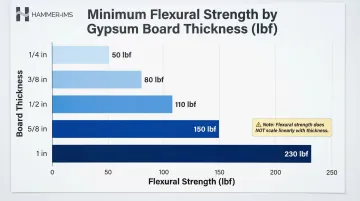
Effective stiffness (EI) is influenced by board density, relative humidity, and orientation. Thicker boards in dry conditions outperform thinner boards even of the same type designation.
Thermal and Weight Properties
| Thickness | R-Value (75°F mean) | Dead Load (psf) |
|---|---|---|
| 3/8" | 0.33 | 1.4 |
| 1/2" | 0.45 | 2.0 |
| 5/8" | 0.48 | 2.5 |
| 3/4" | 0.64 | — |
| 1" | 0.83 | 4.0 |
Dead load for 3/4" is not published in GA-235 for standard assemblies. Source: GA-235
Dead load calculations for ceiling design must account for weight per square foot. A 5/8-inch ceiling at 2.5 psf plus texture finish can exceed 3.0 psf total load—a critical input for joist spacing and hanger design.
Fire and Surface Burning
Gypsum board exhibits a flame spread index of 15 and smoke developed index of 0 per ASTM E84, regardless of thickness. However, fire resistance ratings depend on assembly configuration and thickness.
The 5/8-inch Type X and Type C designations are required for one-hour rated assemblies because:
- Glass fibre additives delay core calcination
- Greater thickness provides more gypsum to absorb heat before structural failure
- Vermiculite (in Type C) compensates for shrinkage in horizontal applications
Beyond fire performance, thickness affects moisture resistance. Thicker boards resist humidified deflection more effectively — a key consideration for ceilings exposed to moisture-laden air or water intrusion events.
How Gypsum Board Thickness Is Specified, Measured, and Controlled
Specification Pathway
Nominal thickness appears on engineering drawings, referenced to ASTM C1396 type designations. The actual acceptable dimensional range is governed by the standard's tolerance provisions:
- Standard wallboard: ±0.015 inches (±0.38 mm)
- Gypsum backing/coreboard: ±0.030 inches (±0.76 mm)
Manufactured values are verified via ASTM C473 test methods before product leaves the plant.
Conventional Measurement Methods
Manual caliper gauging requires line stoppage and provides point-in-time data at limited locations. Technicians use a 1-inch hand micrometer with 1/4-inch diameter anvils graduated to 0.01 inches.
This method cannot maintain ±0.015-inch tolerance across full-width, continuous production runs. Missed deviations are only detected after boards are cut and staged for shipment.
Continuous Inline Thickness Measurement
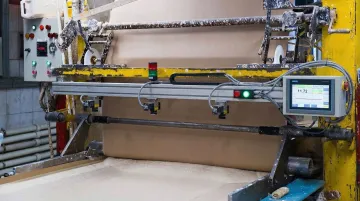
Modern gypsum board manufacturing demands real-time, non-contact measurement systems that monitor thickness continuously across the full board width. Hammer-IMS offers inline measurement solutions for gypsum and plasterboard production using millimetre-wave contactless sensing technology.
Unlike nuclear or isotope-based thickness gauges—which require radiation licensing, regulatory compliance, and periodic source recertification—millimetre-wave systems operate without radioactive materials. This eliminates licensing burden, reduces maintenance complexity, and avoids the performance limitations of nuclear sources when measuring thicker materials.
Continuous inline systems provide closed-loop feedback to press roll actuators, enabling real-time thickness correction based on measured deviations. This approach reduces material waste, maintains tighter tolerances, and prevents out-of-spec boards from reaching the cutting station.
Consequences of Thickness Deviation in Production
Undersized board fails ASTM C1396 minimums and cannot be certified. It may also fail to meet fire resistance ratings or structural load requirements, creating liability exposure for manufacturers.
Oversized board wastes raw gypsum, increases weight (raising material cost per panel and shipping costs), and may cause installation fit problems. When installers encounter boards of varying thickness at abutting seams, they cannot achieve a flat plane, requiring excessive joint compound and creating visible ridges or recesses in the finished surface.
Frequently Asked Questions
Is 1/2 inch drywall actually 1/2 inch thick?
Nominal thickness is a specification target, not a guaranteed exact dimension. A 1/2-inch board may measure slightly above or below 12.7 mm whilst still conforming to ASTM C1396 requirements, which permit a tolerance of ±0.015 inches (±0.38 mm) for standard wallboard.
What is the standard gypsum board thickness for walls vs. ceilings?
1/2-inch is standard for interior residential walls. 5/8-inch is preferred for ceilings because it resists sag between joists better, particularly under the weight of texture finishes, and accommodates the maximum 16-inch o.c. joist spacing when applied parallel to framing.
What are the standard sheet dimensions for gypsum board?
Standard width is 4 feet (48 inches) with variable lengths of 8, 12, or 16 feet. The 4×8 sheet is most common for residential use, whilst longer sheets are used in commercial or high-ceiling applications to minimize horizontal butt joints and improve surface continuity.
How does gypsum board thickness affect fire resistance ratings?
5/8-inch Type X and Type C boards are the minimum thickness required for most one-hour rated assemblies. Fire resistance is an assembly rating — not the board alone — but these boards' glass fiber and additive composition delays calcination and maintains structural integrity under fire exposure.
What tolerance is acceptable for gypsum board thickness during manufacturing?
ASTM C1396 governs dimensional tolerances. Standard wallboard must maintain ±0.015 inches (±0.38 mm) of nominal thickness — boards outside this range fail certification and create installation and performance problems.
How is gypsum board thickness measured in production?
Traditional manual caliper measurement requires line stoppage and provides limited coverage. Modern inline non-contact systems using millimetre-wave or electromagnetic sensing measure continuously across the full board width in real time, enabling immediate process correction without halting output and holding tighter tolerances across the full production run.