Introduction
Panel thickness is the physical property that determines which sound frequencies an acoustic panel can capture and how effectively it controls reverberation. Because acoustic physics dictates that absorbers need to be at least one-quarter of a wavelength thick to absorb incident sound effectively, the thickness you select predetermines whether your treatment will succeed or fail.
Selecting the wrong thickness creates predictable failure modes. Panels too thin for the target frequency range leave low-frequency noise untreated, producing rooms that sound boomy despite visible coverage. Panels thicker than the material's saturation point waste budget and reduce usable room volume without improving performance.
For manufacturers producing acoustic panel substrates, maintaining consistent thickness across production runs is as critical as the target thickness specification itself — acoustic performance is inextricably linked to material depth. This guide covers how to select the right panel thickness for common use cases, where the physics-based thresholds sit, and what manufacturing consistency means for real-world acoustic results.
Key Takeaways
- Panel thickness determines frequency range absorption—thin panels handle high/mid frequencies; thick panels capture low frequencies and bass
- Quarter-Wave Rule: a panel must reach at least one-quarter of the target sound wavelength before absorption begins
- Common thickness categories: 1" panels for speech-dominant spaces; 2" panels for broadband absorption; 3"–4"+ for low-frequency control
- NRC ratings plateau around 1.5"–2" for mid/high frequencies; beyond that, added thickness pays off only in low-frequency absorption
What Panel Thickness Represents in Acoustic Treatment
Panel thickness is the perpendicular distance from the panel's front-facing absorption surface to its backing material, typically measured in inches or millimetres and distinct from panel face dimensions (length × width). Unlike surface dimensions that can be adjusted aesthetically, thickness is a design parameter chosen based on frequency targets and absorption coefficient requirements.
Once installed, it becomes a fixed constraint that cannot be changed without replacing the entire panel.
This dimension directly determines which portion of the audible frequency spectrum the panel can affect. A 1" panel physically cannot absorb bass frequencies below approximately 500 Hz with meaningful efficiency, regardless of how many panels you install or where you place them. The wavelength of those frequencies is simply too long relative to the material depth for viscous dissipation to occur.
Factors That Influence Required Thickness
Two panels with identical 2" thickness can perform very differently depending on material density and porosity. A 2" panel in rigid fibreglass (such as Owens Corning 703 at 3.0 pcf density) and a 2" panel in low-density acoustic foam will not produce the same NRC rating. Material density and airflow resistivity directly affect absorption efficiency at a given thickness. Denser materials with optimal flow resistance (16,000–27,000 Pa·s/m²) achieve higher absorption through greater viscous friction. This means thickness and material are coupled variables that must be evaluated together.
Real-world deviations further complicate performance predictions:
- Manufacturing tolerances: Industry-standard acoustic boards specify thickness tolerances of ±1/16" (1.59 mm), which can alter measured NRC by 5–10% at critical frequencies
- Compression under load: Panels mounted against walls under mechanical pressure experience thickness reduction; acoustic absorption properties decrease during compression because material thickness decreases
- Environmental effects: Moisture uptake in hygroscopic materials can alter performance, though in some pulp-based fibres, moisture content above 9% actually increases low-mid frequency absorption due to fibre swelling
How Thickness Governs Frequency Absorption: The Quarter-Wave Principle
The Quarter-Wave Rule is the governing physics principle: for a sound-absorbing material to begin capturing a given frequency, its thickness must equal at least one-quarter of that frequency's wavelength. The wavelength calculation is straightforward: Wavelength = Speed of Sound (343 m/s at 20°C) / Frequency.
Quarter-Wave Thickness Requirements:
| Frequency | Wavelength | Quarter-Wave Thickness Required |
|---|---|---|
| 125 Hz (bass) | 2.74 m (9.0 ft) | 0.686 m (27.01") |
| 500 Hz (mid) | 0.686 m (2.25 ft) | 0.172 m (6.75") |
| 4000 Hz (high) | 0.086 m (0.28 ft) | 0.021 m (0.84") |
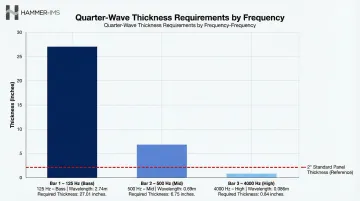
The numbers explain why standard wall panels fail at bass control. Absorbing a 125 Hz wave—common in male vocals, bass guitars, and room modes—requires roughly 27 inches of porous material depth. At 1" or 2", wall panels simply cannot function as true bass traps.
The Absorption Efficiency Curve
Low-frequency absorption usually increases with the thickness of the porous absorber, but mid-to-high frequency absorption reaches a plateau near 1.00 (100% absorption) once thickness exceeds approximately 1.5"–2". Beyond that threshold, adding material depth yields no further benefit in the mid and high ranges.
Owens Corning 703 Performance by Thickness (ASTM C423 Type A mounting):
| Thickness | 125 Hz | 500 Hz | 2000 Hz | NRC |
|---|---|---|---|---|
| 1 inch | 0.03 | 0.65 | 0.99 | 0.70 |
| 2 inch | 0.10 | 1.14 | 1.03 | 1.00 |
| 4 inch | 0.51 | 1.24 | 1.04 | 1.15 |
Moving from 2" to 4" thickness drastically improves 125 Hz absorption (from 0.10 to 0.51), while 2000 Hz absorption remains flat at ~1.00. Every extra inch of material continues to pay off at low frequencies — while doing almost nothing for frequencies already at saturation.
Why Low Frequencies Are Fundamentally More Difficult
Low frequencies are physically harder to absorb because their wavelengths are exceptionally long — 60 Hz, for example, has a wavelength of approximately 5.7 metres (18.76 feet). At a rigid boundary like a wall, particle velocity (the mechanism by which porous absorbers dissipate sound) is zero. Because particle velocity at a rigid boundary is zero, placing thin porous absorbers directly on a boundary renders them highly inefficient at low frequencies.
The practical consequences for room treatment:
- Thin wall panels (1"–2") cannot absorb bass frequencies regardless of material density
- Bass traps require 6"–12"+ material depth to engage wavelengths below 200 Hz
- Corner placement exploits boundary effects where multiple room modes accumulate, improving efficiency without requiring infinite material depth
Air Gap Mounting: A Supplemental Strategy
Mounting a panel away from the wall surface creates an effective increase in low-frequency absorption without requiring thicker material. This works because spacing porous absorbers away from a wall yields excellent low-frequency performance — the air gap shifts the steep absorption increase towards lower frequencies, effectively mimicking a much thicker panel.
ASTM E795 Type E mounting specifies testing with an air space behind the specimen, which inflates low-frequency test results. Mounting a 2" panel with a 2" air gap approximates the low-frequency performance of a 4" panel while maintaining the same installed depth.
NRC Limitations
NRC (Noise Reduction Coefficient) is averaged across four octave bands: 250 Hz, 500 Hz, 1 kHz, and 2 kHz. The NRC completely omits performance at 125 Hz and below, meaning it captures nothing about low-frequency behaviour. A panel rated NRC 0.95 can still perform poorly at 125 Hz — the frequency range responsible for most audible problems in music studios and home theatres. Anyone specifying panels for critical listening environments should require full octave-band absorption data, not just the single NRC figure.
Thickness Ranges for Different Panel Types and Applications
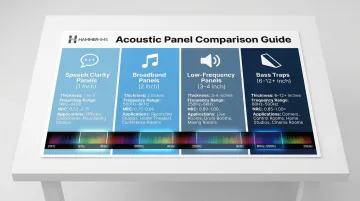
Acoustic Panel Thickness Reference Guide:
| Panel Type | Thickness Range | Effective Frequency Range | Typical NRC Range | Primary Applications |
|---|---|---|---|---|
| Speech Clarity Panels | 1" | >1,000 Hz | 0.65–0.80 | Offices, classrooms, conference rooms, restaurants |
| Broadband Panels | 2" | >500 Hz | 0.95–1.10 | Music studios, home theatres, control rooms, mixed-use spaces |
| Low-Frequency Panels | 3"–4" | >250 Hz | 1.05–1.20 | High-output speaker environments, live rooms, broadcast studios |
| Bass Traps | 6"–12"+ | <125 Hz | N/A (low-freq only) | Corner placement, subwoofer management, studio low-end control |
The 1" vs. 2" Decision Threshold
1" panels are sufficient when the dominant acoustic challenge is human speech reverberation—frequencies above 1,000 Hz where consonants and clarity reside. For offices, classrooms, and conference rooms targeting speech intelligibility, 1" panels provide adequate absorption.
2" panels are needed when musical content, lower-frequency HVAC noise, or male vocal energy below 500 Hz is present. A practical rule: speech-only spaces call for 1"; music or mixed-content environments call for 2".
The Upper Boundary: When Panels Become "Too Thick"
Beyond approximately 2" thickness, further increases yield no meaningful mid/high frequency absorption gain. The absorption coefficient at 2,000 Hz remains at or near 1.00 regardless of whether the panel is 2", 3", or 4" thick. Additional thickness above this threshold is only justified when the target application includes frequencies below approximately 250–300 Hz.
For speech-only office environments, 4" panels add cost and wall protrusion without any acoustic return: absorption at speech frequencies is already maxed out at 2".
Wall Panels vs. Bass Traps: Separate Product Categories
Wall panels and bass traps serve distinct acoustic functions. Wall panels operate primarily in the 250 Hz–4 kHz range with 1"–2" thickness, mounted on flat wall surfaces to control early reflections and reduce reverberation time.
Bass traps are designed for corner placement where low-frequency energy and room modes accumulate. They require different geometry — often wedge or corner-fit profiles — and higher material density to handle sub-250 Hz absorption.
How Acoustic Panel Thickness Is Specified, Measured, and Validated
Panel thickness is first defined by acoustic design requirements: target RT60 (reverberation time), target NRC, and frequency range. These requirements flow from engineering datasheets into manufacturing tolerances.
Rated NRC values are tested to ASTM C423 standards, and those tested values are conditional — they assume panels are produced to nominal thickness within stated tolerances.
The Lab-to-Field Performance Gap
Panels tested at 2.00" nominal may lose measurable absorption performance when actual production thickness runs consistently at 1.75". This 12.5% thickness deviation can reduce absorption coefficients by 10–15% at critical mid-frequencies, directly contradicting published NRC data. Manufacturers and specifiers must treat published NRC data as conditional on thickness conformance, not absolute.
Production Measurement Challenges
Traditional contact gauges (callipers, presser-foot devices following ASTM D1777 or ISO 9073-2) compress soft substrates under measurement — and apparent thickness varies inversely with the pressure applied. In materials like acoustic foam, fibreglass, and mineral wool, this compression masks real production deviations that directly degrade acoustic performance.
For industrial manufacturers of acoustic panel substrates—including polyester fibre, fibreglass, melamine foam, and nonwoven materials—maintaining uniform thickness across the full panel area (not just at edge points) is critical for NRC consistency.
Non-Contact Inline Measurement
Systems like Hammer-IMS's M-Ray technology offer contactless, non-nuclear thickness measurement capable of full-width scanning. M-Ray technology uses electromagnetic millimetre waves to safely measure thickness without touching the web, successfully measuring dense materials up to 80,000 g/m² with high precision. The measurement process transmits a millimetre-wave signal through the material, reflects it off a bottom surface, and analyses the return signal—all whilst maintaining a safe stand-off distance that prevents compression.

For acoustic substrate manufacturers, non-contact inline measurement catches thickness deviations during production — before panels are cut and finished. Key advantages include:
- Reduces thickness safety margins by enabling precise real-time correction
- Ensures NRC conformance against published specifications
- Prevents field failures where installed panels underperform rated values
Field Validation vs. Production Measurement
Installers and acoustic consultants verify thickness by physical inspection and cross-reference with product documentation. This spot-checking approach identifies gross specification errors but cannot validate thickness uniformity across the panel surface. Production facilities require continuous inline measurement to maintain specification conformance at scale, ensuring every square metre of material meets the thickness tolerance required to deliver rated acoustic performance.
Implications of Incorrect Thickness and Common Misinterpretations
Under-Specified Thickness: The Primary Failure Mode
Panels that are too thin fail to absorb the target frequency range, leaving low and mid-frequency energy untreated. The room continues to exhibit excessive reverberation in exactly the problematic range the treatment was meant to address. This is often misdiagnosed as insufficient panel quantity rather than incorrect panel specification—installers add more 1" panels when the actual solution requires 2" or thicker panels.
A common scenario: a home theatre owner installs 20 square metres of 1" acoustic panels to control "boomy" bass, yet the problem persists. The panels are working perfectly at 2,000 Hz and 4,000 Hz, but those frequencies were never the problem. The 80–200 Hz bass energy causing the boom passes through 1" panels with minimal absorption (α ≈ 0.05–0.15), requiring either 4"+ corner bass traps or strategically air-gap-mounted 2" panels to address.
The NRC Misinterpretation
NRC is strictly an average of 250, 500, 1,000, and 2,000 Hz — it completely omits performance at 125 Hz and below. Specifiers must examine octave-band absorption coefficients, not just the single NRC number. A panel with NRC 0.95 may have α₁₂₅ Hz = 0.10, making it ineffective for bass-heavy applications despite its impressive single-number rating. Acoustic standards guidance explicitly warns against using NRC in spaces where low-frequency bass is a concern, such as music studios, clubs, and home theatres.
Over-Specification Risk
Installing excessively thick panels in a space with no meaningful low-frequency content adds cost and wall protrusion without acoustic benefit. In small rooms, over-treatment with very thick panels can deaden the space excessively, reducing natural liveliness below acceptable levels. If RT60 drops below 0.3 seconds in a space not designed for it, the room is considered acoustically dead, leading to loss of spatial cues and listener fatigue.
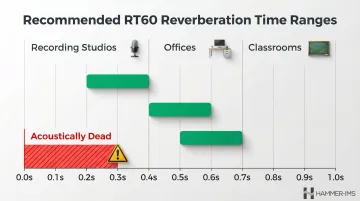
Recommended RT60 values vary: recording studios target 0.2–0.4 seconds, offices 0.4–0.6 seconds, and classrooms 0.5–0.7 seconds. Over-treating with excessive 2" panel coverage in an office environment intended for natural speech can push RT60 below 0.3 seconds, creating an unnaturally dead acoustic that feels oppressive to occupants.
Conclusion
Panel thickness is the primary acoustic design variable — it determines frequency response range, NRC performance, and application fit. Matching it to the target frequency range requires a clear framework:
- 1" panels: Speech clarity above 1,000 Hz
- 2" panels: Broadband music and mixed content above 500 Hz
- 3"–4" panels: Low-mid frequency control above 250 Hz
- 6"–12"+ bass traps: Sub-250 Hz energy absorption
Published specifications are only reliable when panels are manufactured and installed at the specified nominal thickness within acceptable tolerances. Acoustic designers should verify octave-band data rather than relying on NRC alone, matching panel thickness to the actual frequency content of the space. Material manufacturers must treat thickness conformance as equally critical as the design specification itself — deviations as small as 10% can degrade field performance and invalidate published absorption ratings.
Frequently Asked Questions
How thick should soundproofing be?
Soundproofing and acoustic treatment are different problems. Acoustic panels (1"–2" for most rooms, 3"–4"+ for low-frequency control) absorb sound energy within a space. True soundproofing relies on mass — transmission loss increases ~6 dB per doubling of mass, not panel depth. The right approach depends on whether you need internal absorption or external sound isolation.
Is 0.70 NRC good?
An NRC of 0.70 represents solid mid-frequency absorption, absorbing 70% of incident sound energy on average across speech frequencies (250–2,000 Hz). This works well for speech-clarity environments like offices, classrooms, and conference rooms. More demanding applications like music studios or spaces with significant bass energy typically target NRC 0.85 or higher.
What is the 38% rule in room acoustics?
The 38% rule refers to speaker and listener placement—positioning the listening position 38% of the room's length from the front wall to minimise standing wave interaction and avoid the worst peaks and nulls of axial room modes. It is strictly a seating placement guideline created by studio designer Wes Lachot, not a panel thickness or coverage specification.
Can acoustic panels be too thick?
Beyond approximately 2" thickness, mid and high-frequency absorption plateaus at ~1.00 NRC with no additional benefit. Over-thick panels add cost and reduce room volume without acoustic justification unless low-frequency absorption below 250 Hz is the goal — in which case, 4" panels for a speech-only room waste budget with nothing to show for it.
Does the panel material affect how thick it needs to be?
Material density and porosity directly affect absorption efficiency at a given thickness. A denser, higher-flow-resistance material like rigid fibreglass (Owens Corning 703 at 3.0 pcf) achieves higher NRC at 1" than low-density foam of the same thickness. Optimal airflow resistivity (16,000–27,000 Pa·s/m²) maximises viscous friction, so specifying thickness without confirming material properties leads to undersized or over-engineered panels.