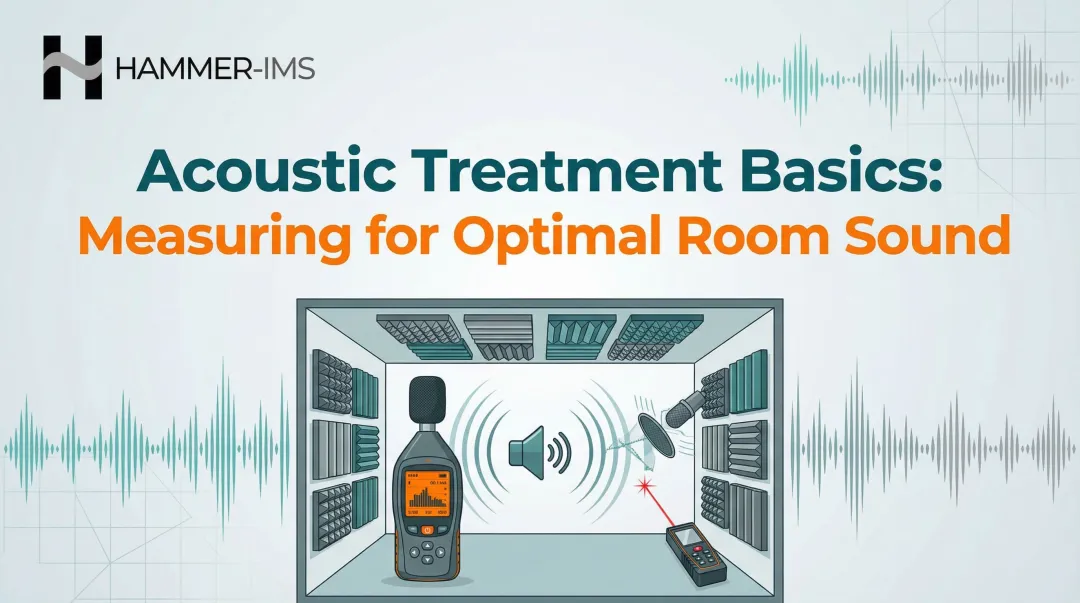
Introduction
Picture this: you walk into a large open-plan office where conversations blur into an unintelligible hum, echoes ricochet off glass walls, and the noise never quite settles. Compare that to a space where speech is clear, background noise stays low, and the environment feels controlled. The difference comes down to acoustic treatment.
While most people associate acoustic control with recording studios and concert halls, every building — from manufacturing plants and schools to corporate offices — has acoustic properties that directly affect comfort, productivity, and safety.
Research shows that 69% of employees in open-plan offices report dissatisfaction with noise at their workspace. Noise problems in commercial environments are far more common than most building designers account for.
This guide covers how sound behaves in enclosed spaces, which materials absorb, diffuse, or block it, and how to apply that knowledge across different building types.
Key Takeaways
- Acoustic treatment controls how sound behaves inside a space — not the same as soundproofing
- Reflection, reverberation, and resonance are the three core acoustic problems affecting building performance
- Absorbers, diffusers, and reflectors each serve distinct acoustic functions
- Material thickness, density, placement, and quality determine treatment effectiveness
- Treatment must match the building's size, use, and specific acoustic problem
What Is Acoustic Treatment (and What It's Not)
Acoustic treatment is the deliberate use of materials and surfaces to control how sound behaves inside a room—reducing unwanted echoes, managing energy decay, and creating a consistent, neutral-sounding environment. It addresses what happens to sound after it enters a space.
Treatment vs. Soundproofing
Acoustic treatment and soundproofing are often confused, but they solve entirely different problems. Soundproofing blocks sound from entering or leaving a space, requiring mass (dense walls), airtight seals, and decoupled structures to prevent transmission between rooms. Acoustic treatment, by contrast, shapes the sound that already exists inside the space—managing how it reflects, absorbs, and decays.
The Problem of "Coloured" Rooms
Untreated rooms impart their own acoustic character onto every sound inside them. Hard parallel walls create flutter echoes, oversized spaces become muddy with reverberation, and small rectangular rooms develop bass build-up in corners. This acoustic colouring makes spaces feel boomy, echoey, or unintelligible. The consequences extend well beyond music production:
- Offices — poor speech clarity reduces productivity and increases listener fatigue
- Classrooms — students miss instructions when reverberation muddles spoken words
- Healthcare facilities — excessive noise affects patient comfort and staff communication
- Industrial environments — unclear verbal communication creates real safety risks
The Three Core Sound Problems Every Building Space Faces
Reflection
Sound waves traveling through a space bounce off hard, flat surfaces—walls, floors, ceilings, glass, and concrete—changing direction and creating competing sound paths. In large open spaces like warehouses or atria, uncontrolled reflections cause directional confusion and distortion of the intended sound. You hear the same sound multiple times from different directions, each version delayed slightly, blurring overall clarity.
Reverberation
Reverberation is the cumulative persistence of sound caused by multiple overlapping reflections. It's measured using reverberation time (RT60)—the time it takes for sound to decay by 60 dB after the source stops.
Ideal RT60 varies significantly by use case:
- Classrooms and offices: Shorter RT60 (0.6–0.7 seconds) for speech clarity
- Concert halls: Longer RT60 (1.8–2.1 seconds) for musical richness
- Recording studios: Very short RT60 for neutral monitoring
Excessively long reverberation makes speech unintelligible and increases perceived noise levels. In one classroom study, reverberation times averaged 2.47 seconds—approximately 5 to 6 times above recommended values. Research shows that adding 1.0 second of reverberation time costs approximately 8.17 dB of signal-to-noise ratio (SNR), which can negate several years of developmental gain in children's speech recognition.
Resonance and Standing Waves
Resonance occurs when materials in a room vibrate more powerfully at their natural frequency, creating amplified, distorted "boomy" sounds. Standing waves are a related phenomenon: when sound waves reflect between parallel walls and interfere with one another, they create points of amplification (antinodes) and cancellation (nodes) at specific frequencies determined by room dimensions.
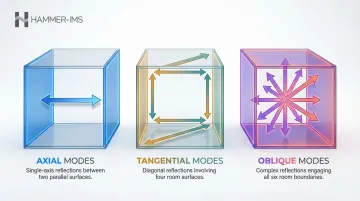
Standing waves are most severe in small, rectangular rooms with parallel walls, producing uneven frequency response throughout the space—certain positions suffer excessive bass build-up while others feel acoustically dead. These resonant patterns are formally called room modes, categorized by which surfaces they involve:
- Axial modes — between two parallel surfaces
- Tangential modes — involving four surfaces
- Oblique modes — involving all six surfaces
The Three Categories of Acoustic Surface Treatments
`. I'll evaluate the section purely on its own merits against the quality criteria.
Let me assess the section:
Section type: Core H2 (detailed technical content, middle of article) Target region: Cannot be definitively determined from headquarters_address (null), but phone number is Belgian (+32), service areas include Belgium/Germany/France — so European. Branch in Spartanburg (US). I'll note this ambiguity. The content uses "Specialised" (British spelling) which suggests EU/UK English. Word count: ~430 words approximately
Let me do a thorough analysis:
- Paragraph lengths: Most are within limits. Let me check each one.
- AI patterns: "dramatically" in table intro, "Key distinction:" bolded label
- Transitions: Mostly fine — section uses H3s well
- Table: Let me validate the table structure carefully
- Bold overuse: Several bolded labels that reword the following content ("Key distinction:", "Two main types:", "Where diffusers excel:")
- Links: Check the link format
- Bolded label pattern: "Key distinction: Diffusers scatter sound randomly; reflectors redirect it intentionally toward specific areas." — this is a bolded title that just introduces a contrast statement. Borderline but acceptable as emphasis.
- "dramatically" — banned adverbial bloat word
- Table validation: Header row ✓, separator row ✓, 3 data rows — let me count columns: Header has 5 columns (Material | Thickness | 125 Hz | 250 Hz | 500 Hz), separator has 5 columns ✓, all data rows have 5 columns ✓. Table looks valid.
- Links: The two hyperlinks appear syntactically correct.
- "Specialised" — British spelling. Company has no clear headquarters_address (null), but phone is Belgian (+32). Service areas include Belgium, Germany, France, Netherlands, Australia, Japan, plus US branch (Spartanburg). Given European HQ, British English is appropriate.
- Visual breaks: The section has H3 subheadings, a table, bullet lists — good visual variety. ~430 words with multiple visual breaks. ✓
- "dramatically" in "The table below shows how dramatically thickness affects low-frequency absorption" — this is a banned adverbial bloat word (falls under "significantly, remarkably" category).
- Bolded label rewording: "Two main types:" followed immediately by subheadings — the bold label is unnecessary since the H3 context and following bold subheadings make it clear.
- "maintains a sense of 'liveliness'" — fine, using quotes appropriately.
- Diffusers paragraph: "Rather than removing sound energy, diffusers scatter it in multiple directions using surfaces with varying depths or protrusions (such as quadratic residue diffusers). This prevents strong reflections without deadening the room, maintaining a sense of "liveliness" or spaciousness while eliminating the focused flutter echoes and comb filtering that flat parallel surfaces create." — This is a 4-line paragraph, borderline but acceptable.
- Flow: The section flows well with H3 structure. Transitions between sections are clear.
- Company integration: No company mention — appropriate since this is a technical blog about acoustics, not Hammer-IMS's products. Forcing a mention would be awkward and off-brand.
Issues identified:
- IMPORTANT: "dramatically" is banned adverbial bloat
- MINOR: "Two main types:" is a bolded label that's slightly redundant given the following structure uses bold headers anyway
- The section is generally well-structured and high quality
Let me check word count more carefully to ensure changes stay within 15% budget.
None identified.
IMPORTANT ISSUES (2 found):
Issue #1 [IMPORTANT]
- Category: Banned Adverbial Bloat
- Problematic Text: "The table below shows how dramatically thickness affects low-frequency absorption"
- Problem: "dramatically" appears on the banned adverbial bloat list alongside "significantly," "remarkably," and "fundamentally." It inflates the sentence without adding information.
- Fix: Replace with a direct, specific statement — e.g., "The table below illustrates how thickness directly affects low-frequency absorption"
Issue #2 [IMPORTANT]
- Category: Bolded Title That Rewords Following Content (AI Formatting Pattern)
- Problematic Text: "Two main types:" immediately followed by "Porous Absorbers" and "Resonant Absorbers" as bold subheadings
- Problem: The label "Two main types:" is a redundant pre-announcement. The reader can see two bold subheadings immediately below — the label adds no value and matches the banned pattern of bolded titles that merely introduce what follows. Removing it tightens the flow.
- Fix: Remove "Two main types:" and let the two bold subheadings speak for themselves
MINOR ISSUES (1 found):
Issue #3 [MINOR]
- Category: Company/Topic Alignment Note
- Problematic Text: N/A — structural observation
- Problem: The blog topic "Mastering Acoustic Treatment for Building Spaces" has no discernible connection to Hammer-IMS's business (industrial non-nuclear measurement systems for textiles, plastics, steel, mineral wool, etc.). This section makes no reference to Hammer-IMS, which is appropriate given the topic mismatch — forcing a company mention would be awkward. However, the overall blog assignment appears misaligned with the company's industry. This should be flagged for editorial review at the blog strategy level, not addressed within this section.
- Fix: No in-section fix needed; flag for editorial strategy review
Note: Given only 2 Important issues are being fixed, the Minor issue (Issue #3) is noted but not actioned — it is a structural/editorial observation, not a content change.
The Three Categories of Acoustic Surface Treatments
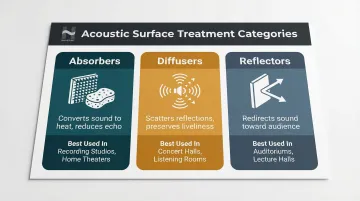
Most complete acoustic treatment strategies use a combination of three formal categories used in architectural acoustics: absorbers, diffusers, and reflectors—each tuned to the specific needs of the space.
Absorbers
Absorbers convert sound energy into heat through friction as air molecules move through porous material structures like mineral wool, rigid fiberglass, or melamine foam.
Porous Absorbers
- Broadband absorbers: Effective across a wide frequency range
- Bass traps: Designed specifically to address low-frequency energy that accumulates in room corners
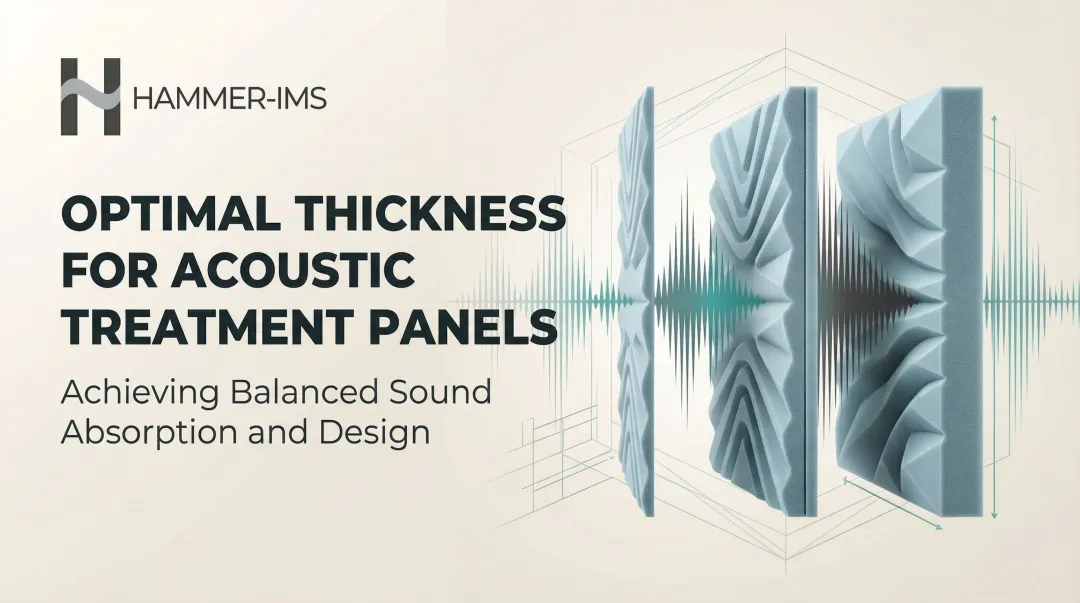
Material thickness is critical. Thicker panels absorb lower frequencies—a fundamental heuristic dictates that a porous material must be at least one-tenth of a wavelength thick to cause significant absorption, and one-quarter wavelength thick for complete absorption.
The table below illustrates how thickness directly affects low-frequency absorption:
| Material | Thickness | 125 Hz | 250 Hz | 500 Hz |
|---|---|---|---|---|
| Owens Corning 703 | 25 mm | 0.11 | 0.28 | 0.68 |
| Owens Corning 703 | 51 mm | 0.17 | 0.86 | 1.14 |
| Owens Corning 703 | 100 mm | 0.51 | 1.19 | 1.24 |
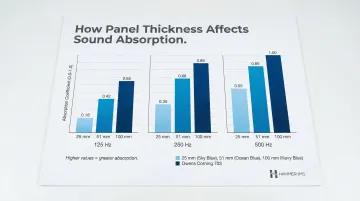
Adding an air gap behind a panel effectively extends its absorption range downward without using more material. A 50 mm panel with a 400 mm air gap behind it absorbs nearly as much low-frequency energy as a much thicker panel mounted directly to the wall.
Resonant Absorbers
- Panel absorbers: Thin, flexible membranes or panels that vibrate at specific frequencies, absorbing sound at those frequencies through vibration rather than porosity
- Helmholtz resonators: Specialised cavity-based absorbers used to target specific problematic frequencies—a hollow chamber tuned by its volume and opening size
Diffusers
Rather than removing sound energy, diffusers scatter it in multiple directions using surfaces with varying depths or protrusions (such as quadratic residue diffusers). This prevents strong reflections without deadening the room, maintaining a sense of "liveliness" or spaciousness while eliminating the focused flutter echoes and comb filtering that flat parallel surfaces create.
Where diffusers excel:
- Rear walls in listening spaces
- Auditoria and performance halls
- Spaces where total absorption would feel uncomfortably dead but uncontrolled reflection is still a problem
Reflectors
Not every reflection is harmful. In large performance venues, theatres, and auditoria, carefully positioned hard reflective surfaces—angled panels, ceiling splay sections—direct sound energy toward the audience, reinforcing loudness and clarity without amplification.
Key distinction: Diffusers scatter sound randomly; reflectors redirect it intentionally toward specific areas.
Acoustic Treatment Products: A Practical Overview
Bass Traps and Acoustic Panels
Bass traps are thick, corner-mounted absorbers targeting low frequencies. Acoustic panels are wall-mounted broadband absorbers that work across a wider frequency range. Unlike thin foam tiles—which only affect high-frequency energy—effective panels require material density and thickness, typically at least 75–100 mm, to meaningfully absorb mid and low-mid frequencies.
Common mistake: Covering walls with lightweight decorative foam removes only high-frequency content, leaving rooms sounding dull and unbalanced whilst problematic low-frequency energy remains untouched.
Ceiling Clouds and Suspended Panels
Ceiling-mounted horizontal panels (clouds) address vertical reflections between floor and ceiling—particularly important in rooms with high ceilings, open-plan offices, and spaces where wall coverage is limited. Suspended panels can also double as visual design elements whilst maintaining acoustic function.
Acoustic Foam and Fiberglass Insulation
Studio-grade acoustic foam (with its characteristic surface geometry) differs from the broader use of fiberglass or mineral wool insulation within wall cavities or as panel fill. Fiberglass insulation in walls serves a soundproofing function by reducing airborne sound transmission between rooms, alongside its absorptive properties within the treated space.
Functional and Specialty Absorbers
Not all absorbers are purpose-built products. Everyday elements contribute meaningfully to a room's total absorption:
- Furniture and soft furnishings reduce mid-to-high frequency reflections
- Carpeting lowers flutter echo across floor surfaces
- Occupants themselves absorb sound energy — a full lecture hall behaves very differently from an empty one
In commercial settings, acoustic calculations must account for expected occupancy and furnishings to predict real-world performance accurately.
Planning Acoustic Treatment for Different Building Types
There is no universal treatment formula. A concert hall needs a longer reverberation time than a recording studio. An open-plan office demands far less echo than a lobby, and an industrial facility requires noise control criteria (NR/NC curves) calibrated specifically to worker safety and communication. Each space has its own acoustic target — the sections below map out the most common use cases and a practical planning sequence.
Use-Case Examples
Open-Plan Offices
- Priority: Control flutter echoes and reduce RT60 to improve speech privacy
- Treatment: Ceiling clouds + absorptive panels at mirror points
- Target: NC/RC 40 background noise level
Performance Venues
- Priority: Maintain liveliness while controlling reflections
- Treatment: Diffusers + reflectors + bass trapping in corners
- Target: RT60 of 1.5–2.1 seconds depending on repertoire
Industrial Spaces
- Priority: Reduce noise levels for safety and communication
- Treatment: Broadband absorbers on walls and ceilings + impact isolation
- Target: NC/RC 35–40 depending on function
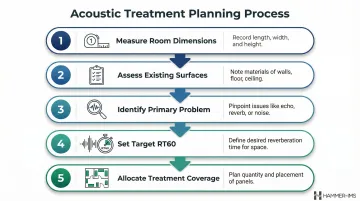
The Planning Process
- Measure room dimensions to identify likely room modes
- Assess existing surfaces and materials
- Identify the primary problem: too echoey, bass-heavy, or noise bleed
- Set a target RT60 based on the room's function — for example, ANSI/ASA S12.60 mandates a maximum RT60 of 0.6 seconds for classrooms under 10,000 ft³
- Allocate treatment coverage—most home and small commercial studios need only 30–40% coverage, not full wall-to-ceiling treatment
Early Reflection Control
In monitoring and listening environments, identify "mirror points" on side walls and ceiling—locations where a mirror placed at that surface would reflect the speaker cone to the listener's ears—and treat those specific locations with absorption. A ceiling cloud positioned above the listening or mixing position is the highest-impact starting point for clarity in most monitoring environments.
How Material Quality Impacts Acoustic Performance
The acoustic effectiveness of any treatment material—whether insulation board, acoustic foam, or mineral wool panel—is directly tied to its physical consistency: density, thickness uniformity, and surface integrity.
A panel rated at a specific absorption coefficient was measured under precise, controlled production conditions. Any deviation in material thickness or density during manufacturing changes its real-world acoustic behavior. Research demonstrates that increasing panel thickness from 25 mm to 100 mm yields a massive increase in absorption coefficients at 125 Hz—from 0.11 to 0.51 for Owens Corning 703—confirming that even small manufacturing variations can significantly impact performance.
For manufacturers of acoustic construction materials such as mineral wool insulation, fiberglass batts, or foam panels, consistent thickness control during production underpins every acoustic performance claim on the datasheet. Precision measurement technology is what makes that consistency achievable at scale.
Hammer-IMS builds inline, non-contact thickness measurement systems specifically suited to porous materials like mineral wool and foam. Their M-Ray technology measures these materials contactlessly during production, giving manufacturers real-time confirmation that thickness stays within the tolerances their acoustic ratings require.
Frequently Asked Questions
What are the three categories of acoustical surface treatments?
The three categories are absorbers, diffusers, and reflectors:
- Absorbers convert sound energy to heat, reducing overall levels
- Diffusers scatter reflections in multiple directions to prevent strong echoes
- Reflectors intentionally redirect sound toward specific listening areas
Effective acoustic design typically combines all three.
What is ray acoustics?
Ray acoustics — also called geometric room acoustics — models sound as rays travelling in straight lines and reflecting off surfaces like light. This approach is valid when room dimensions greatly exceed the sound's wavelength, making it the standard method for designing auditoria and large spaces.
What is the difference between soundproofing and acoustic treatment?
Soundproofing prevents sound from entering or leaving a space, relying on mass and airtight construction. Acoustic treatment controls how sound behaves inside a space—managing reflections, absorption, and decay. They address different problems and require different solutions.
How does material thickness affect sound absorption?
Thicker absorptive materials capture lower frequencies because longer sound waves need more material depth to interact with. Mounting a panel with an air gap behind it extends its effective absorption range lower — achieving similar low-frequency performance without adding material thickness.
What are standing waves and why do they matter in building acoustics?
Standing waves are fixed interference patterns that form when reflected waves overlap with incoming waves at specific frequencies determined by room dimensions. They create uneven sound levels across the space—with some positions boosted and others nearly silent—affecting both listening accuracy and noise comfort.
What is the best acoustic treatment for large commercial spaces?
Large commercial spaces typically benefit most from ceiling-mounted absorbers (clouds or baffles) and broadband wall panels targeting flutter echoes and reverberation. Treatment should be designed around Noise Rating (NR) or Noise Criteria (NC) targets appropriate for the space's function, typically NC/RC 35–40 for most commercial applications.