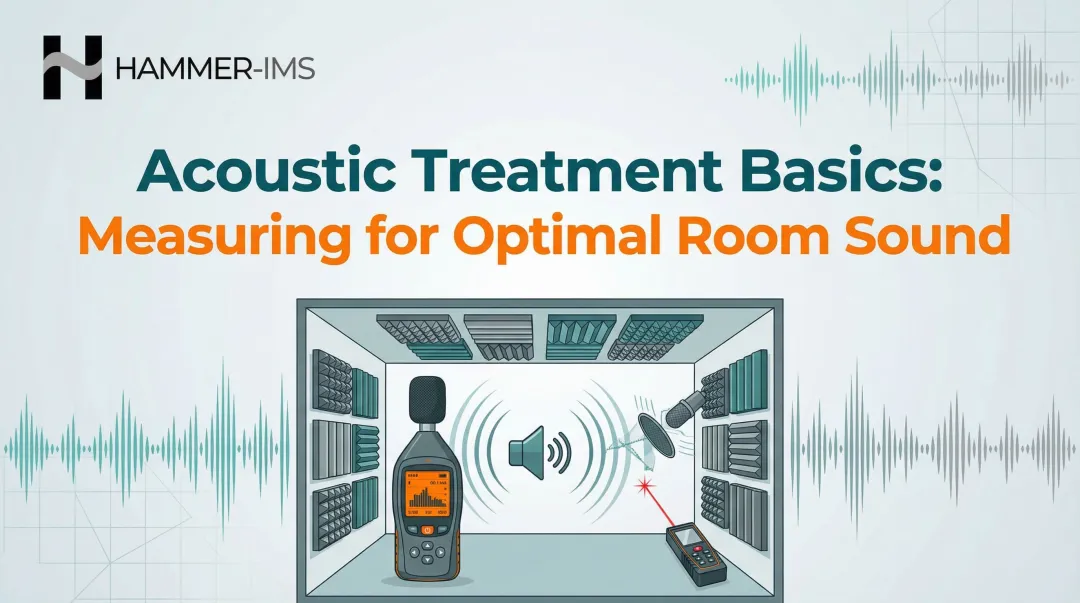

Introduction
Acoustic treatment materials face a fundamental paradox: the very properties that make them excellent sound absorbers also make them vulnerable to moisture damage. Porous, fibrous materials like mineral wool, fiberglass insulation, and open-cell foam work by allowing air molecules through their structure, converting sound energy to heat via friction. That same open structure readily absorbs moisture from the air.
This creates two distinct problems. Elevated humidity changes how sound travels through the air itself, subtly altering a room's acoustic character. Sustained moisture infiltration is the larger concern: it physically degrades treatment materials, promoting mold growth, compressing fibers, and reducing absorption efficiency at the frequencies the panels were designed to treat.
This article covers:
- How humidity affects sound propagation at a physics level
- The mechanisms by which moisture damages acoustic materials
- Ideal humidity targets for critical listening environments
- Common sources of excess moisture in treated spaces
- Practical methods for controlling humidity where natural regulation isn't possible
Key Takeaways
- Humidity primarily affects mid and high frequencies by changing air density—low frequencies travel as pressure waves and remain largely unaffected
- Excess moisture degrades porous absorbers through mold growth and fiber compression, reducing acoustic performance over time
- Target 40–50% relative humidity for recording studios; general acoustic spaces should maintain 40–60% RH
- Sealed and soundproofed rooms trap internally generated moisture — deliberate HVAC management is essential
- Right-sized dehumidification and HVAC systems protect acoustic materials from long-term moisture damage
How Humidity Changes the Way Sound Behaves in Treated Rooms
The Physics of Humid Air and Sound Propagation
Sound travels through air as the medium, and humidity changes that medium's characteristics. Contrary to intuition, humid air is actually less dense than dry air — water molecules (H₂O) have less mass than the diatomic oxygen (O₂) and nitrogen (N₂) molecules they displace. This reduction in density slightly increases the speed of sound. Changing from 0% to 100% relative humidity increases sound speed by approximately 0.1% at room temperature, according to the National Physical Laboratory's calculation using the Cramer equation.
The more consequential effect involves atmospheric sound absorption, which is highly frequency-dependent due to molecular relaxation of oxygen and nitrogen. Higher frequencies are absorbed far more quickly than lower frequencies as they travel through air. In large venues, humidity changes can measurably alter high-frequency EQ and delay times, but in small critical listening rooms, the effect is subtle—perceptible primarily to trained ears familiar with their room's sound signature.
Frequency-Dependent Behavior
Humidity affects different frequency ranges in distinct ways:
- Mid and high frequencies (ray energy) are most susceptible — absorption increases with humidity
- Low frequencies travel as pressure waves and are largely unaffected by humidity changes
- Seasonal imaging shifts — changes in high-frequency clarity point to the air behaving differently, not material degradation

This separation is worth keeping in mind when troubleshooting treatment performance after a humidity swing.
Structural Materials and Resonance Shifts
Humidity doesn't just affect air—it also impacts structural room materials. Wood framing, floor joists, wall panels, and diffusers absorb and release moisture with seasonal changes. Drier wood becomes more flexible and can resonate differently at low frequencies, while moisture-saturated wood becomes heavier and less resonant. Across a full seasonal cycle — from dry winter air to humid summer conditions — these material shifts can alter the low-frequency character of a room enough to affect mixing decisions.
Priority in Acoustic Design
Addressing room modes, early reflections, and reverberation time takes priority over managing air humidity's direct acoustic effects. Where humidity becomes non-negotiable is its impact on materials — both structural elements and acoustic panels degrade, shift resonance, or lose absorption efficiency when moisture is uncontrolled. That's what moves humidity management from a secondary concern to a baseline requirement.
What Moisture Does to Acoustic Treatment Materials
Why Porous Absorbers Are Vulnerable
Materials like open-cell foam, mineral wool, fiberglass insulation (such as Owens Corning 703), and recycled denim panels work by allowing air molecules to move through their porous structure. Sound energy converts to heat via friction as air oscillates within the material. This same porosity that enables sound absorption creates direct pathways for moisture infiltration, leaving them vulnerable to humidity damage over time.
Mold and Microbial Growth
The EPA mandates keeping indoor relative humidity below 60% to prevent mold proliferation in porous building materials. Sustained high humidity—particularly above 60–70% RH—in acoustic treatment creates ideal conditions for mold, mildew, and bacteria. Beyond health hazards, mold structurally degrades fibers, reduces material density, and produces odors that make the space unusable.
Inorganic fibrous materials like mineral wool and fiberglass pass ASTM C1338 fungal resistance tests because their inorganic fibers aren't nutrient sources for mold. However, accumulated organic dust within the porous matrix can support mold if moisture is present, making regular inspection essential.
Fiber Compression and Density Changes
When mineral wool or fiberglass insulation absorbs moisture repeatedly, fibers can clump, compress, or lose their uniform loft. Density and thickness both shift as a result—and those two properties directly determine the absorption coefficient at specific frequencies. A panel rated at a given NRC when new can drop measurably below spec once moisture has altered its structure.
Manufacturers of acoustic insulation depend on tight production tolerances to deliver consistent performance. Hammer-IMS, which serves manufacturers including Owens Corning, supplies contactless thickness and density measurement systems using M-Ray millimeter-wave technology. These systems verify that material meets acoustic specifications before it leaves the factory.
Even a few millimetres of deviation in panel thickness can shift the effective absorption range—meaning a product designed to absorb mid-frequencies may arrive at the end user performing differently than the published NRC suggests.
Foam-Specific Degradation
Polyurethane and melamine foams (like BASF Basotect) behave differently under moisture exposure. Melamine foams are highly hydrophilic and experience dimensional changes with moisture absorption, requiring 3–5 days of environmental conditioning before installation. Polyether-based polyurethane foams exhibit superior hydrolytic stability compared to polyester-based foams—so specifying polyether-based foam in humid environments is a straightforward way to extend service life.
UV exposure combined with humidity accelerates yellowing and surface crumbling in foam. Cheap foam marketed as "acoustic" is particularly vulnerable, often lacking the chemical stability needed for sustained exposure to fluctuating humidity levels.
Vapor Barrier Considerations for Built-In Treatment
When acoustic panels are framed and mounted with air gaps—a common technique to extend low-frequency absorption—condensation can form on the backing surface, especially along exterior walls where temperature differentials exist. Building Science Corporation advises against installing vapor barriers on the interior of air-conditioned assemblies, as this traps moisture and contributes to mold growth. Avoid double vapor barriers on both sides of an assembly; materials must be able to dry in at least one direction.
The Ideal Humidity Range for Acoustic Spaces
Consensus Targets and Relative Humidity Explained
Most acoustic design references and HVAC guidelines cite 40–60% relative humidity as comfortable and acoustically stable for general spaces. Recording studios are often targeted more narrowly at 30–50% RH to protect sensitive equipment and maintain tighter environmental control.
Relative humidity measures moisture as a percentage of the maximum water vapor air can hold at a given temperature. The same absolute moisture content feels different in a cold room versus a warm one—this is why basements feel damp even when RH readings aren't extremely high.
Consequences of Going Too Low
Below 30% RH, wood-based room elements—framing, panels, diffusers, and instrument bodies—can dry out, shrink, and crack. Steinway & Sons recommends 45–50% RH for piano care, noting that excessively dry conditions compromise structural integrity and tonal quality. Low humidity also increases electrostatic discharge (ESD) risk, which can damage sensitive electronics at voltages below 100V.
Beyond the electronics risk, physical gaps from wood shrinkage compromise acoustic seals and soundproofing integrity, allowing sound leakage and degrading isolation performance.
High Humidity Risks
Above 60% RH consistently, problems compound quickly:
- Mold risk rises sharply, threatening both materials and air quality
- Acoustic absorption performance of porous materials degrades
- Electronics face condensation risk and potential failure
- Acoustic treatment materials deteriorate faster, shortening their lifespan
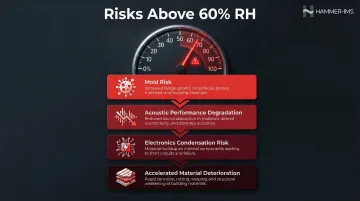
In heavily sealed rooms—common in well-soundproofed studios—humidity climbs faster because minimal air exchange traps moisture with no way out.
Where Moisture Problems Come From in Acoustic Rooms
Primary Moisture Sources
Common moisture sources in acoustic spaces include:
- Human respiration — An adult doing moderately active work generates 200 Btu/h of latent heat (moisture), adding humidity during recording sessions
- Outdoor air infiltration — Especially problematic in humid climates or during summer months
- Ground moisture migration — Common in basement studios, where moisture wicks through concrete
- HVAC fresh-air intake — Improperly managed ventilation systems can introduce moisture-laden outdoor air
The Sealed Room Problem
A well-soundproofed room is, by definition, airtight: essential for isolation but problematic for humidity management. Airtight construction traps internally generated moisture with no natural escape pathway. The better the soundproofing, the more deliberate the humidity management must be.
This means HVAC systems must handle both latent load (moisture removal) and sensible load (temperature control), not just cooling.
Seasonal and Climate Variation
Moisture loads shift significantly with the seasons. In summer, outdoor air drawn in via ERV (Energy Recovery Ventilator) or fresh-air intake arrives warm and moisture-laden. In winter, heated indoor air swings to the opposite extreme — very dry.
ASHRAE recommends keeping RH below 65% in occupied spaces to prevent mould growth. In a sealed studio during peak summer humidity, hitting that ceiling without active dehumidification is a realistic risk, not a remote one.
How to Control Humidity in Acoustic Spaces
HVAC Sizing and Latent Cooling Load
The most consequential mistake is oversizing an HVAC unit. An oversized unit runs in short bursts, cooling the air to the thermostat setpoint too quickly. The compressor shuts off before the evaporator coil reaches dew point, which takes 10-12 minutes of continuous operation. The result: a cold but humid room.
Sensible cooling load refers to temperature removal. Latent cooling load refers to moisture removal. A properly sized system balances both. Consult an HVAC specialist who understands latent load calculations for sealed acoustic rooms—standard residential load calculations often underestimate moisture removal requirements.
Mini-Splits and Humidity Limitations
Mini-splits are popular in studio builds for quiet operation and zoned control. Their "Dry Mode"—which keeps the coil in cooling mode while reducing fan speed—has real limits. It relies on the cooling coil, which means it can overcool the room by several degrees and stops dehumidifying once the sensible temperature drops too low.
Pairing a mini-split with an ERV improves fresh air delivery. Keep in mind that ERVs transfer both sensible heat and latent moisture between airstreams—in humid climates, they reduce the humidity introduced from outside, but the HVAC system still carries the residual moisture load.
Standalone Dehumidifiers as a Practical Solution
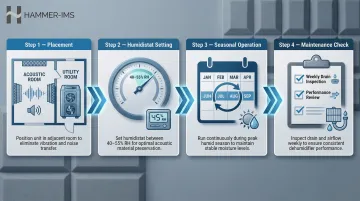
A dedicated dehumidifier can be run during non-recording periods to maintain target RH levels. For best results:
- Locate the dehumidifier in an adjacent utility room, delivering conditioned air silently into the studio
- Set the humidistat to a target range of 40–55% RH
- Run continuously during humid seasons
- Check performance and empty or drain the unit weekly
Monitoring and Maintenance
A calibrated hygrometer (or smart sensor) is standard equipment in any treated acoustic space. Log readings over time. Seasonal trends often reveal problems weeks before they become visible.
Inspect acoustic panels and bass traps annually for signs of moisture absorption:
- Visible discoloration or mold spots
- Musty or damp odor
- Physical sagging or deformation
- Surface texture changes
Materials that have absorbed significant moisture may need replacement to restore original acoustic performance. Wet mineral wool can absorb 18–78% of its weight in water and takes 2 to 6 days longer to dry than closed-cell foams—at that point, replacement rather than drying is often the only viable remedy.
Frequently Asked Questions
What is the ideal relative humidity for a recording studio or acoustic room?
The commonly cited target is 40–60% for general acoustic spaces, with recording studios often maintained at 30–50% RH. Staying within this range protects acoustic materials from mold growth, prevents wood-based elements from cracking or swelling, and safeguards sensitive electronics from condensation and ESD damage.
Does high humidity affect sound quality in a treated room?
Humidity reduces air density, which dampens mid and high frequencies while leaving low-frequency pressure waves largely unaffected. Over time, the bigger risk is physical: moisture degrades absorptive materials, progressively compromising the room's acoustic performance.
Can moisture damage acoustic foam and mineral wool panels?
Yes. Sustained high humidity promotes mold growth in porous absorbers, causes fiber compression in mineral wool, and degrades foam structure. Each of these effects reduces absorption at the frequencies those panels were specifically designed to treat.
Why does a well-soundproofed room have worse humidity problems?
Airtight construction traps moisture from respiration, body heat, and equipment with no natural escape pathway. Managing this requires a properly sized HVAC system with adequate latent load capacity—not just a unit sized for temperature control.
What is the difference between sensible and latent cooling load, and why does it matter for acoustic rooms?
Sensible load is temperature control; latent load is moisture removal. An oversized HVAC unit handles sensible load in short cycles but shuts off before the evaporator coil runs long enough (10-12 minutes) to adequately remove moisture, leaving the room cold but chronically humid.
How do I know if my acoustic treatment materials have been damaged by moisture?
Look for visible mold spots, musty odor, panel sagging, or a room that sounds more reflective than it used to at specific frequencies. Annual visual inspection combined with continuous humidity logging catches problems before they cause significant damage.