Introduction
Manufacturing defects carry staggering costs that multiply at each production stage. The 1:10:100 principle illustrates this escalation: catching an error during production costs 10 times more than preventing it at the design stage, and fixing that same defect after it reaches the customer costs 100 times more. Yet real-world data from the American Society for Quality reveals even starker losses—the Cost of Poor Quality (COPQ) consumes 15–20% of sales revenue for average manufacturers.
Manufacturers across textiles, plastics, nonwovens, automotive, and other continuous-production industries are replacing slow, inconsistent manual inspections with automated quality control systems that deliver 100% coverage at production speed. These systems detect deviations in real time, often triggering automated corrections before defects propagate down the line.
This article covers what automated quality control is, how it works, the benefits it delivers across accuracy and speed, and the key factors to evaluate before implementation.
TLDR:
- Automated quality control uses sensors and software to inspect 100% of products at production speed
- Systems reach 98–99% accuracy at 5,000+ components per hour, versus 80–85% accuracy at 500–800 for manual inspection
- Closed-loop feedback reduces material waste by up to 7% by enabling manufacturers to run closer to specification
- Applications span textiles, plastics, steel, and automotive industries where high-speed continuous production makes manual inspection impractical
What Is Automated Quality Control?
Automated Quality Control (AQC) uses sensors, software, and automated systems to inspect and measure products during or after production—verifying that quality standards are consistently met without relying solely on human inspectors.
Quality Control vs. Quality Assurance
According to ASQ and ISO 9000 definitions, Quality Assurance (QA) is the broader framework focused on providing confidence that quality requirements will be fulfilled: the preventive process design. Quality Control (QC) focuses on the operational techniques used to verify conformity—the inspection and measurement activities. Automation strengthens both by eliminating the delays and inconsistency that manual checks introduce.
Technology Span
The technologies that make AQC practical span inspection, measurement, and active correction—each addressing a different layer of the QA/QC framework:
- Machine vision systems detect surface defects, dimensional deviations, and assembly errors using cameras and image-processing algorithms
- Inline measurement sensors capture physical properties like thickness, basis weight, and profile across the production width
- AI-driven classification software distinguishes acceptable variation from true defects, reducing false positives
- Closed-loop feedback systems communicate with production machinery to automatically adjust parameters like coating thickness, web tension, or extrusion rate
This last capability distinguishes true automated quality control from basic inspection—modern systems don't just detect problems, they correct them.
Manual vs. Automated Quality Control: Key Differences
Manual inspection suffers from three fundamental limitations. First, human fatigue introduces inconsistency—studies show that even highly qualified inspectors correctly reject only 85% of defective items, with miss rates of 20–30% common across industries. Accuracy declines further over long shifts as cognitive fatigue sets in.
Second, sampling-based checks leave statistical blind spots. Acceptance sampling inherently carries risks: Operating Characteristic curves quantify both the probability of accepting bad lots and rejecting good ones. Defects occurring between samples go undetected.
Third, manual inspection creates throughput bottlenecks, especially in high-speed continuous production where line speeds can reach 1,200 meters per minute.
Performance Comparison
| Metric | Manual Inspection | Automated Optical Inspection |
|---|---|---|
| Detection accuracy | 80–85% (declines with fatigue) | 98–99% (consistent) |
| Inspection speed | 500–800 components/hour | 5,000+ components/hour |
| Coverage | Statistical sampling (escape risk) | 100% inline inspection |
| Consistency | Variable (fatigue, complexity) | Identical criteria every time |
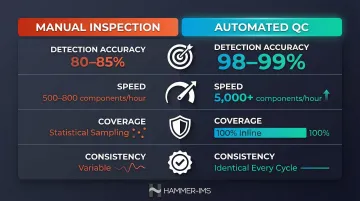
Automated systems apply identical measurement criteria to every unit or every meter of material, flagging or rejecting non-conforming product in real time without slowing production. That performance gap becomes even more significant as production volumes increase.
Scalability Advantage
As production volume grows, manual inspection costs scale linearly: more output means more inspectors. Automated systems handle higher throughput with minimal incremental cost once installed. The financial benefits compound over time through:
- Lower per-unit inspection cost at higher volumes
- Reduced scrap and rework from earlier defect detection
- Freed headcount for higher-value process tasks
How Automated Quality Control Systems Work
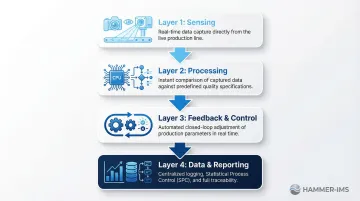
Modern AQC systems operate through four integrated layers, each addressing a distinct function in the quality control workflow.
Sensing Layer
Cameras, laser scanners, ultrasonic sensors, and contactless electromagnetic technologies capture data about the product continuously as it moves through the production line. In continuous web production—textiles, nonwovens, plastics film—contactless sensors measure thickness and basis weight across the full material width without touching the product.
Hammer-IMS M-Ray technology exemplifies this approach, using electromagnetic millimeter waves to measure thickness and basis weight in real time. Unlike nuclear-based gauges that require radiation licensing and pose safety concerns, M-Ray delivers contactless, non-nuclear inline measurement across textiles, nonwovens, plastics, and foam — with no regulatory overhead and no compromise on precision.
Processing Layer
Sophisticated software compares captured data in real time against pre-defined specifications and tolerances. Algorithms—including machine learning in advanced systems—classify whether measurements fall within acceptable ranges or indicate a deviation. A 2024 Cognex study found that 57% of surveyed manufacturers already use AI in their machine vision operations, reflecting AI's ability to catch subtle, complex defects that rule-based systems cannot reliably detect.
Feedback and Control Layer
Modern AQC systems feed measurement results directly back to production machinery, adjusting parameters like coating thickness, web tension, or extrusion rate before deviations spread. This closed-loop control is what separates true automated quality control from basic inspection: the system corrects, not just flags.
A peer-reviewed MDPI case study found that closed-loop cavity pressure control in injection molding reduced material usage by 7% and energy consumption by 2% — achieved through real-time self-correction of injection speed profiles.
Data and Reporting Layer
All measurements are logged, creating a continuous production data record that enables:
- Trend analysis to identify recurring process drift
- Traceability for regulatory compliance and customer audits
- Statistical Process Control (SPC) to monitor process stability
- Informed decisions about process optimization and supplier quality
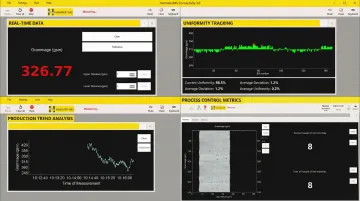
Hammer-IMS's Connectivity 3.0 software integrates these capabilities, providing real-time feedback and data logging across production lines. The system enables manufacturers to track uniformity metrics and adjust production parameters based on actual performance data rather than assumptions.
The Accuracy and Speed Benefits of Automated Quality Control
Speed: Throughput Without Compromise
Inspection bottlenecks disappear when quality control runs at production speed. In electronics manufacturing, Automated Optical Inspection systems inspect 5,000+ components per hour with 98–99% accuracy, compared to human inspectors processing 500–800 components per hour at 85–90% accuracy.
In continuous web production, 100% inline inspection eliminates the pauses and sample-delay cycles that manual or lab-based QC requires. Materials are measured as they move through the line — no stopping, no waiting.
Accuracy and Consistency: Eliminating Human Variability
Fatigue and subjectivity don't affect an algorithm. Every measurement follows identical logic, so the 50th reading of a shift is as reliable as the first — a consistency that matters most in industries where tolerances are tight and even minor deviations affect product performance.
The contrast with manual inspection is stark:
| Automated Systems | Manual Inspection | |
|---|---|---|
| Consistency | Identical algorithm every cycle | Varies by inspector and shift |
| Fatigue effect | None | Accuracy drops over time |
| Throughput | Production-speed | Sampling-rate limited |
Early Defect Detection and Cost Reduction
Catching a defect at the point of production costs a fraction of catching it downstream. Automated systems — particularly closed-loop setups — detect deviations before they compound, preventing the exponential cost increases that occur when non-conforming product reaches finishing, assembly, or the customer.
Waste Reduction Through Tighter Control
Real-time control of production parameters — material thickness, coating weight, basis weight — means manufacturers can reduce the safety margins they build into their products. Rather than over-specifying to compensate for measurement uncertainty, they run closer to specification, resulting in direct raw material savings.
The closed-loop injection moulding study cited earlier quantified this benefit: a 7% material reduction by optimising the process based on continuous feedback rather than conservative static setpoints.
Data-Driven Continuous Improvement
The volume of measurement data generated by automated systems enables manufacturers to:
- Identify recurring process drift patterns that indicate equipment wear or calibration needs
- Improve supplier quality assessments with objective performance data
- Demonstrate compliance with customer or regulatory requirements through complete production records
- Benchmark performance across shifts, lines, or facilities to drive standardisation
Industry Applications: Where Automated QC Delivers the Most Value
Textiles, Nonwovens, and Technical Fabrics
Continuous web production at high speed makes 100% inline measurement essential. Nonwoven production lines operate at speeds up to 1,200 meters per minute—manual sampling cannot keep pace, and deviations in material uniformity directly affect product performance.
Applications where basis weight and thickness uniformity matter:
- Filtration media (efficiency depends on consistent pore structure)
- Acoustic insulation (sound absorption requires uniform density)
- Medical textiles (barrier properties demand consistent basis weight)
- Automotive interior materials (aesthetic and performance specifications)
Hammer-IMS serves manufacturers like Balta, Lano, and Heimbach in this sector, providing M-Ray-based measurement systems that deliver real-time feedback on basis weight and thickness across the full web width.
Plastics Film, Sheet, and Foam
AQC systems measure thickness uniformity across the web width in real time, enabling immediate die-gap or process adjustments. Industries with tight tolerances where consistent measurement is non-negotiable include:
- Medical-grade sheeting (ISO 11607 compliance for sterile barrier systems)
- Automotive trim and interior components (dimensional stability)
- Food-contact packaging (FDA compliance and barrier consistency)
- Foam insulation (thermal performance linked to density uniformity)
Customers like Westlake Plastics, Orfit Industries, and Federal Eco Foam use Hammer-IMS measurement systems to maintain thickness specifications across production runs. Systems measure hot extruded materials immediately after chilling rolls, where material temperatures can still exceed 100°C.
Steel and Construction Materials
Inline thickness and profile measurement in rolling mills and panel production ensures dimensional compliance across high-volume output. Manual measurement would be impractical and dangerous on hot or fast-moving materials like steel plate or mineral wool insulation.
Applications include:
- Hot rolling mills (gauge control across strip width)
- Cold rolling operations (surface quality and thickness tolerance)
- Mineral wool and insulation board (density and thickness uniformity)
- Composite panel production (layer thickness verification)
General Manufacturing and Assembly
Machine vision and AQC apply broadly to component inspection across automotive, electronics, and consumer goods production. Common inspection tasks suited to automation include:
- Surface defect detection (scratches, voids, contamination)
- Dimensional verification against CAD tolerances
- Assembly validation (correct part placement, fastener presence)
- Label and print inspection (barcodes, date codes, fill levels)
In high-volume environments, automating even one of these tasks typically reduces downstream rejects and rework costs—two areas where manual inspection consistently falls short.
Challenges and Considerations When Implementing Automated QC
Upfront Investment and ROI Timeline
Automated systems require capital investment in hardware, software, and integration. However, this must be weighed against ongoing costs of manual QC, scrap losses, rework expenses, and the financial risk of defects reaching customers.
While ROI timelines vary by application, manufacturers should calculate payback based on:
- Current scrap and rework rates
- Labor costs for manual inspectors
- Cost of external failures (customer complaints, recalls, warranty claims)
- Potential material savings from running closer to specification
The COPQ data cited earlier—15–20% of sales revenue lost to poor quality—provides context for evaluating these investments.
Integration with Existing Production Infrastructure
AQC systems must communicate with existing PLCs, ERP/MES systems, and machinery. Compatibility assessment, data protocol alignment, and line modification all require upfront planning.
AQC systems must communicate with existing PLCs, ERP/MES systems, and machinery. Compatibility assessment, data protocol alignment, and line modification all require upfront planning.
Key integration considerations include:
- Protocol alignment: Industrial standards like ISA-95, PROFINET, and EtherNet/IP govern how systems exchange data in real time
- PLC connectivity: Closed-loop control depends on reliable, low-latency links to existing production equipment
- MES/ERP reporting: Production data must flow upstream into enterprise systems for traceability and analysis
Hammer-IMS systems integrate through these standard industrial protocols, supporting closed-loop control and MES/ERP production reporting without requiring custom middleware.
With integration requirements mapped, the next decision is selecting the right inspection technology for each specific application.
Choosing the Right Technology for the Application
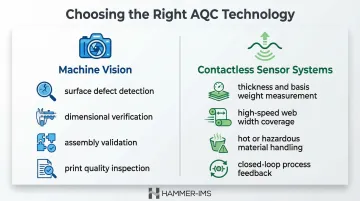
No single AQC technology fits all use cases. Manufacturers should map their specific inspection needs before selecting a system:
Machine vision is best for:
- Surface defect detection (scratches, stains, contamination)
- Dimensional verification (part geometry, edge positioning)
- Assembly validation (component presence/absence)
- Print quality inspection (labels, markings, codes)
Contactless sensor systems are best for:
- Physical property measurement in continuous processes (thickness, basis weight, density)
- High-speed measurement across web width
- Hot or hazardous materials where contact measurement isn't feasible
- Applications requiring closed-loop feedback to production machinery
Start by documenting what properties need measuring, at what speed, and under what process conditions — the right technology follows from those answers.
Frequently Asked Questions
What is automated quality control?
Automated quality control uses sensors, software, and automated systems to inspect products during production, ensuring quality standards are met consistently without relying solely on human inspectors. The systems provide real-time feedback and can trigger automated corrections to production parameters.
What are the 4 types of QC?
The four commonly cited types are:
- Process control — monitoring inputs during production
- Acceptance sampling — inspecting statistical subsets of lots
- Statistical Process Control (SPC) — tracking process stability over time via control charts
- Product inspection — verifying finished goods
Automated QC systems can support all four approaches.
What are the 4 pillars of automation?
The four pillars are:
- Sensing/data capture — cameras and sensors collecting product information
- Analysis/processing — algorithms extracting features and comparing to specifications
- Decision-making — classifying defects and determining actions
- Actuation/feedback — rejecting parts or adjusting process parameters
These map directly to the layers of an automated QC system.
What is the difference between automated quality control and quality assurance?
Quality control detects and corrects defects in actual products through inspection and measurement. Quality assurance is the broader system of processes designed to prevent defects from occurring in the first place. Automation improves both: AQC makes detection faster and more reliable, and the data it generates informs QA process improvements.
What industries benefit most from automated quality control?
Industries with high-volume, continuous, or precision-critical production see the greatest value, including:
- Textiles and nonwovens
- Plastics and film
- Automotive and steel
- Electronics
- Food and beverage
- Medical devices
Any sector where manual inspection creates throughput bottlenecks or where defect escapes carry significant cost stands to benefit.
How does automated quality control reduce material waste?
Real-time measurement and closed-loop feedback allow manufacturers to run closer to specification rather than building in safety margins to compensate for measurement uncertainty. This precision reduces overuse of raw materials—studies show material savings of up to 7% in applications using closed-loop process control based on inline measurement.