In manufacturing, even the smallest surface defect can trigger costly rework, waste, or product rejection. Manual inspection methods struggle to keep up with faster lines, broader materials, and tighter tolerances.
Automated defect inspection offers a practical alternative, combining cameras, sensors, and intelligent software to identify issues the moment they appear.
By detecting surface irregularities in real time, manufacturers can reduce scrap, stabilize processes, and maintain consistent product quality without slowing production.
This guide explains what automated defect inspection is, how it works, and where it delivers the most value. It also explores how technologies help manufacturers move from reactive visual checks to proactive, data-driven process control.
Key Takeaway
Automation improves consistency. Automated defect inspection removes subjectivity and detects flaws at full line speed.
Data replaces guesswork. Real-time defect mapping and integration enable faster adjustments and less downtime.
Combined technologies drive precision. Hammer-IMS’s sensor and camera systems deliver full-width, radiation-free inspection.
Sustainability aligns with efficiency. Reduced scrap and cleaner operation support both cost and environmental goals.
Why Automated Defect Inspection Matters Today
Production lines today operate at higher speeds and tighter quality standards than ever before. Traditional inspection methods, often dependent on operator judgment, can miss subtle or intermittent defects, especially on wide or complex surfaces.
Every undetected flaw that passes downstream increases waste, reduces yield, and risks customer dissatisfaction.
Automated defect inspection addresses these challenges by providing consistent, repeatable, and full-width inspection in real time.
Instead of random sampling or manual checks, every section of the material is analyzed automatically. This ensures early defect detection and gives engineers the opportunity to correct process parameters before an issue escalates.
The Operational Impact
Reduced Scrap: Defects are detected early, preventing large volumes of waste.
Improved Yield: Continuous inspection ensures more consistent product quality.
Lower Downtime: Early alerts help teams adjust before line stoppages occur.
Better Traceability: Each inspection result is logged, supporting audits and supplier agreements.
For industries producing nonwovens, films, or insulation materials, defect escapes can quickly multiply across kilometers of product.
Automated inspection eliminates this uncertainty, supporting higher throughput and stable production output, key priorities for modern manufacturing plants.
What Is Automated Defect Inspection? A Practical Explanation
Automated defect inspection is a system that continuously monitors material surfaces to identify visual irregularities in real time.
Using a combination of cameras, lighting, and intelligent software, it analyses every section of the product as it moves along the production line, detecting defects that manual inspection could easily miss.
Unlike random quality checks, automated inspection ensures 100% surface coverage at full production speed. It captures images, compares them against defined reference standards, and flags deviations such as scratches, pinholes, contamination, or coating inconsistencies.
The system then classifies these defects by type and severity, allowing operators to make immediate process adjustments.
Key Differences from Manual and Legacy AOI Inspection
Coverage: Continuous, full-width detection instead of spot checks.
Consistency: No variation between shifts or operators.
Speed: Real-time analysis that matches high line speeds.
Objectivity: Defect classification based on data, not human interpretation.
Traceability: Automatic image and data logging for audits and customers.
In short, automated defect inspection converts quality control from a subjective, reactive task into an objective, data-driven process. It helps manufacturers maintain higher product consistency and reduce variability, without compromising productivity.
Core Technologies Behind Automated Defect Inspection
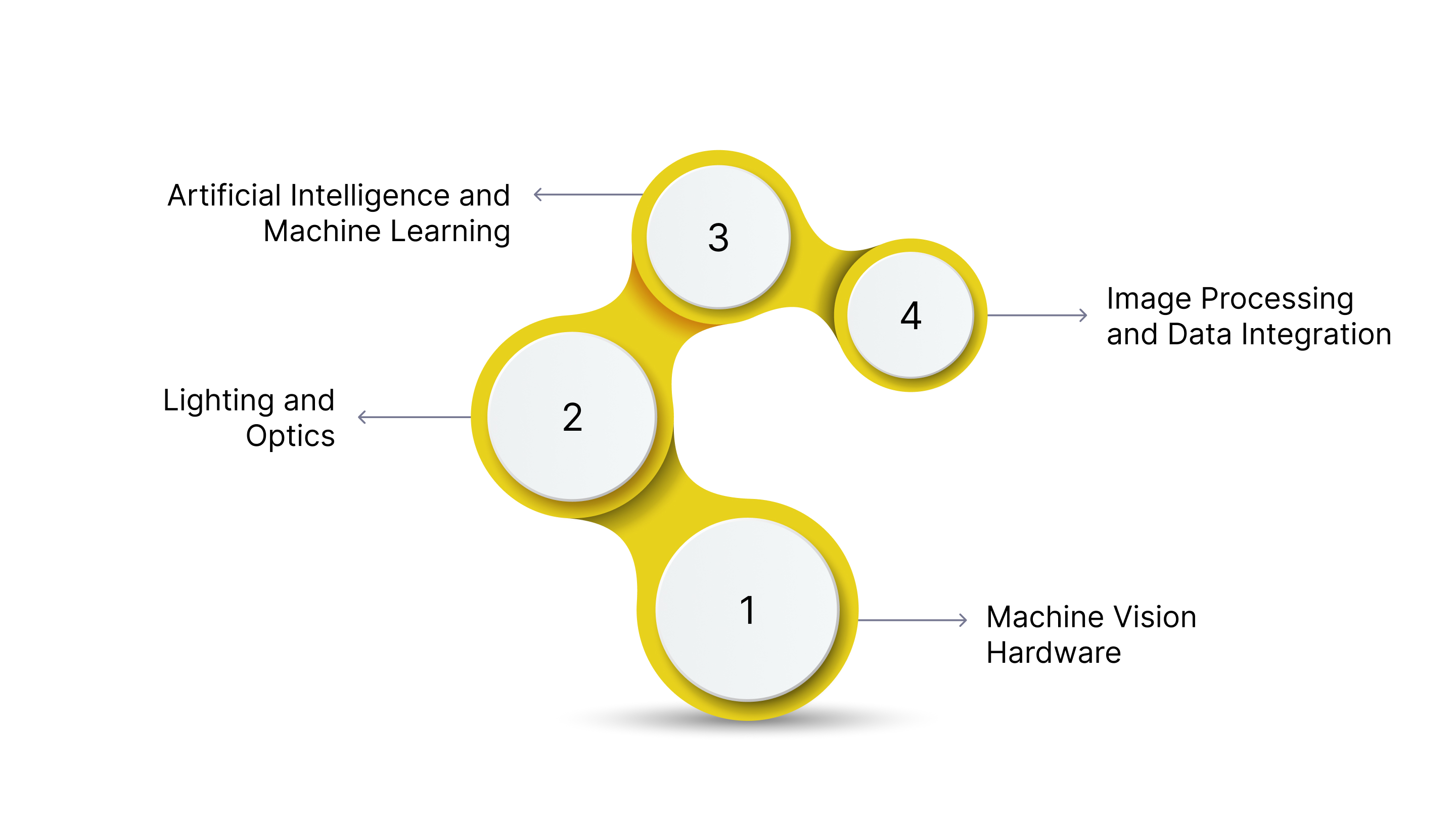
Automated defect inspection combines several complementary technologies that work together to detect, analyse, and report defects in real time. Each element contributes to precision, reliability, and adaptability in industrial environments.
1. Machine Vision Hardware
High-speed cameras, typically line-scan or area-scan, capture continuous images of moving materials. Multiple cameras can be arranged across the full width of a web to ensure there are no blind spots.
2. Lighting and Optics
Lighting determines how well surface defects appear in images:
Bright-field lighting: highlights color or coating variations.
Dark-field lighting: reveals texture, scratches, or raised defects.
Backlight: detects pinholes or edge irregularities.
Proper lighting stabilizes image quality regardless of material color or reflectivity.
3. Artificial Intelligence and Machine Learning
AI-driven algorithms learn to recognize complex or variable defects, such as pattern distortions or subtle texture changes, that rule-based systems might miss. This reduces false positives and improves detection accuracy over time.
4. Image Processing and Data Integration
Advanced software converts raw images into usable data. Detected defects are mapped with coordinates, timestamps, and classifications.
Integration with PLCs or MES systems allows defect trends to inform process adjustments, supporting closed-loop quality control.
Together, these technologies make automated defect inspection a scalable, adaptable, and high-performance solution for continuous manufacturing environments.
Essential Equipment and Components for Reliable Defect Detection
The reliability of an automated defect inspection system depends on the precision of its equipment and how well each component is integrated.
Every part plays a role in capturing clear images, detecting subtle flaws, and ensuring system stability during continuous operation.
1. Cameras and Imaging Hardware
Industrial-grade cameras are the foundation of any inspection system.
Line-scan cameras capture continuous images of wide, moving materials.
Area-scan cameras are suited for smaller or stationary products.
Multi-camera arrays cover the full material width without blind zones.
High frame rates and resolution allow detailed defect detection, even at high line speeds.
2. Lighting and Optical Setup
Lighting consistency ensures accurate imaging.
Bright-field: reveals surface color and coating inconsistencies.
Dark-field: highlights raised textures and fine scratches.
Backlight: detects pinholes, holes, and edge irregularities.
Frames often include enclosures to block ambient factory light, stabilizing results across shifts.
3. Processing Hardware and Software
Powerful processors handle large image volumes instantly. The inspection software includes:
Recipe management for different products
Sensitivity and threshold settings
Real-time dashboards for monitoring
Defect classification and reporting modules
4. Integration and Connectivity
Data from cameras and sensors is sent to PLC, MES, or SCADA systems for live monitoring. Integration supports automated alarms, rejection systems, and process adjustments, turning inspection into a control function rather than just a reporting tool.
What Automated Defect Inspection Can Detect: Typical Defects and Scenarios
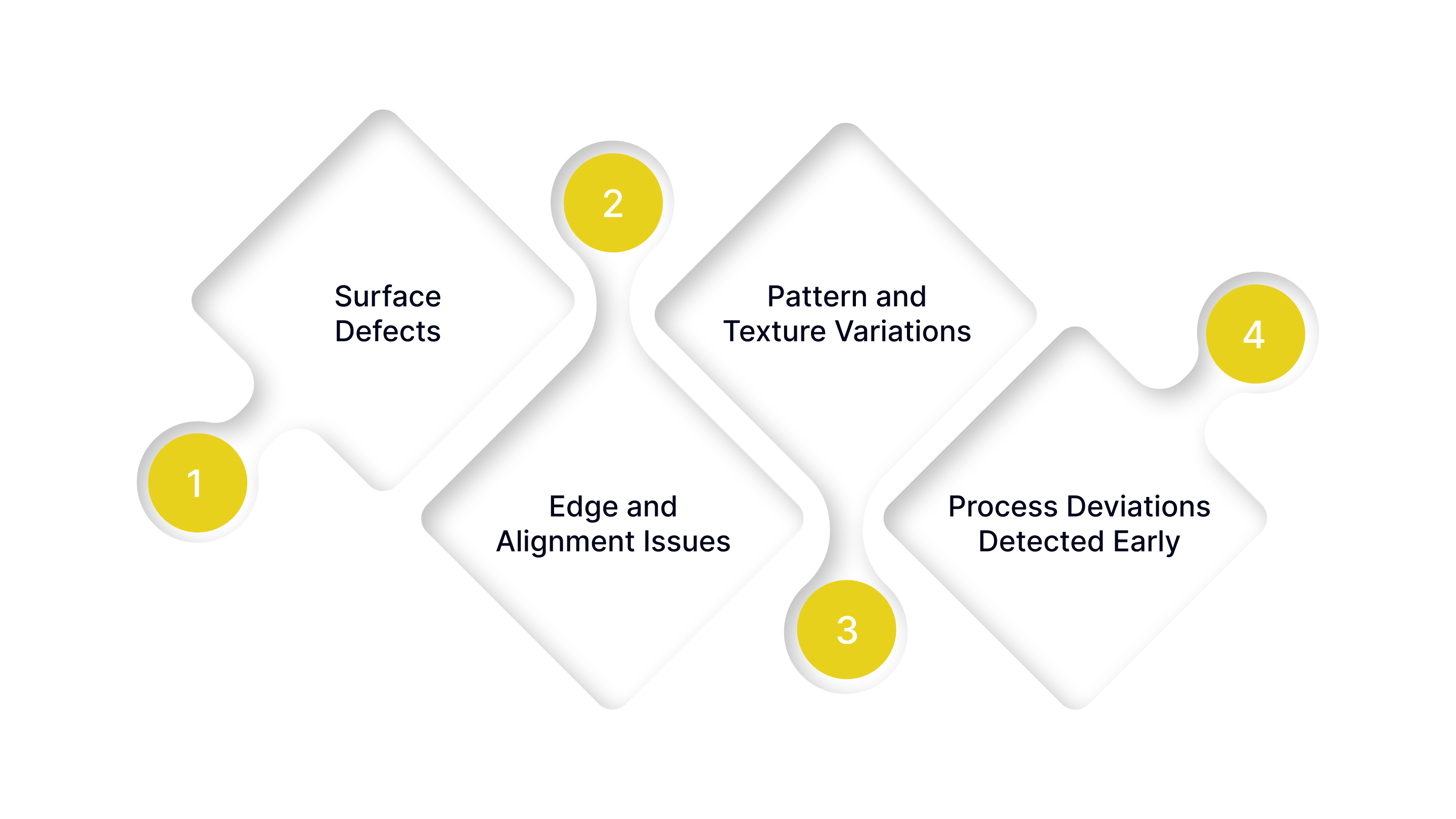
Automated defect inspection identifies a wide range of surface and structural irregularities, depending on the industry and material type. The system’s adaptability allows it to detect both obvious and subtle defects that could affect appearance, performance, or compliance.
1. Surface Defects
Scratches, dents, and streaks caused by rollers or tooling
Coating or print irregularities (thin spots, color shifts)
Pinholes, voids, or blisters in films or coated surfaces
Dust, dirt, or fiber contamination
2. Edge and Alignment Issues
Edge tears, fraying, or misaligned trims
Coating overflow or uneven edges
Offset seams or strip misplacement
3. Pattern and Texture Variations
Distorted or shifted patterns in textiles and flooring
Gloss differences or uneven finish
Irregular texture distribution in nonwovens or foams
4. Process Deviations Detected Early
By visualizing defects in real time, operators can spot early signs of:
Equipment wear
Coating head misalignment
Air bubbles or inconsistent feed rates
Outcome:
Automated inspection provides complete visibility across the production width, ensuring consistent product quality and reducing rework. It helps manufacturers meet customer expectations while maintaining high throughput and stable performance.
Applications and Examples of Automated Defect Inspection for Flat Materials
Automated defect inspection delivers the highest value in industries that process flat or web-shaped materials, where even minor surface inconsistencies can lead to large-scale waste.
Continuous inspection ensures consistent quality and early correction across a range of applications.
1. Nonwovens and Technical Textiles
Nonwoven lines often face irregular fiber distribution, contamination, or coating variations. Automated inspection monitors fiber homogeneity after carding and identifies defects or uneven bonding early.
In coated textiles, it ensures uniform coverage and grammage, supporting applications such as filtration, automotive interiors, and protective fabrics.
2. Plastic Films and Sheets
In extrusion and cast-film processes, tiny streaks or pinholes can multiply quickly. Automated systems detect gels, inclusions, and scratches at full speed, helping operators stabilize thickness, coating, and gloss uniformity, key for packaging, construction, and technical films.
3. Insulation Boards and Mineral Wool
Inspection ensures visual and structural consistency, detecting crushed areas, density variations, or surface irregularities. This supports stable thermal and mechanical performance and compliance with building standards.
4. Battery Films and Energy Materials
Surface precision directly affects performance and safety. Automated inspection identifies coating gaps, pinholes, or conductive material contamination, helping maintain high yield and traceability in EV and energy sectors.
5. Decorative Surfaces and Flooring
For wallcoverings, laminates, or flooring, visual perfection is critical. Automated inspection verifies pattern alignment, gloss uniformity, and print accuracy, preventing costly returns or reputation loss.
Traditional vs. Automated Defect Inspection: Manual & AOI Compared
Manufacturers traditionally relied on manual inspection or early-generation automated optical inspection (AOI) systems.
Both have significant limitations in speed, consistency, and adaptability, especially in wide or high-speed production environments. Automated defect inspection offers a clear upgrade.
Aspect | Manual Inspection | Legacy AOI Systems | Automated Defect Inspection |
Coverage | Partial, random checks | Limited field of view | Full-width, continuous scanning |
Accuracy | Depends on the operator's skill | Moderate | High, data-driven precision |
Speed | Slows with fatigue | Moderate | Matches full line speed |
Consistency | Variable between shifts | Stable but rigid | Adaptive and repeatable |
Integration | None | Minimal | Full PLC/MES connectivity |
Traceability | Manual logging | Basic defect counts | Image and data records |
Key Benefits of Automation
Detects small, low-contrast defects missed by human vision
Ensures constant accuracy regardless of lighting or shift
Reduces workload for operators while improving inspection frequency
Generates automatic digital reports for audits and compliance
Automated defect inspection delivers faster, more reliable, and scalable quality control, transforming visual inspection into a strategic process tool rather than a reactive checkpoint.
How Hammer-IMS Helps Manufacturers Achieve Smarter Defect Inspection
Hammer-IMS helps industrial manufacturers move beyond traditional, limited inspection methods through clean, radiation-free, and fully modular defect detection systems.
The company’s solutions combine advanced sensors, machine vision, and intelligent software to deliver a complete, integrated view of product quality, both surface and internal.
1. Clean and Non-Contact Technologies
Hammer-IMS’s proprietary M-Ray millimetre-wave technology measures thickness and basis weight without using nuclear or X-ray sources. When combined with Edge-Vision 4.0, a camera-based surface inspection system, manufacturers gain total visibility, from structural uniformity to surface finish.
2. Modular and Scalable Systems
The Marveloc-CURTAIN and CHARIOT families are designed for different line configurations, from compact retrofits to wide, high-speed lines. Systems can integrate multiple sensors (M-Ray, L-Ray, C-Ray, or camera) to meet material and process needs.
3. Unified Software and Data Integration
With Connectivity 3.0, Hammer-IMS connects all inspection data directly to plant PLCs and MES systems. Operators receive live defect maps, historical reports, and actionable process trends that support continuous improvement and audit readiness.
4. Value Delivered to Manufacturers
Reduces scrap and rework
Improves product uniformity and yield
Eliminates radiation safety and licensing issues
Supports quality documentation for demanding customers
Hammer-IMS transforms inspection from a manual burden into an automated, intelligent process-control function, supporting long-term efficiency, compliance, and sustainability.
Conclusion
Automated defect inspection enables manufacturers to achieve consistent, traceable, and waste-free production.
By detecting flaws early, operations can stabilize output, cut material loss, and maintain quality across every roll, sheet, or panel produced. For industries where precision and compliance drive profitability, automation is no longer optional; it’s essential.
Hammer-IMS helps manufacturers modernize quality control with radiation-free, data-driven measurement and inspection systems built for flat materials. Its modular platforms combine surface, thickness, and basis-weight monitoring into one connected solution for process control and sustainability.
Ready to upgrade your inspection line?
Contact Hammer-IMS to explore how we can help reduce waste, improve product consistency, and deliver cleaner, smarter manufacturing performance.
FAQs
1. What is automated defect inspection?
It’s a technology that uses cameras, sensors, and intelligent software to automatically detect visual or structural defects in real time during production.
2. How does it differ from manual inspection?
Manual checks rely on human judgment and limited coverage. Automated systems inspect the full material width continuously, ensuring consistency and speed.
3. Does automated inspection slow down the line?
No. These systems operate in-line at full production speed without interrupting throughput.
4. Can it handle textured or reflective materials?
Yes. Advanced lighting and AI-based software adapt to surface changes, reducing false results.
5. Is it difficult to integrate with existing equipment?
Modern systems, like those from Hammer-IMS, integrate easily with PLCs and MES platforms.
6. Does it replace human inspectors?
No. It supports operators by automating repetitive detection tasks while humans focus on process decisions.
7. What industries benefit most?
Manufacturers of nonwovens, plastics, insulation, films, and battery materials gain the greatest value from automated defect inspection.