Manufacturers today face rising pressure to deliver quality at high speed while minimizing waste. Manual inspection or spot-checks often fall short. Defects that escape visual checks can lead to scrap, rework, and lost profitability.
We understand that keeping up with these demands can feel overwhelming, especially when traditional inspection methods fail to catch every defect, putting your production goals and margins at risk.
Recent market research shows that demand for multi-camera vision inspection systems is rising sharply, with a 12.7% CAGR, according to Researchandmarkets. This reflects a broader shift: more plants are adopting automated, inline inspection to secure yield and uptime.
This guide explains how multi-camera vision inspection works, why it matters for Tier 1 industries, and how integrating it with non-contact measurement systems (thickness, basis weight, moisture) supports real operational gains.
Key Takeaways
Why manufacturers shift to multi-camera vision inspection for full-width, real-time defect detection.
Overcomes single-camera limits on speed/web width, boosting uptime and throughput in nonwovens/insulation/rubber.
AI classification reduces false positives; pairs with non-contact gages to provide complete quality (surface plus thickness/moisture).
Delivers KPI wins: lower scrap/yield loss, supplier traceability, compliance ease without nuclear sources.
Evaluate vendors on modularity, sensor fusion, and support to minimize long-term risks.
What Drives the Shift to Multi-Camera Vision Inspection
Modern production lines face several constraints that make traditional inspection methods inadequate:
Wide webs and large sheet widths
High line speeds and continuous operation
Complex material types (nonwovens, foams, insulation, rubber)
Tight cost and compliance pressures
Single-camera or sampling-based inspection cannot reliably cover these conditions. Multi-camera vision inspection solves these limitations through full-width, real-time optical scrutiny.
Common Surface Defects & Their Operational Impact
Different industries and materials show varied defect types. Below is a summary of common issues and why they matter:
Defect Type | What It Is | Impact (Scrap / Rework / Customer Complaints) |
Holes / Tears / Thin Spots | Gaps caused during processing or handling | Roll or batch rejection due to structural failure or leak paths |
Surface Roughness / Texture Variation | Uneven fiber distribution or surface finish | Reduced material performance, poor appearance |
Contamination / Foreign Particles | Dust, gel drops, debris embedded in the web | Inclusion defects, surface blemishes, and final quality issues |
Streaks or Lines | Process drift, coating irregularity | Visible defects, inconsistent product quality |
Color or Density Variation | Uneven pigmentation or material flow | Customer complaints, potential performance issues |
Edge Defects / Misalignment | Jagged edges, mis-cut, edge distortions | Problems in conversion or downstream processing |
Addressing these limitations starts with a closer look at how multi-camera vision inspection actually works.
How Multi-Camera Vision Inspection Works
A multi-camera inspection system typically includes:
An array of high-resolution cameras covering the full web width
Consistent, controlled lighting to maintain image quality
Software to process, stitch, and analyze images in real-time
Optional thermal or IR imaging for special inspections
AI-assisted defect classification to reduce false positives
100 Percent Surface Coverage
Digital twins from stitched data enable post-run defect sorting
This setup captures the moving material without stopping the line. Every square inch is inspected, and anomalies are reported instantly, helping making sure of fast detection during high-speed runs.
Why Multi-Camera Inspection Outperforms Single-Camera or Sampling Methods
The move to multi-camera inspection is a strategic choice driven by physical and economic limitations. Single-camera architectures are fundamentally constrained in a high-speed, wide-web environment. The choice is a direct factor in your ultimate Throughput and system Uptime.
Critical Differences Between Single-Camera System and Multi-Camera System Impacting Your KPIs
Challenge | Single-Camera System (Legacy) | Multi-Camera System (e.g., Edge-Vision 4.0) |
Web Width | Limited | Full-width coverage |
Line Speed | May require slowdown | Works at full line speed |
Detection Resolution | Lower / spot checks only | High-resolution, continuous coverage |
Defect Localization | Poor and often miss small defects | Detects and logs defects precisely |
False Positives / Negatives | High risk | AI-assisted classification improves accuracy |
Throughput & Uptime | Interrupted for checks | No stoppage; continuous inspection |
For high-throughput, wide-web lines (e.g., nonwovens, XPS boards, foams), multi-camera vision inspection enables reliable inline quality control.
Types of Vision Cameras for Inspection
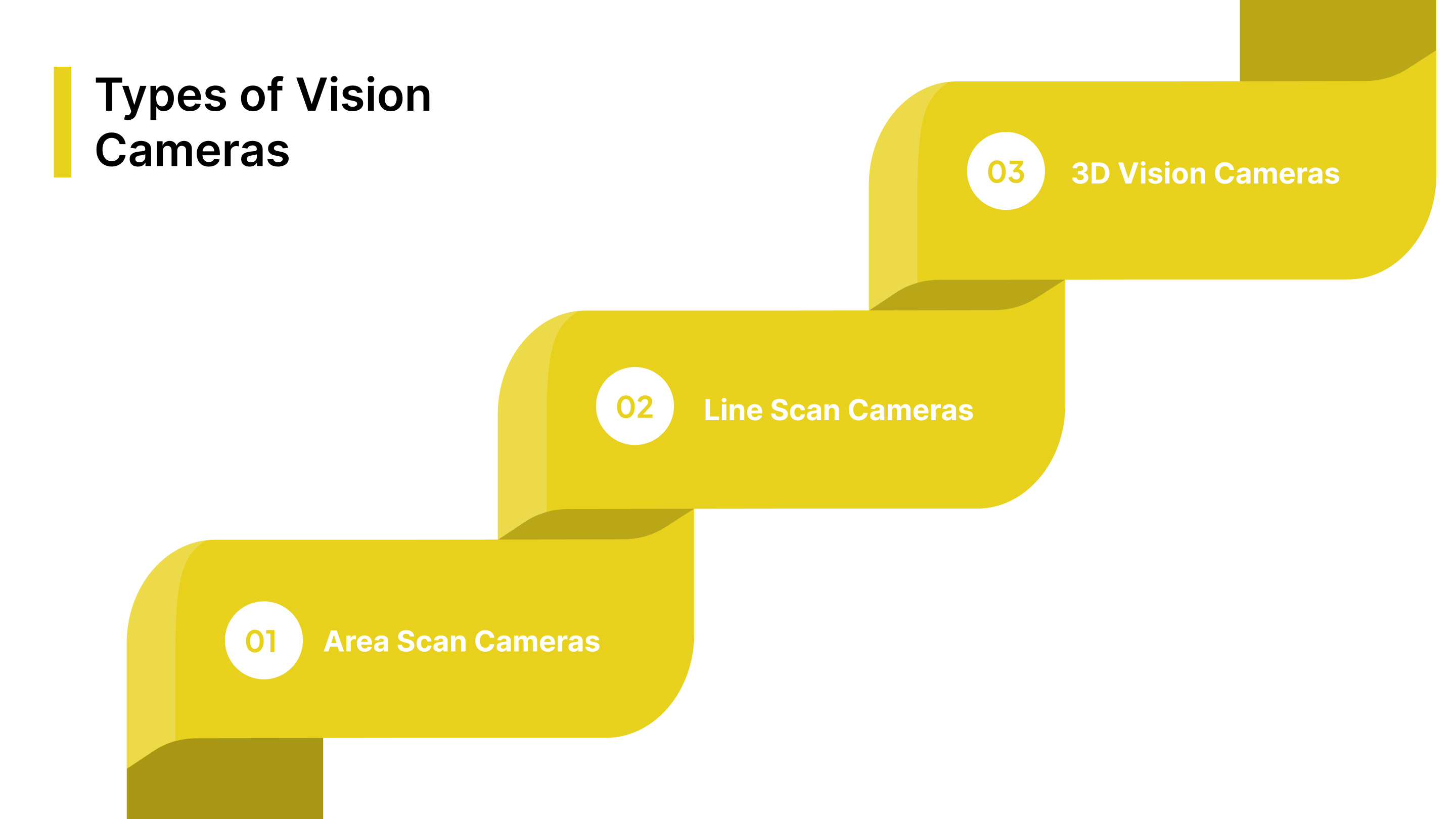
Different camera types solve different inspection needs. This section explains the main categories in clear, plant-friendly terms.
1. Area Scan Cameras
Area scan cameras capture still images of defined sections. They work well on discrete parts but suit wide, fast webs poorly. They require high processing power to stitch images across large widths.
2. Line Scan Cameras
Line scan cameras capture data one pixel row at a time. They suit continuous materials, yet they create large data streams. These streams need robust processing and stable web handling.
3. 3D Vision Cameras
3D cameras support thickness or profile checks. They cannot detect 2D surface issues like inclusions or discoloration. They complement, rather than replace, surface inspection tools.
While camera types address specific needs, sampling limits their potential in high-volume US manufacturing. Inline systems like multi-camera setups overcome this by enabling continuous monitoring.
Why Sampling is No Longer Enough for US Manufacturing
Many teams still depend on sampling. This method often misses progressive drift or random defects. When defects appear late, the cost of rework or scrap increases sharply.
Inline inspection provides continuous visibility. This supports faster responses to machine drift or raw material variation. It also supports operators with reliable information during each run.
The consequences of relying on sampling become clearer when you look at the industries where quality expectations are the highest.
Key Tier 1 Industries Where It Matters
The flexibility of the multi-camera setup allows for targeted inspection in diverse, high-priority manufacturing sectors. Multi-camera vision inspection is especially relevant to these industrial segments:
Industry | Critical Inspection Need | Operational Benefit |
Nonwovens | Homogeneity Index monitoring, foreign object detection, and color variations due to blending. | Ensures consistent material quality for hygiene or filtration products; helps reduce high raw material consumption. |
Rubber & Tire | Detecting porosity, damage, streaks, and surface inclusions in black rubber compounds. | Strengthens overall product performance while minimizing the likelihood of structural failures. |
Insulation Boards (XPS, EPS) | Surface integrity (dents, scratches) and geometry (edge tracking, dimensional compliance). | Meets building code standards and reduces waste associated with poorly cut or damaged boards. |
Acoustic/Textiles | Broken filaments, spots, stains, and coating uniformity across wide webs. | Supports high safety standards for automotive or medical applications. |
Once we identify the industries where precision is non-negotiable, it becomes clear why both vision and non-contact gages are needed for complete quality assurance.
Why Vision and Non-Contact Gages Provide Complete Quality Assurance
Surface inspection is essential, but many materials also require dimensional or internal property checks (thickness, basis weight, moisture). Combining vision inspection with other sensors ensures comprehensive quality control.
Example sensor suite:
M-Ray (millimeter-wave): Measures basis weight, internal moisture, and density for porous or thick materials.
L-Ray (laser triangulation/time-of-flight): Checks thickness, profile, geometry for foams, composites, boards.
U-Ray (ultrasonic): For metallic or metallised materials where EM sensors struggle.
Edge-Vision 4.0 (multi-camera vision): Captures surface defects, texture, inclusions, and edge anomalies.
This sensor fusion gives operators a complete picture: surface, internal quality, and dimensional compliance, all in line.
Operational Gains for Plant Teams
Multi-camera and non-contact sensors support key operational priorities across production floors.
The system helps reduce scrap by detecting defects early.
It supports higher yield through stable, continuous monitoring.
It can improve uptime by reducing manual inspection stoppages.
It supports better throughput by matching full line speed.
It helps manage supplier risk by inspecting incoming material.
It supports lead-time stability through early detection of drift.
Multi-camera systems inspect incoming webs thoroughly, tracing defects to suppliers via logged data. This cuts rejection costs and stabilizes procurement, which is key for US plants facing variable raw materials.
People Also Liked: 5 types of surface inspection with camera technology
How Multi-Camera Vision Supports Key KPIs
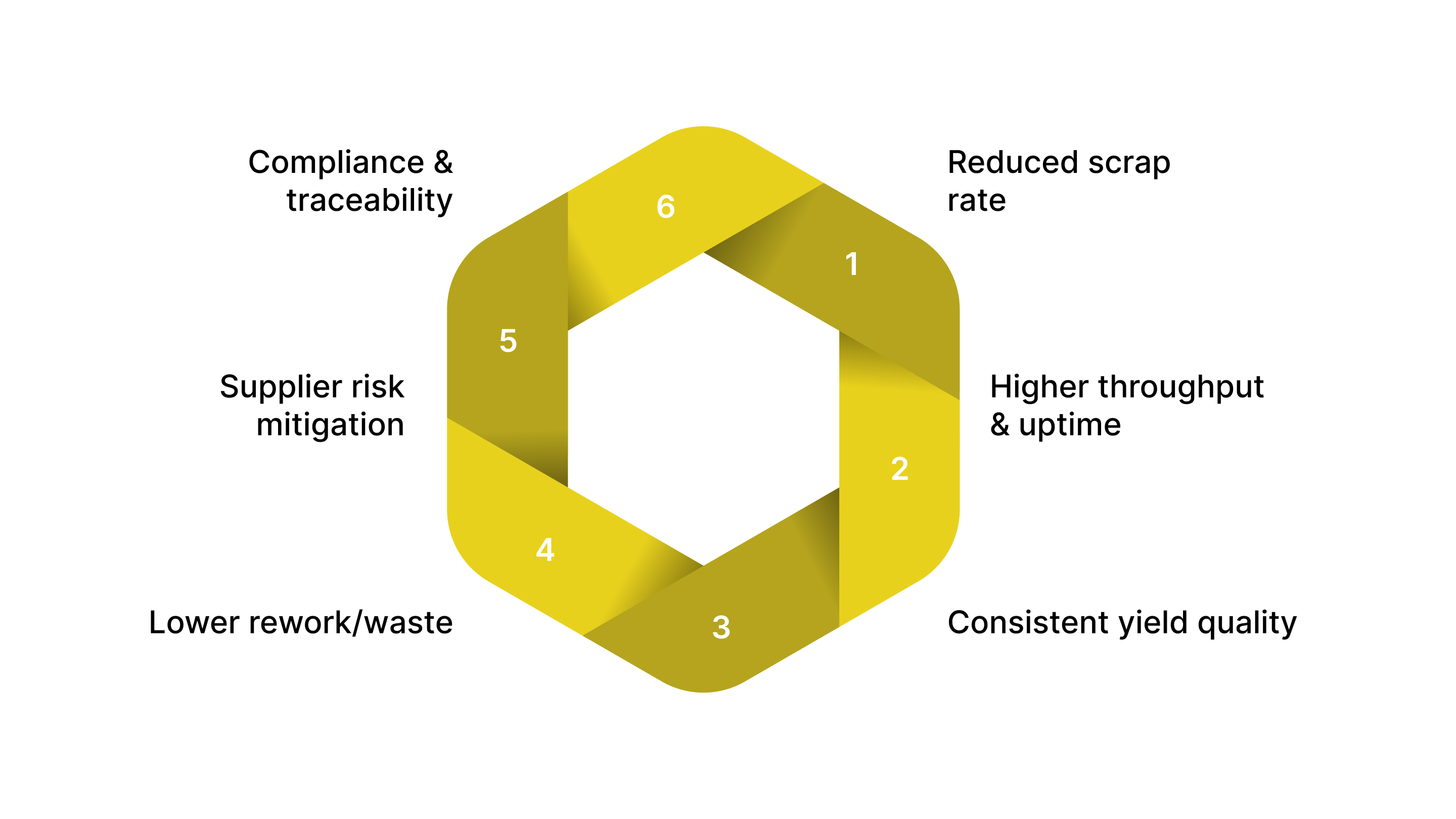
Multi-camera vision impacts the KPIs that shape daily production performance, not just inspection outcomes.
Reduced scrap rate: Early detection of surface and structural defects prevents processing defective material downstream.
Higher throughput & uptime: Continuous inline inspection avoids line stoppage for manual QC.
Consistent yield quality: Uniform material quality supports stable production batches.
Lower rework/waste: Defects logged early; rolls can be diverted or repaired before major processing.
Supplier risk mitigation: Incoming raw webs are inspected fully; supplier-related defects are caught promptly.
Compliance & traceability: System logs and data archives support audits, quality standards, and traceability needs.
While the KPI impact shows what multi-camera vision improves, the next step is understanding how the technology delivers these gains. The following capabilities form the technical backbone that enables real shifts in yield, uptime, accuracy, and traceability.
Capabilities That Help in Technical Growth
Here are the capabilities that directly support long-term technical growth and operational maturity.
100% × 100% In-Line Inspection: Multi-camera vision captures every feature from every angle, enabling complete, real-time analysis instead of limited sampling. This capability is the foundation behind KPI shifts in FPQ, scrap reduction, and throughput stability.
Retroactive Inspection: Stitched image data creates a digital twin of each part, enabling new inspections, virtual sorting, and traceability long after production. This directly supports warranty reduction, audit readiness, and customer claim resolution.
Software-Only Flexibility for New Inspections: Inspections can be updated or added by simply marking new points on the CAD model; no hardware changes are needed. This enables faster ECRs, lower downtime, and smoother program launches.
Built-In Camera Redundancy: Every feature is captured by multiple cameras, allowing inspection to continue even if a camera fails. This maintains uptime and prevents unexpected stoppages on high-volume lines.
Self-Diagnostics for Measurement Accuracy: Photogrammetry allows the system to validate its own measurement reliability in real time and flag deviations. This makes sure of consistent accuracy, reduces false rejects, and supports high-precision manufacturing.
Technical capabilities set the benchmark for performance, but successful implementation depends on how well the solution aligns with your plant's needs, constraints, and future roadmap. To make an informed decision, buyers should look beyond features and evaluate several critical factors.
What Buyers Should Consider
Plants need stable, reliable partners for long-term inspection systems. This section helps readers evaluate vendors clearly.
Non-nuclear sensing reduces compliance and training requirements.
A supplier with sensor fusion provides one system instead of several.
Mechanical platform stability affects inspection accuracy.
A modular system lowers long-term sourcing risk.
Quality support and maintenance affect uptime.
Non-nuclear sensors reduce regulatory burdens under OSHA/EPA, minimizing audit risks in safety-critical sectors.
Criterion | Why It Matters |
Non-Nuclear Tech | Cuts compliance/training costs |
Sensor Fusion | Single platform, less integration downtime |
Modularity | Adapts to material changes |
Support Network | Make sure of uptime via parts access |
With the core evaluation factors in place, the next step is understanding how these capabilities translate into operational KPIs with Hammer-IMS.
Why Hammer-IMS Supports Your Operational KPIs
Selecting the right technology partner involves assessing technological capability against long-term sourcing and maintenance risks. Your decision should center on systems that directly address your pain points without introducing new ones.
In a competitive field including large integrators (Cognex, Keyence) and specialized gaging companies (Mahlo, Scantech), Hammer-IMS offers a distinct value proposition rooted in operational simplicity and technical depth:
Non-Nuclear Core Technology: Unlike some competitors that still rely on Beta-ray or X-ray gages, Hammer-IMS is fundamentally built on non-radiative sensing (M-Ray, L-Ray, U-Ray). This drastically simplifies your compliance obligations and eliminates the safety and administrative burden associated with managing nuclear sources on the plant floor.
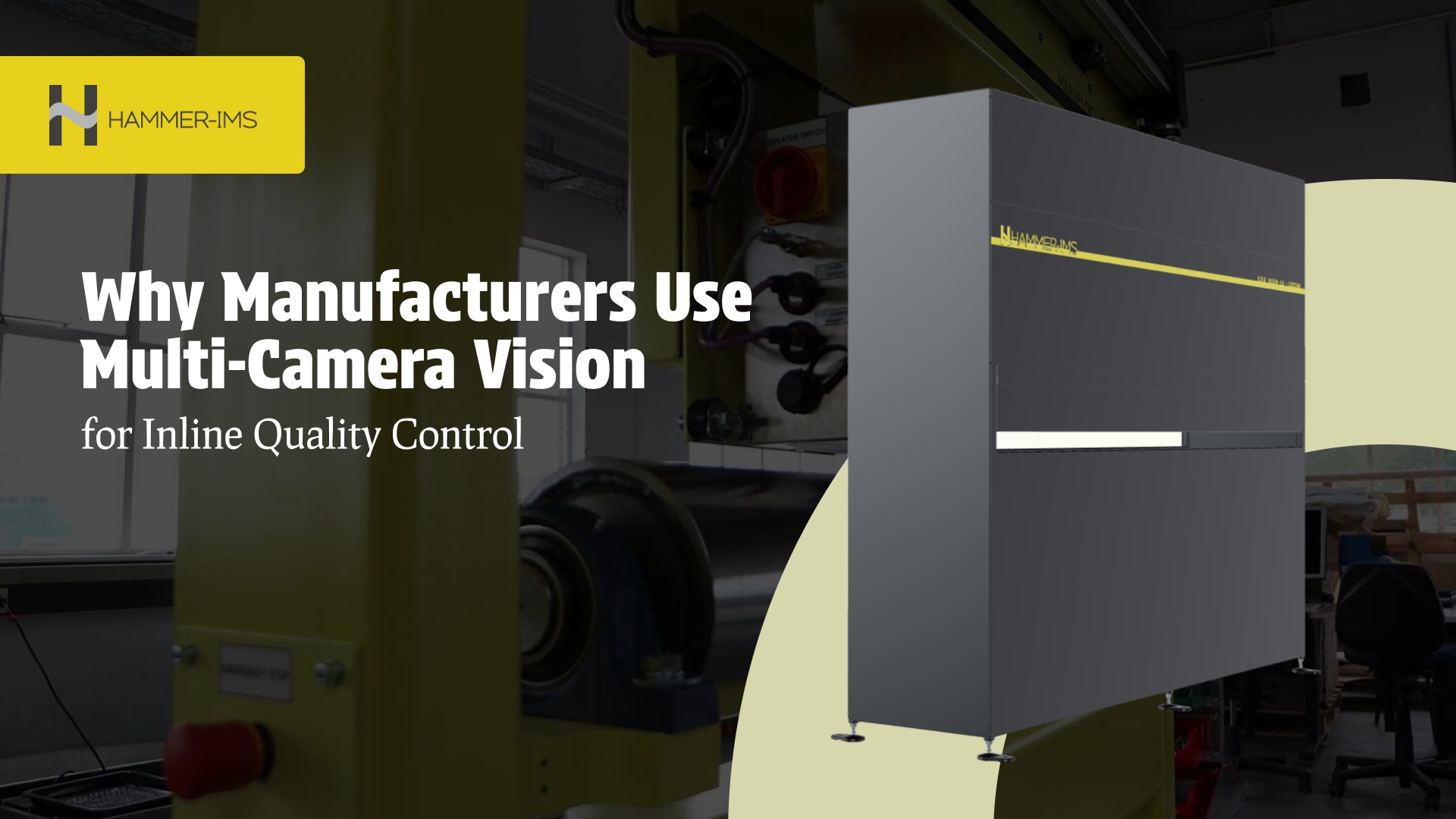
True Sensor Fusion: Many systems require marrying a third-party vision system with a separate dimensional gage. It delivers both the Edge-Vision 4.0 and the M-Ray/L-Ray/U-Ray sensors on a single CURTAIN platform, managed by a single software suite. This minimizes integration complexity and avoids the downtime often associated with integrating disparate vendor technologies.
Connectivity 3.0 software suite: Integrates sensor data streams, logs inspection results, and supports real-time dashboards.
Focus on Difficult Materials: The ability to combine M-Ray (for dense materials like mineral wool) with Edge-Vision (for surface flaws) and U-Ray (for conductive rubber compounds) means the system is built to provide reliable results in materials that challenge conventional sensing technologies.
Reduced Sourcing Risk: By offering a modular, configurable solution from a single vendor, you reduce the long-term risk of relying on multiple suppliers for maintenance, spare parts, and software updates. This simplifies your vendor evaluation process and makes long-term support more predictable.
Hammer-IMS is positioned as a specialized partner focused on continuous, 100% material scrutiny, enabling you to focus on production and meeting your quality targets.
For manufacturers aiming to strengthen inspection protocols and ensure reliable product quality, Hammer‑IMS showcases how advanced technology can complement traditional QC practices. Book a demo to see how inline inspection can improve your quality control processes.
Conclusion
The operational success of a manufacturing facility is tied directly to its ability to manage and eliminate process variation. Multi-camera vision inspection is no longer a luxury; it is a foundational technology for continuous yield improvement and guaranteed throughput. By implementing systems that provide high-speed, 100% surface inspection integrated with precise dimensional gaging, you equip your production team with the tools to control quality proactively.
The strategic move is to partner with a vendor that understands the realities of your industrial environment and can deliver a cohesive, easy-to-integrate solution. This will make sure that your plant can scale production, minimize scrap, and meet the high-quality standards demanded by the US market.
Ready to move past sampling and achieve 100% material scrutiny? Request a consultation with a Hammer-IMS process engineer to configure an Edge-Vision 4.0 solution for your line.
FAQs
1. How accurate are multi-camera systems for defect detection?
Accuracy depends on material type and camera settings. High-resolution systems like Edge-Vision 4.0 detect defects at small scales during fast runs.
2. How does a multi-camera system help reduce downtime?
It reduces downtime by automating inspection. It also continues inspection even if one camera stops, which supports uptime.
3. Can multi-camera systems measure thickness?
The vision system handles surface checks. Thickness and profile checks come from L-Ray or other dimensional sensors.
4. How does vision inspection support supplier risk control?
Incoming webs or boards are inspected fully. Operators can trace defects to material loads and address supplier issues quickly.
5. Which industries benefit most from multi-camera inspection?
Nonwovens, mineral wool, synthetic foams, insulation boards, rubber sheets, and acoustic materials benefit strongly from these systems.