Introduction
For EPS insulation manufacturers, even small deviations in thickness or density during production can silently undermine product quality, R-value guarantees, fire compliance, and structural integrity — while also inflating material costs. A 1mm excess on a 50mm board represents a 2% material overrun; across millions of board feet, this "safety buffer" significantly erodes margins.
Panels produced too thin or too low in density risk failing compressive strength ratings or fire performance thresholds — creating downstream liability and field failures.
Real-time industrial measurement systems directly address these risks. As EPS specification requirements tighten across building codes and customer contracts, manufacturers still relying on sampling-based or contact measurement methods face growing exposure to non-conformance, over-specification waste, and reactive quality management. This guide covers how to close that gap.
Key topics covered:
- How thickness and density variation drives material waste and compliance risk
- The measurement technologies available for inline EPS production monitoring
- What to evaluate when selecting a system for your production environment
Key Takeaways
- EPS insulation performance depends on two variables — thickness and density — each requiring precise control during production
- Uncontrolled thickness causes R-value non-compliance; density deviations compromise compressive strength, fire ratings, and structural performance
- Inline, non-contact measurement systems allow real-time quality control throughout the EPS production line, unlike traditional offline or destructive methods
- Closed-loop measurement feedback enables automatic production adjustments, reducing reject rates and over-specification costs
- Modern non-nuclear measurement technologies make EPS quality control safer and more consistent across every production shift
What Is EPS Insulation Thickness and Density Measurement?
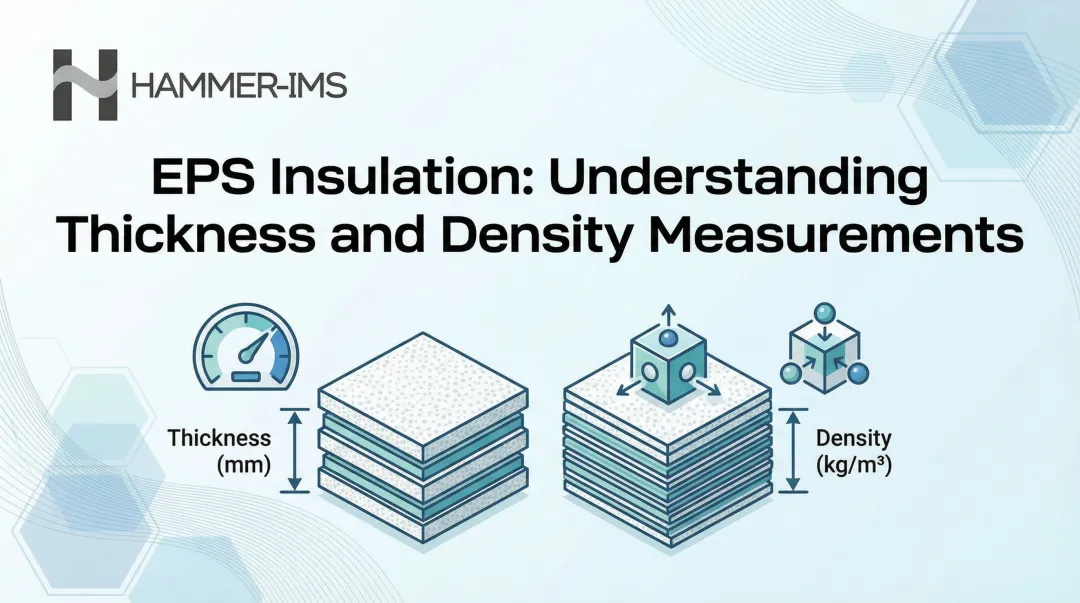
EPS (expanded polystyrene) insulation is a rigid foam panel produced by expanding polystyrene beads with steam. Two physical parameters govern its performance: thickness (how much insulation is present) and density (how tightly packed the expanded bead matrix is). Both directly determine whether a panel meets specification.
Thickness measurement determines whether a panel meets specified R-value requirements. Since R-value scales directly with thickness per inch, a panel cut 3mm thinner than specification will deliver proportionally less thermal resistance — potentially failing building code requirements and customer expectations.
Density measurement (typically expressed in kg/m³ or lb/ft³) determines the EPS "type" or grade. Under ASTM C578, EPS is classified into types ranging from Type I (minimum 0.90 lb/ft³ or 15 kg/m³) through Type XV (3.00 lb/ft³ or 48 kg/m³), each with defined density ranges for different structural applications. Type I delivers approximately 3.6 R/in at 75°F, while Type II (1.35 lb/ft³) delivers 4.0 R/in — a direct correlation between density and thermal performance.
Two measurement approaches dominate production environments:
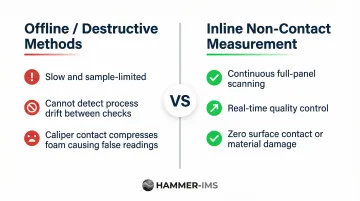
- Offline/destructive methods: Weighing cut samples, caliper gauging: slow, sample-limited, and unable to detect process drift between checks
- Inline non-contact measurement systems: Scan the full panel continuously during production without touching the material, enabling real-time quality control and process correction
Why Accurate Measurement Is Critical in EPS Manufacturing
EPS manufacturers are held to strict product specifications. Industry standards such as ASTM C578 (US) and EN 13163 (Europe) define minimum density and thickness tolerances that panels must meet. Failing these tolerances can result in rejected shipments, insurance liability, and building code non-compliance.
The Cost of Under-Specification
Panels produced too thin or too low in density may fail:
- R-value claims: Thermal resistance falls below specification
- Compressive strength ratings: Structural performance degrades
- Fire performance thresholds: Non-compliant panels create liability exposure
Each failure type compounds the others. Inconsistent density produces non-uniform R-values across a batch, introduces structural performance variability in load-bearing applications, and drives customer returns.
The Equally Damaging Cost of Over-Specification
When manufacturers add extra thickness or density as a buffer for process variability, they are giving away material and cost margin. Because contact gauges often under-read thickness (due to foam compression), operators frequently set wire saws slightly wider than the target thickness to ensure panels pass manual QC checks. A 1mm excess on a 50mm board represents a 2% material overrun — over millions of board feet, this "safety buffer" significantly erodes margins.
The Invisible Quality Risk: Density Variation
Unlike thickness, density cannot be detected visually. Two panels of identical size can have significantly different densities, meaning visual inspection provides zero quality assurance on this metric.
Density variations within a block lead to inconsistent compressive strength. ASTM C578 requires density to be calculated on the whole block or specific specimens, but localised variations can cause spot failures that sampling methods miss entirely. In high-volume production, that gap between what sampling catches and what ships is where quality problems — and liability — accumulate.
How EPS Thickness and Density Measurement Systems Work – Step by Step
This section breaks down the real-world stages of an EPS measurement system workflow — from setting production targets to acting on measurement data. Understanding these stages reveals what manufacturers often get wrong: relying on spot checks rather than full-width scanning, or not closing the loop between measurement output and process adjustment.
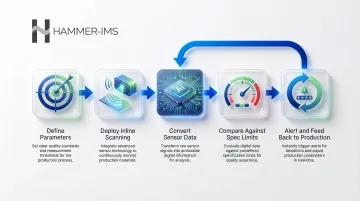
Step 1 – Define Measurement Parameters and Targets
Establish the target thickness range and density grade for the production run based on the product specification (e.g., Type II EPS at 100mm nominal thickness with ±2mm tolerance). This step must include:
- The applicable standard (ASTM C578 or EN 13163)
- The measurement frequency required — full-panel or edge-to-edge scanning
- Tolerance classes for thickness (EN 13163 uses TC designations like T1, T2)
Step 2 – Deploy Inline, Non-Contact Scanning Across the Production Line
Sensors are positioned to continuously scan panels as they exit the cutting or forming process, capturing thickness and density data across the full width and length of each panel without physical contact.
Why non-contact measurement is essential for EPS: The material is compressible. Any contact-based gauge will compress the surface and produce falsely low thickness readings, whilst also risking panel surface damage. Research on foam hardness testing highlights that even minor variations in dwell time and force can alter deflection readings, creating non-reproducible results.
Step 3 – Convert Raw Sensor Data Into Usable Measurement Values
The sensor system processes raw signals (e.g., time-of-flight, millimetre-wave attenuation) and converts them into calibrated thickness and basis weight (density proxy) values. This stage must account for:
- Temperature compensation
- Material composition variation
- Signal noise filtering
These adjustments produce accurate, repeatable measurements across production shifts and environmental conditions.
Step 4 – Compare Real-Time Data Against Specification Limits
Each measurement value is compared automatically against the pre-defined tolerances for the production run. The system flags panels or sections that fall outside specification limits — either above (over-specified, wasteful) or below (under-specified, non-compliant).
Some systems generate colour-mapped thickness or density profiles of each panel for visual operator review, enabling immediate identification of process drift or localised defects.
Step 5 – Interpret Results, Generate Alerts, and Feed Back to Production
Alongside visual review, measurement outputs trigger real-time alerts for out-of-tolerance conditions. Systems with closed-loop integration feed this data directly into process control — for example, adjusting cutting blade position, steam pressure, or conveyor speed to correct for drift before the next panel is produced.
Where many manufacturers leave value on the table: data is collected but not acted upon automatically, meaning corrections still happen after the fact. Connecting measurement output to process adjustment — not just flagging exceptions — is what separates a monitoring system from a true quality control system.
EPS Measurement in Practice – A Production Scenario Walkthrough
Consider a mid-volume EPS panel producer manufacturing Type II density boards (approximately 22 kg/m³) at 100mm nominal thickness for a commercial insulation customer. The customer's specification includes ±2mm thickness tolerance and density verification per EN 13163.
The Problem Without Inline Measurement
Thickness is manually verified by operators using callipers on 5 sampled panels per shift. Density is checked by weighing cut specimens from the block before wire-saw cutting. This approach catches gross deviations but misses:
- Gradual process drift
- Skin effects at panel edges
- Density variation across the block face
The Inline Measurement Workflow
Sensors scan every panel across the full width as it exits the wire saw. Within the first two hours of the shift, the system detects a systematic 3mm over-thickness on one edge (caused by wire bow in the cutting frame). This is flagged immediately, the operator corrects wire tension, and the production run self-corrects before significant waste accumulates.
The Measurable Outcome
Terahertz imaging studies demonstrate that inline scanning can identify local density variations and defects that random sampling would miss.
By eliminating the need for a "safety buffer" in thickness and density, manufacturers can target closer to minimum density thresholds (e.g., targeting 14.6 kg/m³ instead of 15.2 kg/m³ for Type I) whilst ensuring 100% compliance — reducing raw material cost per panel.
The same real-time data log becomes the quality certificate provided to the customer, replacing manual record-keeping and providing documented evidence of compliance.
How Hammer-IMS Can Help EPS Manufacturers
For EPS producers dealing with inconsistent panel thickness or density variation, Hammer-IMS offers a direct solution. Their M-Ray technology uses millimetre wave-based sensing designed for low-density foam materials like EPS — eliminating the contact distortion, radioactive source requirements, and maintenance overhead associated with older gauge technologies.
M-Ray systems address the core measurement challenges on EPS lines:
- Simultaneous thickness and basis weight (density proxy) measurement across full panel width
- Real-time data output for closed-loop production control
- Connectivity 3.0 software for data logging, remote monitoring, and quality reporting
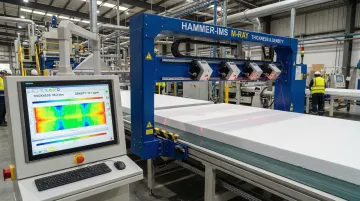
Hammer-IMS systems integrate into existing EPS production lines with minimal disruption. The non-nuclear technology removes regulatory licensing and radiation safety requirements that burden competing gauge technologies — meaning no radiation safety officer, no source licensing, and no periodic regulatory audits tied to the measurement system.
Conclusion
Accurate, continuous measurement of EPS insulation thickness and density is not a quality-check afterthought — it is a core production control function that directly determines material cost, product compliance, customer satisfaction, and competitive margin.
As EPS specification requirements tighten — in both building codes and customer contracts — manufacturers relying on sampling-based or contact methods face growing risk of non-conformance, material giveaway, and reactive quality management.
Inline, real-time measurement systems address each of these risks directly. They allow producers to:
- Run closer to specification limits without over-specifying material
- Catch thickness and density deviations before non-conforming product leaves the line
- Generate documented quality records that satisfy customer and regulatory requirements
For EPS manufacturers under pressure to reduce waste and prove compliance, continuous measurement is no longer optional — it's the practical path to consistent, auditable production.
Frequently Asked Questions
What is EPS in insulation?
EPS (expanded polystyrene) is a rigid closed-cell foam insulation made from expanded polystyrene beads fused with steam, widely used in construction for walls, roofs, and below-grade applications. Its insulation performance is defined by its density grade and thickness, with R-values ranging from 3.6 to 4.3 per inch depending on the type.
Which is better, XPS or EPS?
EPS and XPS differ in moisture absorption, long-term R-value retention, and cost. EPS maintains its R-value over time (constant over 50 years) and is lower cost per R-value unit, whilst XPS offers slightly higher initial R-value per inch but can lose thermal resistance as blowing agents dissipate. EPS also offers greater density grade flexibility and is more widely specified across building applications.
Does EPS need a vapour barrier?
Unfaced EPS is vapour permeable and typically requires a separate vapour barrier or retarder depending on climate zone and building code requirements. ASTM C578 specifies maximum water vapour permeance of 5.0 perms for Type I and 3.5 perms for Type II at 1-inch thickness. Faced EPS products can serve as vapour retarders, with the exact requirement varying by panel density, thickness, and assembly type.
How is EPS density measured in production?
Traditionally, EPS density is verified by cutting and weighing samples from the production block — a slow, destructive, and sample-limited process. Modern inline measurement systems use non-contact sensing technologies to measure basis weight (a density proxy) continuously across the full panel surface during production, enabling real-time quality control and process adjustment.
What thickness tolerances are required for EPS insulation panels?
Thickness tolerances for EPS insulation are defined by standards such as ASTM C578 (US) and EN 13163 (Europe), which specify allowable deviations — typically in the range of ±1 to ±3mm depending on nominal thickness and product type. Manufacturers must verify compliance through measurement, not estimation.
Why does EPS density variation matter for insulation performance?
Density directly affects EPS compressive strength, fire resistance, and thermal performance uniformity. Panels with below-spec density may fail load-bearing or fire code requirements, whilst undetected variation across a batch creates inconsistent performance and potential liability — risks that ASTM C578's rigid density thresholds are specifically designed to prevent.