

Introduction
Film thickness measurement is fundamental to quality control across plastic film, nonwoven, textile, and industrial coating production. Engineers, process technicians, and procurement teams routinely encounter multiple unit systems—gauge, mil, micron, and millimetre—depending on their region and material type.
The friction is real: unit inconsistencies between suppliers, equipment specifications, and customer requirements generate conversion errors that cause material waste and off-spec product.
According to industry data, US manufacturers predominantly use mils and gauge, while European manufacturers work exclusively in microns (µm). The abbreviation "mil" is frequently misread as "millimetre" in international specifications, triggering costly supply chain errors. Even the common shorthand of dividing gauge by 4 to get microns introduces a 1.57% mathematical error — one that compounds into significant material give-away at high production volumes.
This guide explains what each film thickness unit means, how to convert between them accurately, and how to apply these measurements correctly in real production environments.
Key Takeaways
- Film thickness uses gauge, mil, micron (µm), and millimetre—mixing them up causes costly errors
- Key conversions to know: 1 mil = 25.4 µm, 1 gauge = 0.01 mil, and 1 mm = 1,000 µm
- Confirm which unit your equipment, supplier, and customer use before production starts
- Inline measurement catches thickness drift as it happens, preventing scrap and rework that conversion charts alone won't stop
- Thicker film isn't always better—wrong specs waste material and breach customer specs or regulatory limits
Film Thickness Units Explained: Gauge, Mil, Micron, and More
Four primary units express film thickness: gauge (ga), mil, micron (µm), and millimetre (mm). Each originated from different industry or regional standards. Note that gauge for plastic film works inversely to wire gauge—higher gauge numbers mean thicker film, not thinner.
Mil: The US Standard
1 mil = 1/1000th of an inch (0.001 inch) = 25.4 microns exactly.
The term "mil" creates frequent confusion in international specifications because it shares the abbreviated form "mm" with "millimetre" in some contexts. European manufacturers unfamiliar with imperial units routinely misinterpret mil specifications as millimetres, creating order-of-magnitude errors that result in material rejection or production failures.
Micron: The Global Metric Standard
1 micron (µm) = 1 millionth of a metre = 0.001 mm.
Microns are the standard unit in European and metric-system manufacturing, making this critical for companies operating across Belgium, Germany, France, and the Netherlands. ASTM D8136 explicitly recommends SI units (microns/mm) as the standard to prevent cross-border specification errors.
Gauge: The Plastic Film Convention
Gauge = 100 × mils.
For example, 80 gauge = 0.80 mil. This is specific to plastic film and differs entirely from gauge systems used for wire, sheet metal, or coatings. An 80-gauge film measures 0.80 mil or approximately 20.3 microns.
Where Confusion Most Commonly Occurs
Two scenarios account for the majority of costly unit errors in film procurement:
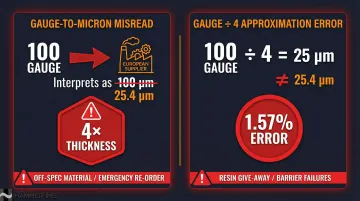
- Gauge-to-micron misread: A procurement team specifies 100-gauge film (expecting 25.4 microns), but a European supplier interprets it as 100 microns — shipping material four times thicker than intended. The result: off-spec material, emergency re-ordering, and compounded waste throughout the value chain.
- Approximation error: Using the "gauge ÷ 4" shortcut (100 gauge ÷ 4 = 25 µm) instead of the exact conversion (100 gauge = 25.4 µm) creates a 1.57% systematic underestimation. Across millions of metres of film production, that gap produces measurable resin give-away and barrier property failures.
How to Convert Film Thickness Measurements
Essential Conversion Formulas
Mil to gauge:
- Multiply mils by 100
- Example: 0.8 mil = 80 gauge
Gauge to mil:
- Divide gauge by 100
- Example: 120 gauge = 1.2 mil
Mil to micron:
- Multiply mils by 25.4
- Example: 1 mil = 25.4 microns
Micron to mil:
- Divide microns by 25.4
- Example: 50 microns ≈ 1.97 mils
Micron to millimetre:
- Divide microns by 1,000
- Example: 20 microns = 0.020 mm
Film Thickness Conversion Table
| Gauge | Mil | Micron (µm) | Millimetre (mm) | Inch | Centimetre (cm) |
|---|---|---|---|---|---|
| 30 | 0.30 | 7.62 | 0.00762 | 0.00030 | 0.000762 |
| 40 | 0.40 | 10.16 | 0.01016 | 0.00040 | 0.001016 |
| 50 | 0.50 | 12.70 | 0.01270 | 0.00050 | 0.001270 |
| 60 | 0.60 | 15.24 | 0.01524 | 0.00060 | 0.001524 |
| 80 | 0.80 | 20.32 | 0.02032 | 0.00080 | 0.002032 |
| 100 | 1.00 | 25.40 | 0.02540 | 0.00100 | 0.002540 |
| 120 | 1.20 | 30.48 | 0.03048 | 0.00120 | 0.003048 |
| 150 | 1.50 | 38.10 | 0.03810 | 0.00150 | 0.003810 |
| 200 | 2.00 | 50.80 | 0.05080 | 0.00200 | 0.005080 |
The exact values in the table above matter more than they might appear — especially when a common shortcut introduces consistent error.
The Error-Prone "Gauge ÷ 4" Approximation
Many operators use gauge ÷ 4 to quickly estimate microns (e.g., 100 gauge ÷ 4 = 25 µm). This approximation underestimates true thickness by 1.57% compared to the exact conversion of 25.4 µm. For rough packaging selection, that margin is often tolerable. For precision manufacturing or compliance specifications with tight tolerances, it is not.
Use the exact formula: µm = (gauge ÷ 100) × 25.4.
Coating Thickness Conversion
Industrial coatings — PVD, thermal spray, barrier films — follow the same micron/mil/mm framework but operate at finer scales. Typical ranges by coating type:
- PVD (Physical Vapour Deposition): 1–25 µm, kept thin to minimise residual stress
- Plastic barrier films: 7.6–50+ µm, depending on application and substrate
- Thermal spray coatings: hundreds of microns or more for heavy-wear structural applications
How to Measure Film Thickness in Practice
Accurate conversion is only as useful as the measurement it's based on. Selecting the right measurement method for the material and production context is as important as knowing the formulas.
Selecting the Right Measurement Method
Contact methods (mechanical caliper or micrometre) physically compress the film surface. For films under 50 microns, contact measurement introduces a bias of up to 3%—a fatal error margin when profit margins sit below 10%. Contact methods are unsuitable for high-speed inline use due to web flutter, vibration, and the risk of scratching delicate materials.
Capacitance-based sensing (ASTM D8136) measures dielectric properties without contact, suitable for non-conductive plastic films from 2.5 to 250 microns. Sensitivity to anti-static additives can affect accuracy.
Optical interferometry (ASTM D8331) achieves sub-nanometre resolution but requires transparent or semi-transparent materials, limiting application to clear multi-layer films and coatings.
Millimetre-wave (M-Ray) technology penetrates porous and opaque materials without contact. This technology achieves micrometre-level accuracy on nonwovens, foams, and opaque plastics where optical sensors scatter and contact gauges compress the substrate.
Taking a Measurement Correctly
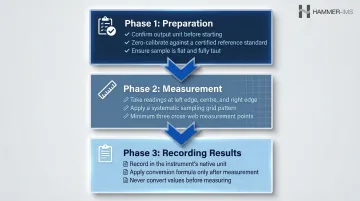
Once you've selected the appropriate method, consistent measurement technique determines whether your readings are usable. Follow these steps:
Preparation:
- Confirm the measurement unit the gauge outputs (microns, mils, mm)
- Zero-calibrate against a certified reference standard in the same thickness range
- Ensure the film sample or web is flat and taut with no air pockets, wrinkles, or surface contamination
Measurement:
- For offline sampling, take multiple readings across the width (edge, centre, opposite edge) to capture cross-directional variation
- A single-point reading is unreliable for characterising overall thickness
- Use a systematic sampling grid for profiling (minimum three points across web width)
Recording results:
- Record the raw measurement value in the instrument's native unit
- Apply the appropriate conversion formula only after measurement to preserve accuracy
- Never convert units before measurement
Inline vs. Offline Measurement
Offline spot-checking introduces time lag and misses localised defects or thickness drift. Sampling every hour or every roll provides snapshots but no real-time process control.
Inline continuous measurement measures every point of the web in real time, catching sporadic anomalies and thickness drift as they occur — not after the roll is finished. Hammer-IMS's M-Ray systems enable this through contactless cross-directional profiling with near 100% material coverage. Operators can adjust die gaps, coating applicators, or winding tension on the fly, reducing waste and keeping off-spec product off finished rolls.
Where Film Thickness Measurement Is Applied Across Industries
Industry-Specific Thickness Ranges and Unit Preferences
Plastic film and packaging:
- Typical range: 7–125 microns (0.28–5 mil)
- US preference: gauge/mil
- European preference: microns
- BOPP films: 15–50 microns
- Retail shrink wrap: 12–30 microns
Nonwovens and technical textiles:
- Measured in grams per square metre (gsm) cross-referenced with thickness in microns or mm
- ISO 9073-2 specifies thickness measurement under 0.5 kPa pressure to standardise loft without crushing porous structure
- Medical and hygiene applications: highly variable depending on loft and compression
Industrial coatings:
- PVD coatings: 1–25 microns (reported in micrometres)
- Thermal spray: 50–500+ microns (0.05–0.50 mm)
- Barrier films on battery substrates: sub-micron to 20 microns
Construction membranes:
- Vapour barriers (ASTM E1745): trending from historical 6 mil (150 microns) to 10–15 mil (250–380 microns) due to heavy construction equipment and liability concerns
- Medical IV bags: 320–350 microns (12.6–13.8 mil)
These unit conventions carry through every stage of the production process, not just specification sheets. Measurement happens at four distinct points on the line.
Production Workflow Application Points
Incoming inspection — Verify supplier material against specification before it enters production. Unit mismatches caught here prevent entire production runs from failing downstream quality checks.
Extrusion or casting die — Set target thickness at the point of formation. Inline measurement at the die exit provides immediate feedback to die gap adjustment systems.
Winding station — Profile finished roll uniformity across the web. Cross-directional scans identify edge bead, centre thinning, or gauge bands that signal die lip wear or temperature non-uniformity.
Quality release — Confirm compliance with customer or regulatory specification before shipment. In regulated industries such as medical devices, automotive components, and construction membranes, the measurement unit, method standard (such as ASTM D8136), and calibration traceability must all be documented. Conversion errors at this stage trigger non-conformances or product recalls.

Best Practices for Accurate Film Thickness Measurement
Unit Standardisation — Define which unit system (microns, mils, or gauge) applies across the full production order: specification, equipment output, and final report. Document the conversion used. Multi-unit environments are the leading source of thickness errors during production handoffs.
Instrument Calibration — Use a certified reference standard matched to the thickness range of the film being measured. A reference standard from a different thickness class introduces range-dependent error. Set calibration intervals using risk-based protocols per ILAC G24 guidelines, accounting for equipment stability and usage frequency.
Automated Inline Measurement — Where thickness uniformity directly affects product performance or material consumption, inline systems eliminate sampling gaps and deliver closed-loop feedback to the process. Hammer-IMS M-Ray systems, for example, measure contactlessly without nuclear or radioactive technology and connect to PLCs via PROFINET or OPC UA for automatic process control and audit-ready documentation.
Frequently Asked Questions
How do you convert mil to gauge?
Multiply the mil value by 100. For example, 0.8 mil = 80 gauge. This conversion is specific to plastic film gauge and does not apply to wire or sheet metal gauge systems.
Which is thicker, 4 mil or 7 mil?
7 mil is thicker. Mil values represent thousandths of an inch, so higher numbers mean greater thickness. 4 mil = 101.6 microns and 7 mil ≈ 177.8 microns.
What is the difference between gauge and micron for plastic film?
Gauge is a unitless multiplier (gauge = mils × 100) used in the US packaging industry. Microns are a metric unit (1 micron = 0.001 mm) used in European and scientific contexts. Both describe the same physical property but require conversion for international specs.
What unit of measurement is most commonly used for film thickness in Europe versus the US?
European manufacturers typically report film thickness in microns (µm) or millimetres. US manufacturers more commonly use mils or gauge. The conversion formula is 1 mil = 25.4 microns.
How often should film thickness be measured during production?
Frequency depends on application and risk level. High-speed or precision lines benefit from continuous inline measurement for real-time feedback. Standard production runs require at minimum offline sampling per roll or per shift — single-point spot checks miss cross-web variation and are insufficient for reliable process control.