Modern factories are no longer built only around mechanical repeatability. As of 2024, over 4.28 million industrial robots are active globally, a figure that underscores how common automation has become across sectors. With integrated vision systems, robotic cells no longer just execute fixed motions; they perceive their surroundings, detect parts or defects, and adapt on the fly.
This shift is redefining what “automation” means. A robot that can see doesn’t wait for an operator to intervene; it adapts to real-world variation in size, position, and surface quality. That intelligence drives higher efficiency, safer processes, and more consistent quality.
This guide explains how to integrate vision systems into robotic cells effectively, from the technologies that make it possible to the best practices that ensure reliability.
Key Takeaways
Vision is now the core of automation, enabling robots to adapt, inspect, and improve continuously.
Successful integration depends on alignment between motion, optics, communication, and data feedback.
3D, AI, and edge processing are unlocking new precision levels across industries from nonwovens to battery materials.
Hammer-IMS solutions bridge sensing, inspection, and control, helping manufacturers reduce waste, improve yield, and simplify compliance.
Why Vision Integration Is Changing the Factory Floor
Factories once relied on robots that repeated the same motion endlessly, efficient, but blind. If a part was misplaced or a surface defect appeared, production stopped.
Today, vision-equipped robots change that reality. They see, understand, and act before an error becomes downtime.
Rapid growth in automation is visible across industries. Global robot density, a measure of how many robots operate per 10,000 factory employees, has climbed from 74 in 2017 to 162 in 2023.
This doubling reflects a broader shift: when robots become the norm, they need vision, not just motion, to handle variability, quality control, and real-time decision making.
What Vision Integration Adds
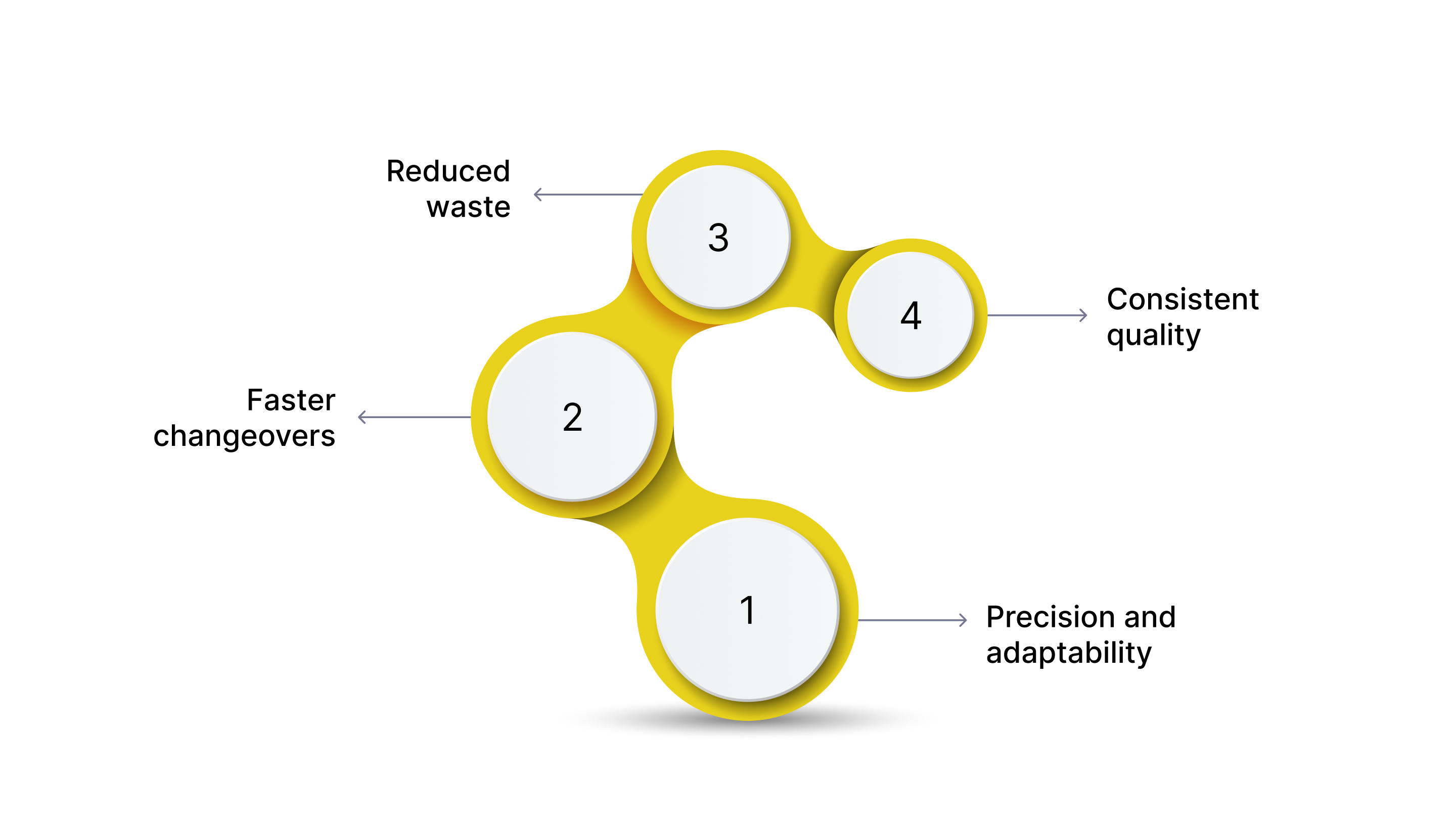
Precision and adaptability: Cameras and sensors detect part positions, shapes, and defects in real time.
Faster changeovers: Recipe-based calibration replaces manual setup for new SKUs.
Reduced waste: Visual data reveals issues before materials are wasted.
Consistent quality: Automatic correction replaces subjective inspection.
The Business Impact
Challenge | How Vision Integration Solves It |
Misalignment or variability | Real-time position correction through visual feedback |
Product defects | Early detection, classification, and rejection |
Downtime from manual checks | Continuous automated inspection |
Material waste | Preventive adjustment during production |
Data gaps | Digital records for traceability and audits |
From Blind Repetition to Smart Automation
In flat-material industries, nonwovens, films, insulation, or battery coatings, even a millimeter deviation can create rework or waste. A vision-enabled robotic cell detects inconsistencies instantly and adjusts without pausing production.
By merging motion and visual intelligence, manufacturers move from reactive control to real-time optimization, turning robotics into the foundation of truly adaptive manufacturing.
What Makes a Robotic Cell ‘Vision-Ready’?
Adding a camera to a robot doesn’t make it intelligent. A true vision-ready robotic cell is one where every element, mechanical, optical, and digital, works together to turn visual data into reliable motion and inspection decisions.
Let’s break down what that means in practice.
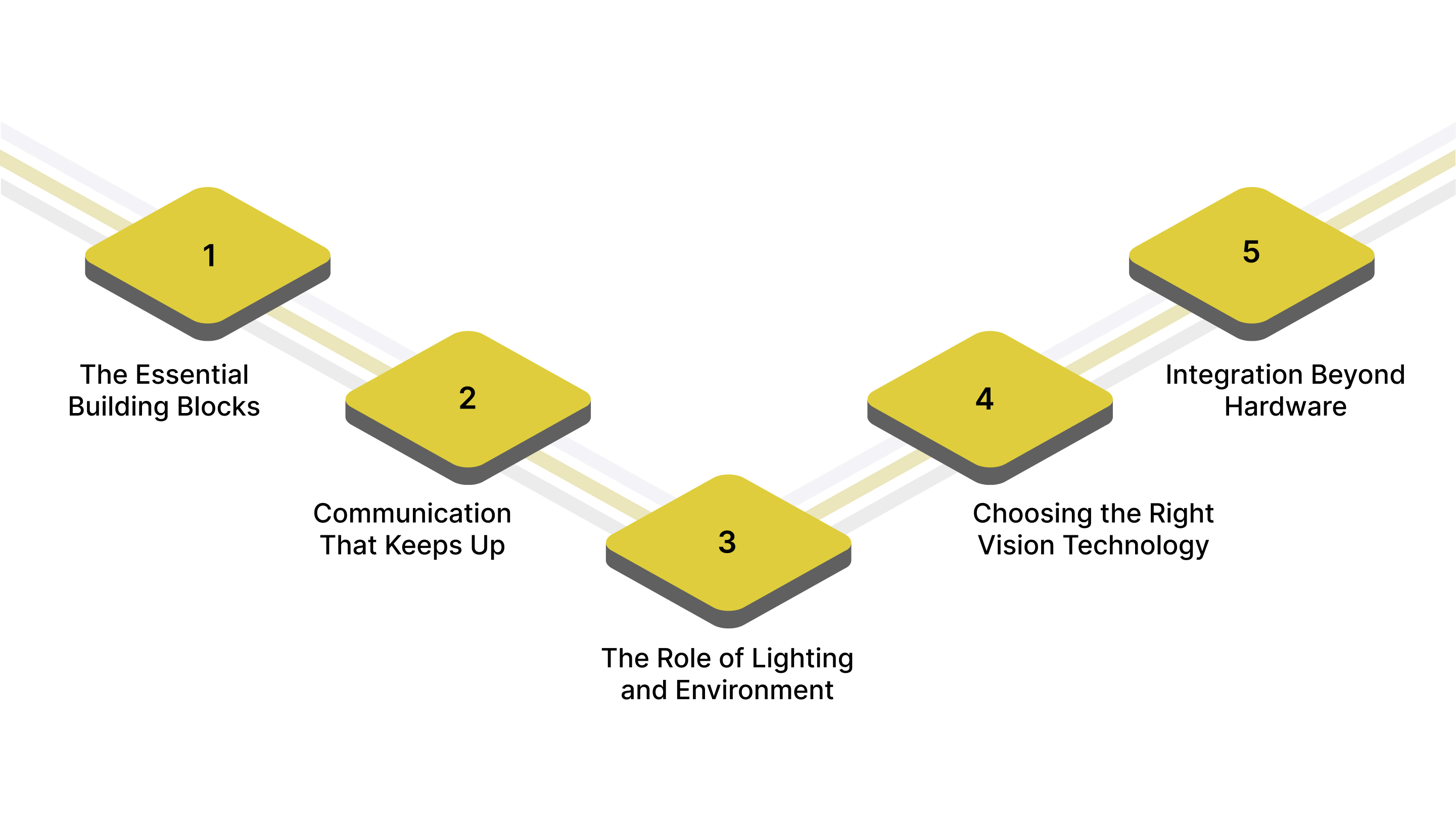
1. The Essential Building Blocks
A high-performing vision-enabled cell is made of five synchronized layers:
Cameras: Capture images or depth data from the robot’s workspace.
Lighting: Provides controlled illumination for consistent imaging.
Optics: Defines the clarity, focus, and depth of field.
Processing Unit: Converts raw images into actionable measurements or coordinates.
Controller Interface: Links the vision output to the robot’s motion commands and the plant’s PLC.
Each layer must be designed for speed, accuracy, and repeatability, and tested together, not in isolation.
2. Communication That Keeps Up
A vision system only performs as well as its data exchange allows. To achieve real-time feedback, robots and vision controllers typically use industrial protocols such as Ethernet/IP, PROFINET, or OPC UA.
Reliable communication ensures that image data, motion commands, and inspection results flow in milliseconds, not seconds. This prevents lag during defect detection, alignment correction, or pick-and-place operations.
3. The Role of Lighting and Environment
Lighting is often underestimated. Shadows, reflections, or dust can mislead even the most advanced vision algorithm. Stable, enclosed lighting setups, using diffuse, dark-field, or structured light, help maintain image quality regardless of material finish or shift conditions.
For high-speed web materials, vibration damping and shielding also protect image consistency.
4. Choosing the Right Vision Technology
Different applications demand different vision types:
2D Vision: Ideal for positioning, orientation, and label checks.
3D Vision: Adds depth and contour detection for stacked or irregular parts.
AI-Driven Vision: Learns from data to recognize subtle textures, defects, or pattern shifts that rules-based systems miss.
Combining these technologies often yields the best results, for example, pairing 3D sensing for alignment with AI software for surface inspection.
5. Integration Beyond Hardware
Being “vision-ready” also means software alignment. Vision systems must connect directly to the plant’s MES or quality systems to log data, analyze trends, and trigger process adjustments.
This digital connection transforms isolated robot tasks into part of a larger continuous-improvement loop.
A vision-ready robotic cell isn’t just smarter, it’s self-aware, capable of detecting, correcting, and documenting each operation. That foundation makes the next stage, integration, far easier and far more valuable.
What Must Be Done Right Before Adding Vision to a Robot Cell?
Integrating vision into a robotic cell is where planning meets precision. It’s the process of aligning motion, optics, and intelligence so the robot and vision system operate as one.
When done right, integration delivers accuracy, repeatability, and real-time feedback. When rushed, it leads to delays and calibration drift.
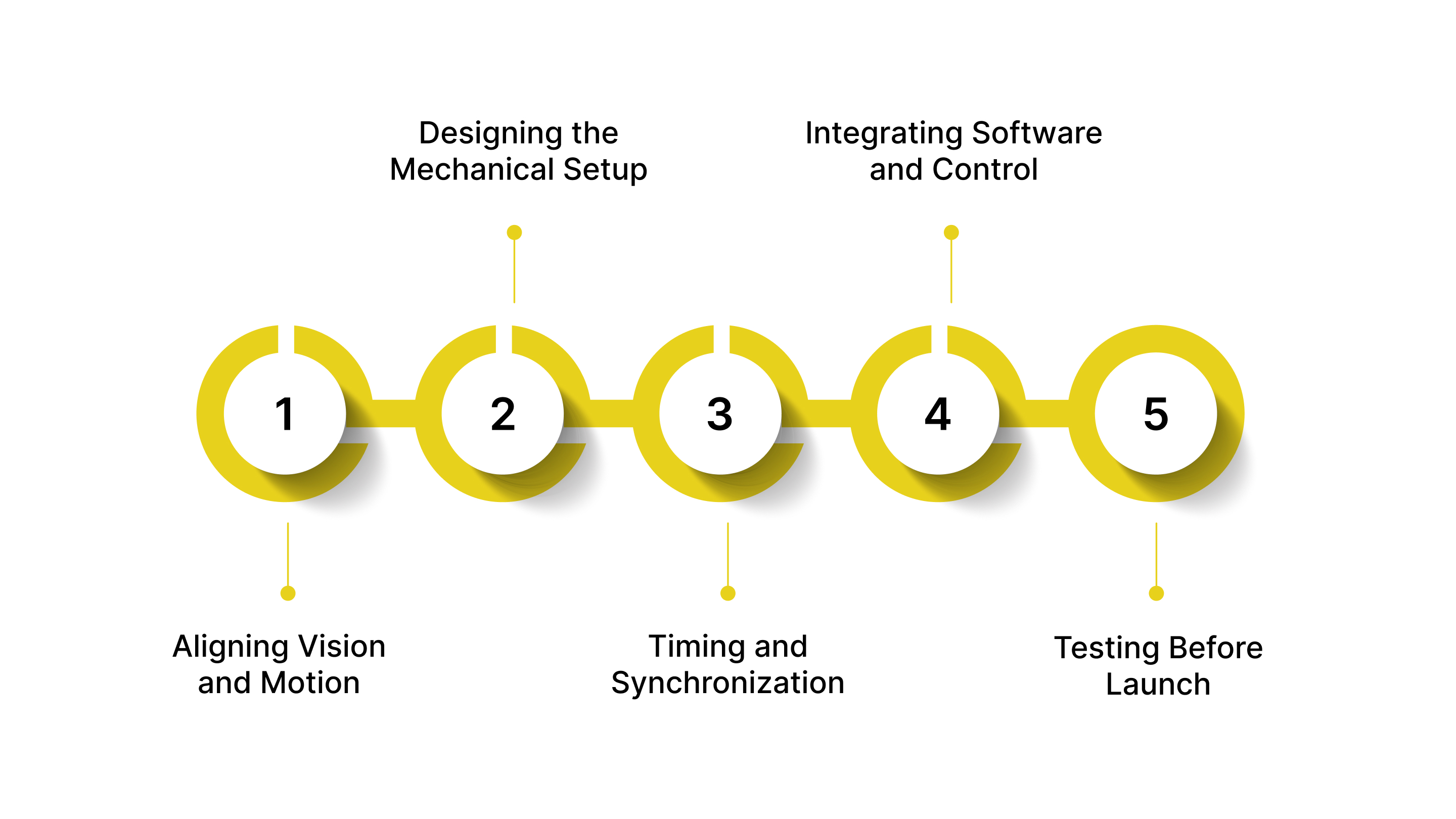
1. Aligning Vision and Motion
Every vision-guided robot depends on hand–eye calibration, mapping the camera’s coordinates to the robot’s workspace. This ensures the robot acts exactly where the camera “sees.”
Regular recalibration is crucial, especially in high-vibration environments or when changing camera positions.
2. Designing the Mechanical Setup
Camera placement defines what the system can measure or inspect.
Fixed cameras: Best for stable, repeatable tasks.
Robot-mounted cameras: Useful for variable or moving parts.
Lighting should be shielded from factory light and mounted rigidly to prevent motion blur or misreads.
3. Timing and Synchronization
Vision must match motion speed. Using trigger signals or synchronized timestamps, image capture aligns perfectly with robot movement, preventing lag and missed detections. This timing ensures accurate inspection even in high-speed lines.
4. Integrating Software and Control
Vision results flow to the robot controller or PLC using Ethernet/IP, PROFINET, or OPC UA.
Real-time communication enables instant response, guiding movements, rejecting parts, or adjusting positions.
5. Testing Before Launch
Before production, simulate workflows and validate performance under different conditions. Testing lighting, timing, and calibration stability ensures consistent accuracy once live.
Best Practices for Successful Vision Integration
Integrating a vision system into a robotic cell goes far beyond connecting hardware. It’s a combination of design, calibration, and coordination that determines whether the system becomes a long-term asset or a recurring headache.
Below are the proven practices, insights, and real-world tips that help manufacturers achieve reliable, high-value integration.
1. Start with the Process, Not the Hardware
Define why the robot needs vision before deciding how. Outline whether it will perform defect inspection, part guidance, measurement, or safety checks.
That process map drives every design choice, camera type, optics, lighting, and even control software.
Pro Tip: Start integration planning with a “vision intent document.” List what the robot must see, measure, and act on. This eliminates confusion later during commissioning.
2. Plan Communication Early
Reliable, low-latency communication is the backbone of vision-guided robotics. Standardize on proven industrial protocols like Ethernet/IP, PROFINET, or OPC UA to ensure that cameras, PLCs, and robot controllers exchange data seamlessly.
Insight: Most integration issues stem from mismatched protocols or overburdened network traffic. Design data flow for scalability, not just for current cycle times.
3. Choose Camera Placement Strategically
Camera position determines what your robot can actually “see.”
Fixed cameras deliver stable, repeatable imaging for steady part flows.
Robot-mounted cameras enable flexibility for variable components or orientations.
For wide or fast-moving surfaces, consider multi-camera setups or traveling frames to avoid blind zones.
Example: In nonwoven fabric inspection, dual cameras mounted above and below the web detect fiber uniformity and surface defects simultaneously, cutting inspection time by 40%.
4. Leverage 3D and AI Vision When Needed
2D vision works for consistent, flat products, but complex materials or varying part geometries benefit from 3D vision and AI-driven software. 3D sensors add depth and contour detection; AI learns to recognize evolving defects or irregular patterns.
Example: In battery film coating lines, AI-assisted 3D vision distinguishes between harmless texture variation and coating voids that could cause product failure.
5. Prioritize Real-Time Data and Feedback
Vision data is only valuable if it drives immediate action. Use edge computing or onboard processors to process images near the source, reducing latency and improving response speed.
This enables real-time defect rejection, adaptive alignment, and process optimization.
Insight: Every 100 ms of delay in vision feedback can compound into millimeters of error in robot positioning, especially in high-speed or large-surface lines.
6. Build Safety into the Design
Vision systems can double as safety layers. Define visual safety zones, collision detection, and confirmation checks for clear workspaces.
Integrate these controls with safety PLCs to comply with Premium and enable safe human–robot collaboration.
7. Validate and Calibrate Consistently
Lighting changes, vibration, and temperature can drift calibration over time. Schedule regular validation cycles to maintain precision.
Pro Tip: Use quick calibration targets or printed reference grids, a five-minute routine that prevents hours of troubleshooting later.
8. Document Every Connection and Workflow
Maintain complete documentation of network configurations, calibration parameters, and workflows. This ensures continuity when systems are upgraded, new engineers join, or audits occur.
Insight: Plants that document integration visually (with network maps and configuration snapshots) resolve production interruptions 30% faster than those relying on tribal knowledge.
9. Think Long-Term: Integration Is a Lifecycle
The “best option” isn’t a one-time setup; it’s a living system. Schedule maintenance intervals, review data logs for drift or missed detections, and keep the software updated for new materials or product types.
Integration maturity grows with usage; systems that learn, adapt, and evolve yield compounding value.
When vision integration follows these principles, robotic cells shift from fixed-function machines to adaptive process controllers.
They not only see what’s happening but also help improve it, delivering measurable gains in yield, uptime, and process consistency across the production line.
Where Vision-Integrated Robotics Deliver Real Impact?
Vision-integrated robotic cells are no longer experimental; they’re reshaping production lines across multiple industries. Wherever accuracy, surface quality, and repeatability matter, the combination of robotics and vision intelligence delivers measurable returns.
The market is responding. The global robotic vision systems market is valued at nearly USD 2.78 billion in 2024 and is on track for steady growth over the coming years.
For you, this means vision integration is no longer a marginal add-on; it’s becoming a core pillar of modern automation strategy, driving measurable gains in quality, throughput, and process reliability.
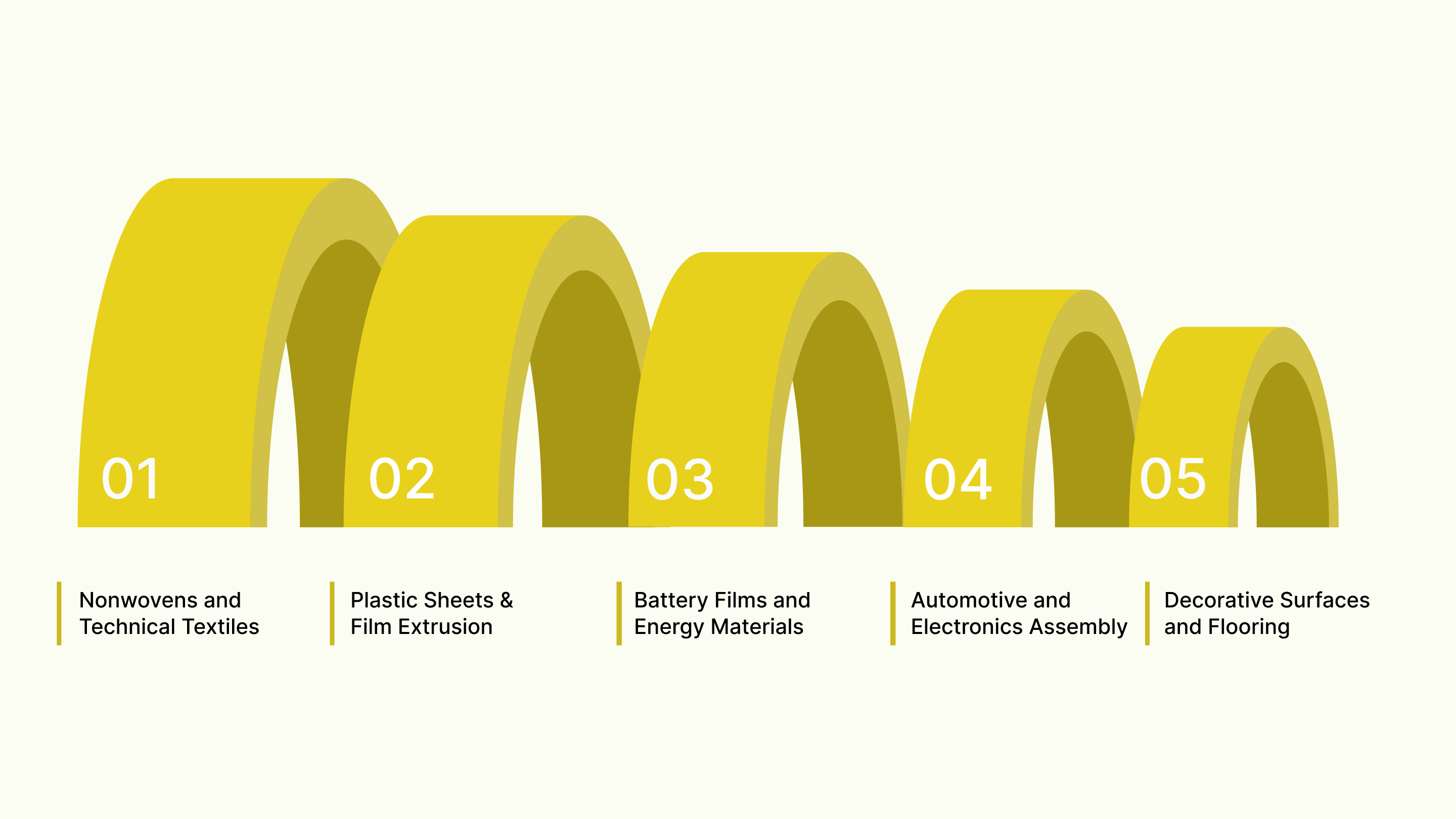
1. Nonwovens and Technical Textiles
In nonwoven production, fiber alignment and coating uniformity are critical. Vision-guided robots inspect the web in real time, detecting thin spots, clumps, or edge defects that affect performance.
By automating inspection, manufacturers reduce waste, maintain weight uniformity, and react instantly to line variations.
Example: A European insulation producer integrated vision-guided handling robots with inline inspection, cutting defect-related scrap by nearly half.
2. Plastic Sheets and Film Extrusion
In extrusion and casting lines, surface imperfections and thickness variations often lead to expensive rejects. Robots equipped with vision systems continuously scan for streaks, gels, or inclusions while also handling rolls or sheets.
Integration with process feedback allows immediate correction rather than post-production sorting.
3. Battery Films and Energy Materials
In energy-material coating and calendering, even microscopic coating gaps can cause performance loss. Vision-enabled robotics verifies coating alignment, measures layer consistency, and classifies defects such as pinholes or dust inclusions.
These capabilities are essential in battery and hydrogen-cell manufacturing, where tolerances are tight and traceability is mandatory.
4. Automotive and Electronics Assembly
Precision and consistency drive competitive advantage. Vision-assisted robotic cells identify part orientation, verify component presence, and inspect weld seams or adhesive lines.
AI-based vision software adapts automatically to minor design variations, improving throughput without reprogramming.
5. Decorative Surfaces and Flooring
In visual-quality-driven sectors such as flooring or wall coverings, vision integration ensures defect-free finishes.
Robotic cells equipped with high-resolution cameras detect gloss differences, pattern shifts, or foreign particles before packaging, maintaining both aesthetics and brand reputation.
Why It Matters
Metric Improved | Typical Impact of Vision-Integrated Robotics |
Scrap rate | Reduction through early detection and feedback |
Throughput | Increased by eliminating manual checks |
Downtime | Lowered due to predictive visual monitoring |
Yield consistency | Improved through stable, adaptive inspection |
Traceability | Full digital image and data record per batch |
Whether the product is a fiber mat, coated film, or complex assembly, vision-integrated robotics converts quality from a checkpoint into a continuous process function, ensuring that production stays both efficient and audit-ready.
How Hammer-IMS Helps Manufacturers Get Vision Integration Right
Building a truly intelligent robotic cell requires precision measurement, stable vision data, and software that connects seamlessly to automation systems.
Hammer-IMS delivers all three, offering manufacturers a modular ecosystem that supports both inspection and robotic decision-making in real time.
1. Radiation-Free, Non-Contact Measurement
At the core of Hammer-IMS solutions is its proprietary M-Ray millimeter-wave technology, a clean, non-nuclear alternative to traditional gauges.
Provides continuous thickness and basis-weight measurement for flat materials.
Works safely and accurately without radiation or physical contact.
Ideal for robotic applications where precision feedback is required without slowing production.
This sensing capability gives robotic cells the data they need to perform high-accuracy handling, gauging, and inline quality control.
2. Surface and Defect Inspection with Edge-Vision 4.0
Hammer-IMS’s Edge-Vision 4.0 combines multi-camera vision and AI-driven analysis for real-time defect detection. When connected to robotic systems, it enables:
Automatic rejection or sorting of defective materials.
Adaptive process adjustments through live data feedback.
Comprehensive surface documentation for quality assurance.
It transforms robots from passive handlers into active quality controllers.
3. Integration-Ready Platforms and Connectivity
All Hammer-IMS solutions are built to integrate smoothly into modern factory ecosystems:
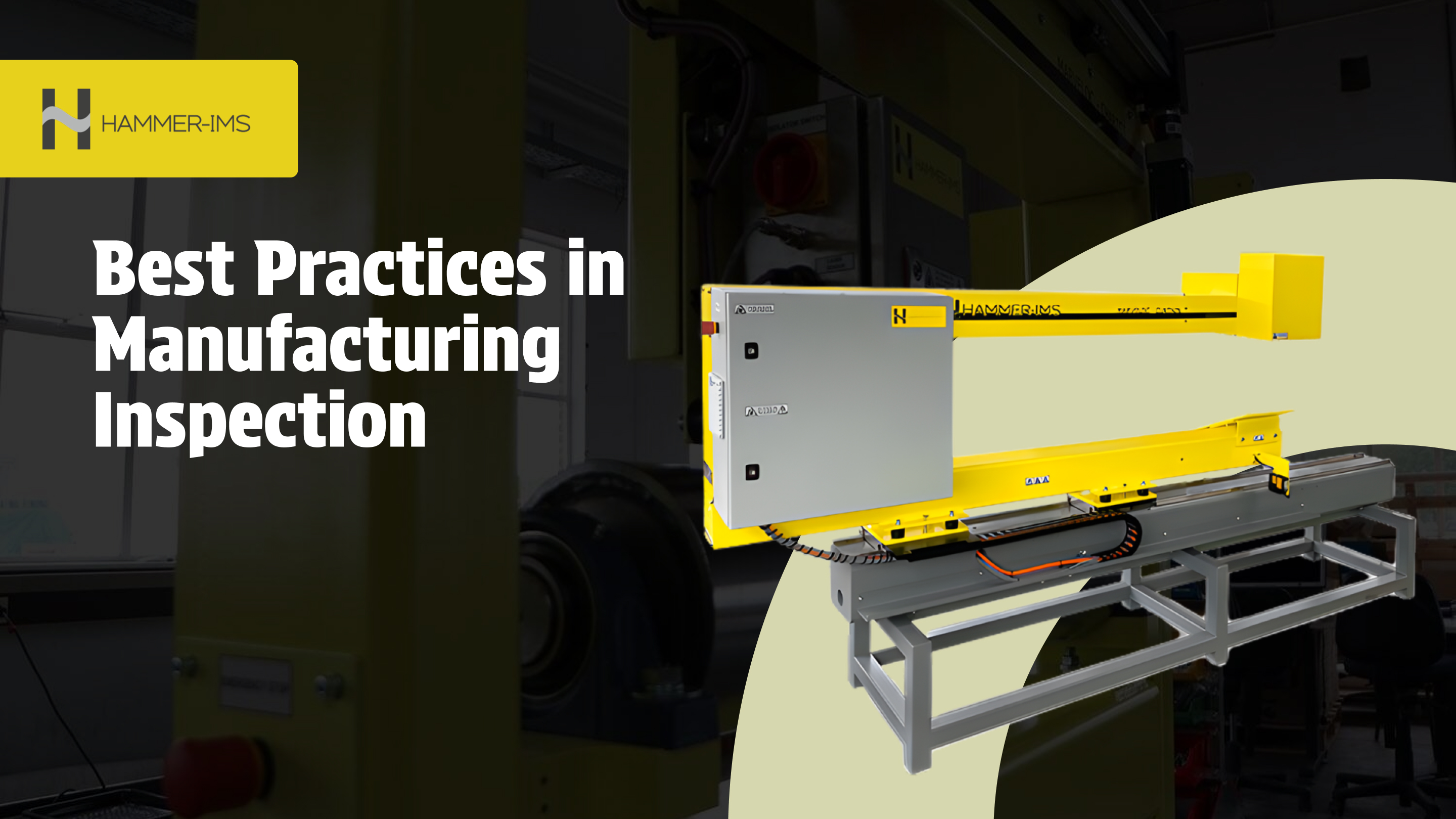
Marveloc-CURTAIN – multi-sensor O-Frame systems for wide material inspection.
Marveloc-CHARIOT – compact, mobile setups for flexible or space-limited lines.
Connectivity 3.0 software – the digital bridge linking sensors, robots, and PLCs for synchronized data exchange.
This modular architecture allows vision and sensing technologies to be added to new or existing robotic cells with minimal downtime.
4. End-to-End Engineering Support
From application design and system configuration to installation, calibration, and maintenance, Hammer-IMS provides full technical partnership.
Its experts ensure that every vision or measurement module operates as part of a stable, closed-loop automation workflow.
Hammer-IMS helps manufacturers turn vision into process intelligence, creating robotic cells that are faster, cleaner, and more adaptive to modern production demands.
The Path Forward
Every factory’s next performance leap will come from visibility, seeing more, sooner, and smarter.
By integrating reliable, radiation-free measurement and intelligent vision systems, manufacturers can transform robotic cells into continuous quality engines that keep production efficient, safe, and compliant.
If your goal is to make your robotic systems more intelligent, adaptive, and sustainable, Hammer-IMS can help you get there.
Explore integration-ready solutions like Edge-Vision 4.0, Marveloc-CURTAIN, and Connectivity 3.0, and discover how they can bring real-time vision intelligence to your production line.
Book a demo to start your integration journey.
Frequently Asked Questions
1. What is a vision system in robotics?
A vision system in robotics uses cameras, lighting, and image-processing software to help robots “see” their environment. It enables robots to detect parts, verify dimensions, inspect surfaces, and make adjustments during operation.
2. Why should manufacturers integrate vision systems into robotic cells?
Vision integration allows robots to perform real-time quality checks, handle variable parts, and adjust automatically to production changes. This leads to fewer stoppages, less scrap, and more consistent output.
3. What are the best options for integrating vision into existing robotic systems?
Choose systems that support standard communication protocols (Ethernet/IP, PROFINET, OPC UA), non-contact sensors, and AI or 3D vision for complex environments. Modular solutions like Hammer-IMS’s Connectivity 3.0 make upgrades faster and scalable.
4. How do I decide between fixed and robot-mounted cameras?
Use fixed cameras for repetitive, predictable tasks, and robot-mounted cameras when part orientation or position changes often. Some hybrid setups combine both for full coverage and flexibility.
5. What role does lighting play in vision accuracy?
Lighting defines image clarity and defect visibility. Controlled illumination, such as backlighting or diffuse lighting, ensures reliable results under different materials and factory conditions.
6. Can AI improve automated vision inspection?
Yes. AI-based vision systems learn from image data, allowing robots to recognize new or subtle defects that rule-based systems might miss. This is especially useful in textured or non-uniform materials.
7. What kind of ROI can vision-integrated robotics deliver?
ROI typically comes from reduced scrap, lower downtime, and higher yield consistency. While numbers vary by process, plants that integrate vision with robotics often see measurable improvements in months, not years.