Introduction
Consumer expectations for cabin quietness are rising sharply. Electric vehicles are stripping away the engine noise that once masked unwanted sounds, which puts far more pressure on automotive manufacturers to measure and control interior noise precisely.
When measurement falls short, the consequences compound quickly: failed NVH validation, costly late-stage design changes, supply chain disputes between OEMs and Tier 1 suppliers, and vehicles that miss increasingly stringent noise regulations.
This guide covers what engineers and quality teams need to measure automotive acoustics with confidence:
- Core acoustic measurement techniques used in NVH development
- Key instruments and their applications across vehicle subsystems
- Material qualification and lab testing methods
- Regulatory compliance measurement and documentation practices
Key Takeaways
- Automotive acoustic measurement encompasses SPL, NVH, pass-by noise, powertrain, and in-cabin audio tests used to validate vehicle comfort, safety, and regulatory compliance
- Core tools include calibrated microphones, IEPE-compatible DAQ systems, anechoic chambers, and ISO-aligned analysis software
- A reliable workflow follows six stages: objective definition, environment prep, calibration, testing, result interpretation, and documentation
- Acoustic performance begins before vehicle assembly—material thickness and uniformity directly affect downstream measurement outcomes
- Hammer-IMS's M-Ray technology measures acoustic material thickness in-line during production, catching variation before it affects downstream NVH performance
What Is Automotive Acoustic Measurement and Why Does It Matter?
Automotive acoustic measurement is the systematic process of capturing, analyzing, and interpreting sound pressure levels, frequency responses, vibrations, and material-generated noise across different operating conditions. It's used at both component and system levels throughout vehicle development.
Where It Fits in the Development Lifecycle:
- Material qualification and component testing
- Powertrain validation and end-of-line checks
- Regulatory pass-by noise compliance testing
- Consumer-oriented in-cabin audio benchmarking
Why It's Non-Negotiable:
Regulatory requirements enforce strict exterior pass-by noise limits. UN ECE R51.03 Phase 3 mandates 68 dB(A) for standard M1 passenger vehicles, with calibration drift tolerances of ≤0.5 dB. Beyond compliance, NVH refinement directly impacts perceived quality and brand differentiation.
Electric vehicles have reshaped automotive acoustics. Without combustion engine noise masking the cabin, previously inaudible sources become prominent: inverter whine, electric motor tones, wind turbulence, and tire contact patches.
According to J.D. Power's 2025 U.S. Initial Quality Study, interior noise complaints have risen as EVs expose high-frequency tonal noises between 600 Hz and 10 kHz.
For OEMs and Tier 1 suppliers, misalignment on acoustic material specifications carries real consequences:
- Production variability creates scatter bands in end-of-line NVH performance
- Inconsistent material properties trigger warranty claims and supplier disputes
Core Automotive Acoustic Measurement Techniques
Five primary measurement techniques cover the vehicle development process. Each targets a different noise source or system interaction and requires specific setup configurations.
Sound Pressure Level (SPL) Testing
SPL testing quantifies how loud a vehicle or component is in decibels (dB). Calibrated microphones and sound level meters identify noise hotspots from the engine, tires, wind, and HVAC—both inside and outside the cabin.
SPL meters must conform to IEC 61672-1:2013, utilizing A, C, and Z frequency weightings to match human hearing sensitivity across different frequency ranges.
NVH Testing and Vibration Analysis
NVH (Noise, Vibration, and Harshness) testing is a multi-domain approach that correlates acoustic signals with structural vibrations from the engine, transmission, and suspension. Engineers simulate road and operating conditions indoors—before physical road trials—using:
- Hydraulic rigs to replicate road load inputs
- IEPE accelerometers to capture structural vibration
- Calibrated microphones to record the resulting acoustic response
This enables controlled, repeatable testing in a single facility.
Acoustic Material Testing
Acoustic material testing evaluates how cabin materials—carpet, headliners, door panel absorbers, foam liners—absorb or reflect sound energy. This testing determines material specifications before assembly and ties to the mass-law relationship between material weight/thickness and transmission loss.
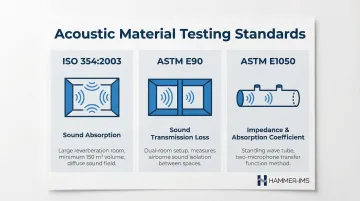
Key Testing Standards:
| Standard | Application | Methodology |
|---|---|---|
| ISO 354:2003 | Sound Absorption | Measures absorption coefficient in a reverberation room (minimum 150 m³) |
| ASTM E90 | Transmission Loss | Laboratory measurement of airborne sound transmission loss between reverberant rooms |
| ASTM E1050 | Impedance/Absorption | Uses impedance tube and two microphones to determine normal incidence absorption coefficients |
Powertrain Noise Testing
Powertrain noise testing isolates sounds produced by the engine, transmission, and drivetrain in dedicated high-absorbency anechoic chambers. This allows engineers to characterize tonal content, identify resonance frequencies, and optimize component NVH performance separately from the full vehicle environment.
Semi-anechoic chambers absorb reflections above a cutoff frequency while reflecting from the floor to simulate road surfaces, creating realistic yet controlled test conditions.
Pass-By Noise and In-Cabin Audio Measurement
Where powertrain and material testing focus on internal isolation, pass-by noise and in-cabin audio measurement assess how the vehicle performs in real-world and regulatory contexts.
Pass-by noise testing measures exterior noise as the vehicle accelerates past fixed microphones under UN ECE R51. Two run types feed the result:
- Wide-open throttle (WOT) — captures acceleration noise
- Constant road speed (CRS) — captures rolling and aerodynamic noise
Together, they calculate a final Lurban (urban pass-by noise level) value representing average urban noise.
In-cabin audio measurement uses multi-microphone arrays to characterize frequency response, maximum SPL, spectral uniformity, and distortion of the vehicle's audio system. The AES TC-AA recommends a 6-microphone H-array positioned at the driver's seat to capture a representative sound field.
Essential Tools and Equipment for Automotive Acoustic Testing
Tool selection directly impacts measurement accuracy, repeatability, and comparability. The right sensor, interface, environment, and software combination matters as much as the test method itself.
Measurement Microphones
Engineers face key choices between microphone types:
1/2" Free-Field Microphones:
- Historically dominant due to lower noise floor (17–20 dBA)
- Extensive historical data compatibility
- Higher sound field disturbance at high frequencies
1/4" Multifield Microphones:
- Preferred by AES TC-AA for in-cabin work
- Smaller form factor reduces sound field disturbance at high frequencies — particularly critical for EVs, where high-frequency inverter noise dominates
- Modern high-sensitivity models (e.g., GRAS 46BC) close the dynamic range gap
- IP67-rated variants available for on-road and thermal chamber testing (e.g., GRAS 146AE, rated -40°C to 125°C)
Data Acquisition Systems (DAQ) and Signal Analyzers
IEPE-compatible dynamic DAQ systems digitize microphone signals with sufficient bandwidth and dynamic range for acoustic analysis. Modern DAQ platforms support:
- Time-domain and frequency-domain display
- Event triggering for synchronized measurements
- Data export to MATLAB, LabVIEW, or dedicated audio analysis software
- High dynamic ranges (>100 dB with 24-bit ADCs)
Popular systems include the NI 9234 and HBK LAN-XI, which integrate directly with analysis platforms like BK Connect.
Test Environments: Anechoic Chambers and Wind Tunnels
Semi-anechoic chambers are the standard environment for SPL, NVH, and pass-by testing. They absorb reflections above a cutoff frequency while reflecting from the floor to simulate road surfaces.
Wind tunnels serve aeroacoustics testing, while reverberant chambers are used for material absorption testing per ISO 354:2003.
Calibration Equipment and Standards Compliance
Calibration ensures traceable, repeatable results across every test session. Key requirements include:
- Calibrate microphone sensitivity using pistonphones or acoustic calibrators before each session
- Verify signal chain accuracy through interface-level calibration
- Adhere to applicable standards:
- IEC 61094 for microphone characterization
- IEC 61672 for sound level meters
- AES TC-AA recommendations for in-car audio
- UN ECE R51 for exterior noise
UN ECE R51.03 requires the entire acoustic measurement system to be checked with a Class 1 sound calibrator (IEC 60942) before and after every session. If the difference between readings exceeds 0.5 dB, test results must be discarded.
Step-by-Step: How to Conduct an Automotive Acoustic Measurement
While specific procedures vary by test type, the following six-stage workflow applies across SPL, NVH, material, and in-cabin measurements. Mistakes at early stages compound into unreliable results downstream.
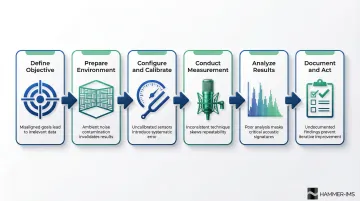
Step 1 – Define the Measurement Objective
Start by defining:
- What is being measured (component, subsystem, or full vehicle)
- The pass/fail criteria or benchmarking target
- Which standard or customer specification applies
Misaligned objectives lead to the wrong microphone configuration or test signal.
Step 2 – Prepare the Test Environment
Set up the anechoic chamber, wind tunnel, or test track. Verify background noise floor meets requirements—UN ECE R51.03 mandates background noise must be at least 10 dB(A) below the vehicle's A-weighted sound pressure level. If the margin is between 10 and 15 dB(A), correction factors (0.1 to 0.5 dB) must be applied.
Position the vehicle or component correctly and check for extraneous vibration paths that could contaminate measurements.
Step 3 – Configure and Calibrate Equipment
Mount microphones in specified positions:
- H-array per AES TC-AA for in-cabin testing
- ISO-mandated positions for pass-by noise
Connect to DAQ via IEPE-standard cables. Perform acoustic calibration on all channels. Set sampling rate, dynamic range, and trigger parameters appropriate for the frequency range of interest.
Step 4 – Conduct the Measurement
Run defined test signals at specified operating conditions:
- Pink noise: Frequency response testing
- Logarithmic sine sweep: Distortion analysis
- Drive-by acceleration: Pass-by noise testing
Critical Control Variables:
- HVAC state (on/off, fan speed)
- Window position (open/closed)
- Seat occupancy (empty/occupied)
These variables significantly affect in-cabin measurements and must be controlled and documented.
Step 5 – Analyze and Interpret Results
Process time-domain signals into frequency-domain data using FFT, one-third octave spectra, or narrow-band analysis. Identify peaks, resonances, and anomalies. Compare against target curves, historical baselines, or competitor benchmarks.
For in-cabin audio, key metrics include:
- Frequency response flatness
- Seat-to-seat spectral uniformity
- Total Harmonic Distortion (THD)
- Maximum SPL
Step 6 – Document, Validate, and Act
Log calibration records, environmental conditions, and raw data for traceability. Confirm anomalies through repeat measurements before triggering design changes.
Apply findings to concrete engineering decisions (material changes, component redesign, tuning adjustments) and coordinate directly with the supplier or subsystem team responsible.
How Hammer-IMS Supports Acoustic Performance at the Material Level
Acoustic measurement results in the vehicle depend on consistent production of acoustic materials. Carpet underlays, nonwoven felt, foam liners, and textile composites must be manufactured to precise thickness and areal weight tolerances—because deviations in mass per unit area directly translate to deviations in sound absorption and transmission loss performance.
Berger's Mass Law dictates that transmission loss increases by approximately 6 dB for every doubling of material mass. However, EVs cannot afford heavy acoustic damping due to range penalties. This makes thickness uniformity critical—even small variations create unpredictable NVH outcomes.
Hammer-IMS's M-Ray technology provides contactless, non-nuclear in-line thickness and basis weight measurement of automotive acoustic materials during production. The millimeter-wave-based system delivers real-time data that enables closed-loop process control, ensuring every roll of acoustic material shipped to an OEM or Tier 1 assembler meets specification.
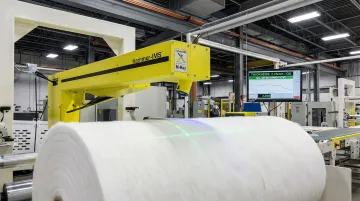
Major automotive acoustic materials suppliers, including Autoneum and Autins Group, rely on precise measurement capabilities to meet tight OEM tolerance requirements. Autoneum produces lightweight PET underbody shields and cotton-based insulators, while Autins Group specializes in microfibre nonwoven barriers, both product lines where thickness uniformity directly drives acoustic performance.
Consistent material quality across production runs is where Hammer-IMS's Connectivity 3.0 software platform adds further value. Quality teams gain:
- Remote monitoring and data logging via PROFINET and OPC UA integration
- Verification of acoustic material consistency across production runs
- Reduced material waste through real-time out-of-spec detection
- Traceable quality documentation that supports OEM supplier qualification
Frequently Asked Questions
What is NVH testing in automotive engineering?
NVH (Noise, Vibration, and Harshness) testing measures and characterizes unwanted noise and vibration from powertrain, road, and wind sources, covering both interior comfort and exterior emissions. It's conducted using microphones, accelerometers, and hydraulic test rigs in specialized facilities to correlate acoustic and structural behavior.
What equipment is needed for automotive acoustic measurements?
Core equipment includes calibrated measurement microphones (1/4" or 1/2"), an IEPE-compatible DAQ system or audio measurement interface, acoustic calibrators, and a controlled environment such as a semi-anechoic chamber. Analysis software must align to the relevant test standard, such as AES TC-AA or UN ECE R51.
What is the AES TC-AA standard for automotive audio measurements?
The AES TC-AA white paper defines standardized in-car acoustic measurement methods: a 6-microphone H-array configuration, specified test signals, and metrics covering frequency response, maximum SPL, and impulsive distortion. The goal is repeatable, comparable results across OEMs and Tier 1 suppliers.
How do electric vehicles change acoustic measurement requirements?
EVs eliminate combustion engine noise that previously masked many interior sounds, making wind noise, tire noise, electric motor tones, and inverter whine suddenly audible. This demands lower-noise-floor microphones, wider frequency sensitivity (particularly 600 Hz to 10 kHz), and renewed focus on acoustic material performance in the cabin.
Why is acoustic material thickness important for vehicle NVH performance?
Acoustic materials such as carpet underlay, nonwoven felt, and foam rely on mass-law absorption: thickness and areal weight directly determine how much sound energy they absorb or block. Inconsistent thickness during production creates scatter bands in end-of-line NVH testing and unpredictable cabin acoustic results.
What is the difference between pass-by noise testing and in-cabin acoustic measurement?
Pass-by noise testing measures exterior vehicle noise as it drives past fixed microphones to assess community noise impact and regulatory compliance (e.g., UN ECE R51), while in-cabin acoustic measurement focuses on the interior sound environment—evaluating audio system performance, NVH refinement, and occupant comfort using microphone arrays inside the vehicle.