What is the difference between machine direction and cross direction paper?
Machine direction (MD) refers to measurements along the direction of material travel through the production line, while cross direction (CD) refers to measurements across the width of the material, perpendicular to its travel. CD profiling is crucial because it reveals uniformity issues across the width that MD measurements alone cannot detect, such as uneven thickness from individual extrusion dies or calender pressure variations.
How does multi-sensor CD profiling improve upon single-sensor systems?
Multi-sensor systems provide simultaneous measurements at multiple points across the material width, offering complete cross-directional visibility in real-time. This enables faster detection of localized issues, reduces the time needed for full-width scanning, and allows identification of specific process problems like individual extrusion screw malfunctions that single traversing sensors might miss or detect too slowly.
Can your CD profiling systems measure very thick materials?
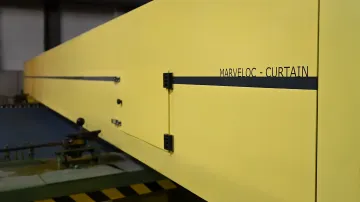
Yes, our Marveloc-CURTAIN systems can measure materials up to 30 centimeters thick using advanced M-Ray millimeter wave technology. This makes them suitable for thick plastic sheets, particle boards, and other construction materials that exceed the capabilities of traditional measurement systems.
How quickly can CD profiling systems respond to production changes?
Our systems operate at multi-kHz measurement rates, providing real-time data with minimal latency. For high-speed production lines, our paper quality control systems support measurement rates of 3 kHz, enabling accurate profiling on lines running up to 500 meters per minute with immediate feedback for process adjustments.
What are the safety advantages of non-nuclear CD profiling?
Non-nuclear M-Ray technology eliminates regulatory requirements for radioactive source handling, licensing, and disposal. This enables 24/7 production access for all personnel without safety restrictions, reduces compliance costs, eliminates environmental concerns, and provides a cleaner, safer working environment compared to traditional nuclear gauge systems.
How does CD profiling reduce material waste?
By providing complete visibility of thickness and weight variations across the material width, CD profiling enables precise process adjustments that reduce overproduction margins. Manufacturers can operate closer to target specifications with confidence, typically reducing material consumption by 3-5% while maintaining quality standards and reducing off-spec production.
Can CD profiling systems integrate with existing production control systems?
Yes, our systems feature closed-loop production adjustment capabilities and can integrate with your existing process control infrastructure. The Connectivity 3.0 software provides real-time feedback, data logging, and analytics integration, while our IoT Industry 4.0 app enables remote monitoring and analysis from any device.
What industries benefit most from CD profiling for thickness and weight?
CD profiling is essential for any continuous production process where width uniformity affects product quality. Key industries include plastic sheet and film extrusion, paper and pulp manufacturing, nonwovens production, construction materials (particle board, plywood, mineral wool), textiles, and automotive acoustic materials.