
Introduction
Industrial manufacturers face mounting pressure to reduce volatile organic compounds (VOCs), comply with stricter emissions standards, and improve workplace safety. Water-based coatings have moved well past "greener alternative" status — in automotive finishing, textile production, packaging, and construction materials, they are now the baseline expectation.
The operational case is concrete: lower material costs, more predictable surface quality, and reduced regulatory exposure.
The real-world performance of water-based coatings hinges on application discipline. Switching to waterborne systems without implementing proper process controls—controlled temperature, humidity, and real-time coating weight monitoring—defeats the purpose. This article explains the operational advantages of water-based coatings and why the right application practices determine whether those advantages are captured in production.
Key Takeaways
- Water-based coatings use water as the primary carrier solvent, reducing VOC emissions by up to 90% compared to solventborne alternatives
- They deliver measurable benefits in regulatory compliance, material efficiency, and production cost control across automotive, textiles, packaging, and construction
- Modern waterborne formulations now match solventborne systems in adhesion, corrosion resistance, and barrier properties across most light-to-medium-duty applications
- Value depends on strict process control—consistent application conditions, defined coating weight targets, and inline measurement of film thickness
- Neglecting coating quality control leads to material waste, compliance risk, and inconsistent product outcomes that erode ROI over time
What Are Water-Based Coatings?
Water-based (or waterborne) coatings are formulations in which water serves as the primary carrier or dispersion medium. Functional ingredients—resins, pigments, additives—are suspended or dissolved in water rather than petroleum-derived organic solvents. According to ISO 4618, a water-borne coating material is defined as a "coating material in which the main component of the volatile matter is water."
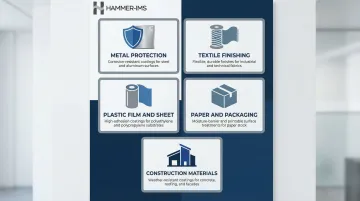
These coatings are applied across diverse industrial substrates:
- Metal protection: Direct-to-metal (DTM) coatings for light-to-medium corrosion environments
- Textile finishing: Functional and decorative coatings on woven and nonwoven fabrics
- Plastic film and sheet manufacturing: Barrier and protective coatings for packaging and construction applications
- Paper and packaging: Barrier coatings for extended shelf life and recyclability
- Construction materials: Protective coatings for insulation, roofing, and structural components
For manufacturers, the practical appeal is straightforward: lower VOC emissions, reduced solvent handling costs, and coating weights that can be monitored and adjusted in real time on the production line.
Key Advantages of Water-Based Coatings
The advantages below are grounded in what manufacturers actually track—cost, output quality, regulatory standing, and operational risk—not theoretical claims about chemistry.
Advantage 1: Lower VOC Emissions and Reduced Regulatory Exposure
Water-based coatings contain far lower levels of volatile organic compounds compared to solventborne alternatives. Modern waterborne acrylics achieve VOC levels below 50 g/L, often qualifying as "low-VOC" or "zero-VOC" under stringent standards such as South Coast AQMD Rule 1107.
How this creates value in practice:
Facilities using water-based coatings typically face fewer restrictions on application volumes, reduced requirements for specialised ventilation infrastructure, and lower risk of regulatory penalties. For example, a 2022 settlement between South Coast AQMD and Axalta Coating Systems resulted in a $1.37 million penalty for selling auto primer products that exceeded Rule 1151's 250 g/L limit by more than 30%. Non-compliance carries financial penalties, production halts, and reputational risk.
Transitioning to waterborne systems removes this exposure entirely while improving workplace air quality for operators. Manufacturers operating under ISO 12944 C3 or lighter corrosion environments, or in textile/nonwoven production, can achieve full compliance without sacrificing coating performance. Waterborne systems also eliminate or substantially reduce the need for capital-intensive abatement infrastructure such as Regenerative Thermal Oxidizers (RTOs), which can cost over $3 million to install.
KPIs impacted:
- Regulatory audit outcomes
- VOC content per litre of coating
- Workplace air quality measurements (ppm of hazardous air pollutants)
- Insurance and liability cost indices
When this advantage matters most:
This advantage is most critical for facilities in regions with strict air quality mandates (e.g., California, EU member states, China's industrial conversion zones), or manufacturers seeking to qualify products for export markets with tighter environmental labelling requirements.
Advantage 2: Material Efficiency and Lower Total Production Cost
Water-based coatings enable tighter control over coating weight and film thickness—when applied correctly and monitored consistently—which directly reduces material consumption and minimises overcoating.
How this advantage plays out operationally:
Because water-based systems dry through water evaporation rather than solvent flash-off, they are more predictable in film build. Manufacturers can apply them at optimised add-on weights without excess. Waterborne Direct-to-Metal (DTM) coatings, for example, are engineered to provide the adhesion and corrosion resistance of a primer combined with the aesthetics and durability of a topcoat in a single layer, typically around 50 microns (2 mils). This consolidation reduces the number of required coats from two or three down to one, yielding significant labour and material cost savings.
Overcoating wastes material and increases drying time and energy costs, while undercoating produces nonconforming product. Both outcomes are more costly than the investment in precise process control. In a documented case study, optimising the inside spray process for 2-piece aluminium can manufacturing resulted in over $550,000 in coating material savings annually, alongside a 4–8% reduction in overall lacquer consumption.
Production managers can justify the switch to water-based systems through measurable reductions in raw material spend per unit of output, especially at high volumes.
KPIs impacted:
- Coating add-on weight (g/m²)
- Material cost per production run
- Drying energy consumption
- Product rejection/rework rate
- First-pass yield
When this advantage matters most:
High-volume continuous production lines—such as nonwoven fabric coating, plastic film lamination, or roll-to-roll textile finishing—benefit most, because even small reductions in per-unit coating material use compound significantly at scale.
Advantage 3: Strong Performance Across Diverse Industrial Substrates
Advances in waterborne resin technology, pigment dispersion, and formulation have brought water-based coatings to performance parity with solventborne systems for most light-to-medium-duty industrial applications—covering adhesion, barrier properties, corrosion resistance, UV durability, and flexibility.
How this is achieved in practice:
Through hydrophobic acrylic-latex polymers, improved coalescent chemistry, and anticorrosive pigments, modern water-based coatings form dense, low-porosity films that resist moisture ingress and provide reliable adhesion to metal, plastic, textile, and paper substrates. The historical perception that "waterborne = inferior performance" has been disproven for most ISO 12944 C1–C3 environments and equivalent textile/plastic substrate requirements. Manufacturers no longer need to trade performance for sustainability.
Consistent film performance translates directly to fewer customer complaints, lower warranty costs, and a more predictable product specification.
Performance data:
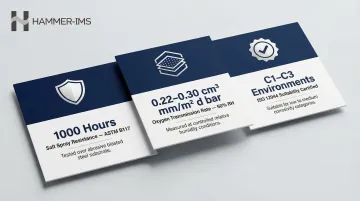
- Salt spray resistance: Advanced waterborne acrylic DTMs formulated at under 25 g/L VOC have demonstrated the ability to withstand 1000 hours of accelerated salt fog exposure (ASTM B117) over blasted steel
- Oxygen transmission rate (OTR): A 10 µm modified-PVOH layer applied to a PBAT/PLA biofilm substrate achieved an OTR of 0.22 to 0.30 cm³ mm/m² d bar at 50% RH
- ISO 12944 suitability: Waterborne DTM products are highly recommended for C1 to C3 environments (light to medium duty applications)
KPIs impacted:
- Salt spray resistance hours
- Oxygen transmission rate (for packaging coatings)
- Tensile/adhesion strength
- Gloss retention
- UV weathering ratings
- Moisture vapour transmission rate
When this advantage matters most:
Performance advantages are most fully realised when application conditions are controlled (temperature, humidity, substrate cleanliness) and when coating thickness is monitored in real time—otherwise the potential of the formulation is not consistently achieved.
What Happens When Water-Based Coating Quality Is Neglected
Switching to water-based coatings without implementing proper process controls undermines the investment. Poor film formation due to incorrect temperature, humidity, or coating weight results in porous, weak films that fail to deliver the promised benefits.
Operational consequences:
- Inconsistent coating weight produces nonconforming batches, increased scrap and rework, and unpredictable end-product performance
- Uncontrolled drying conditions cause film defects — cracking, blistering, poor adhesion — that cost more to remediate downstream than to prevent inline
- Catching defects after production rather than controlling them in-process drives up per-unit costs and creates delivery schedule pressure
- Compounding inefficiencies erode the cost and compliance advantages that motivated the switch, making ROI difficult to demonstrate
These losses add up fast. For many manufacturers, Cost of Poor Quality (COPQ) consumes 15% to 20% of total sales revenue. In coating operations specifically, deviations in viscosity, flow, and film thickness lead to drips, sags, and mottling. First-pass yield (FPY) for liquid coating systems averages around 95% — meaning up to 5% of production may require scrap or rework due to application defects alone.
How to Get the Most Value from Water-Based Coatings
Water-based coatings perform best when applied under controlled, consistent conditions:
Critical application parameters:
- Clean, properly prepared substrate surface at the correct temperature
- Ambient humidity below 85% RH to prevent blistering and adhesion failure
- Film build matched to the specific substrate and performance requirement
ISO 8502-4, ASTM D3276, and SSPC-PA 1 mandate that the substrate must be a minimum of 3°C (5°F) above the dew point to prevent invisible condensation. Minimum air/surface temperature should generally be 10°C (50°F) for waterborne acrylics to ensure proper minimum film forming temperature (MFFT).
Real-Time Measurement Enables Proactive Correction
Outcomes must be reviewed against defined production KPIs: coating add-on weight, film thickness uniformity, and drying efficiency. Real-time data from inline measurement systems lets production teams correct deviations before they become batches of nonconforming product.
Contactless, non-nuclear systems such as Hammer-IMS M-Ray solutions serve these applications directly. They deliver accurate, real-time coating weight and thickness data across textile, nonwoven, plastic film, and other continuous manufacturing lines.
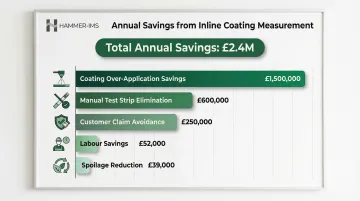
To illustrate the category-wide financial impact, a documented case study of an architectural coil coating line using an inline SpecMetrix measurement system reported £2.4 million in total annual savings, broken down as:
- £1.5 million in coating savings (eliminating over-application)
- £600,000 from elimination of manual test strips (saving 400 hours of production time)
- £250,000 in customer claim avoidance
- £52,000 in labour savings
- £39,000 in spoilage reduction
Sustaining Value Over Time
The value of water-based coatings compounds when treated as an ongoing process discipline rather than a one-time material switch. Regular formulation reviews, application parameter audits, and data-driven adjustments keep performance from drifting as substrates, suppliers, or production speeds change.
Teams that embed measurement into their coating process—rather than relying on periodic offline testing—consistently maintain tighter thickness tolerances and lower material consumption over the long term.
Conclusion
Water-based coatings deliver on three fronts: regulatory compliance, material cost efficiency, and cross-substrate performance. Yet none of these hold without treating application and process control as seriously as the coating formulation itself.
Water-based coatings represent not just an environmental upgrade but an ongoing operational practice. Manufacturers who monitor coating weight consistently, adjust proactively, and review outcomes regularly will maintain consistent quality, reduce material waste, and keep production running within spec.
Frequently Asked Questions
What are water-based coatings?
Water-based coatings use water as the primary carrier or dispersion medium instead of organic solvents, with functional ingredients like resins and pigments suspended in water. They dry as water evaporates and are used across industrial, construction, and consumer applications.
What are the main advantages of water-based coatings over solvent-based coatings?
Key advantages over solvent-based systems include:
- Significantly lower VOC emissions and reduced regulatory risk
- Lower material costs and less waste with proper process control
- Strong adhesion, durability, and barrier performance in most light-to-medium-duty applications
What industries use water-based coatings most commonly?
Water-based coatings are used extensively in automotive finishing, metal protection, textile and nonwoven manufacturing, plastic film and sheet production, paper and packaging, and construction materials. Any process requiring surface protection or functional finishing is a likely fit.
What are the limitations of water-based coatings?
Water-based coatings are more sensitive to application temperature and humidity, have slower drying times than some solventborne alternatives, and may not meet performance requirements in highly corrosive environments (ISO 12944 C4 and above) or immersion service applications.
How do you ensure consistent quality in water-based coating applications?
Consistent quality requires controlled application conditions (temperature, humidity, substrate prep), defined coating weight targets, and real-time inline measurement of film thickness or coating add-on weight to catch and correct deviations during—not after—production.
Are water-based coatings as durable as solvent-based alternatives?
Modern waterborne formulations perform comparably to solventborne systems in corrosion resistance, adhesion, UV durability, and barrier properties for most industrial applications. The durability gap that historically existed has largely closed as resin chemistry and formulation science have matured.